




























Views
Downloads
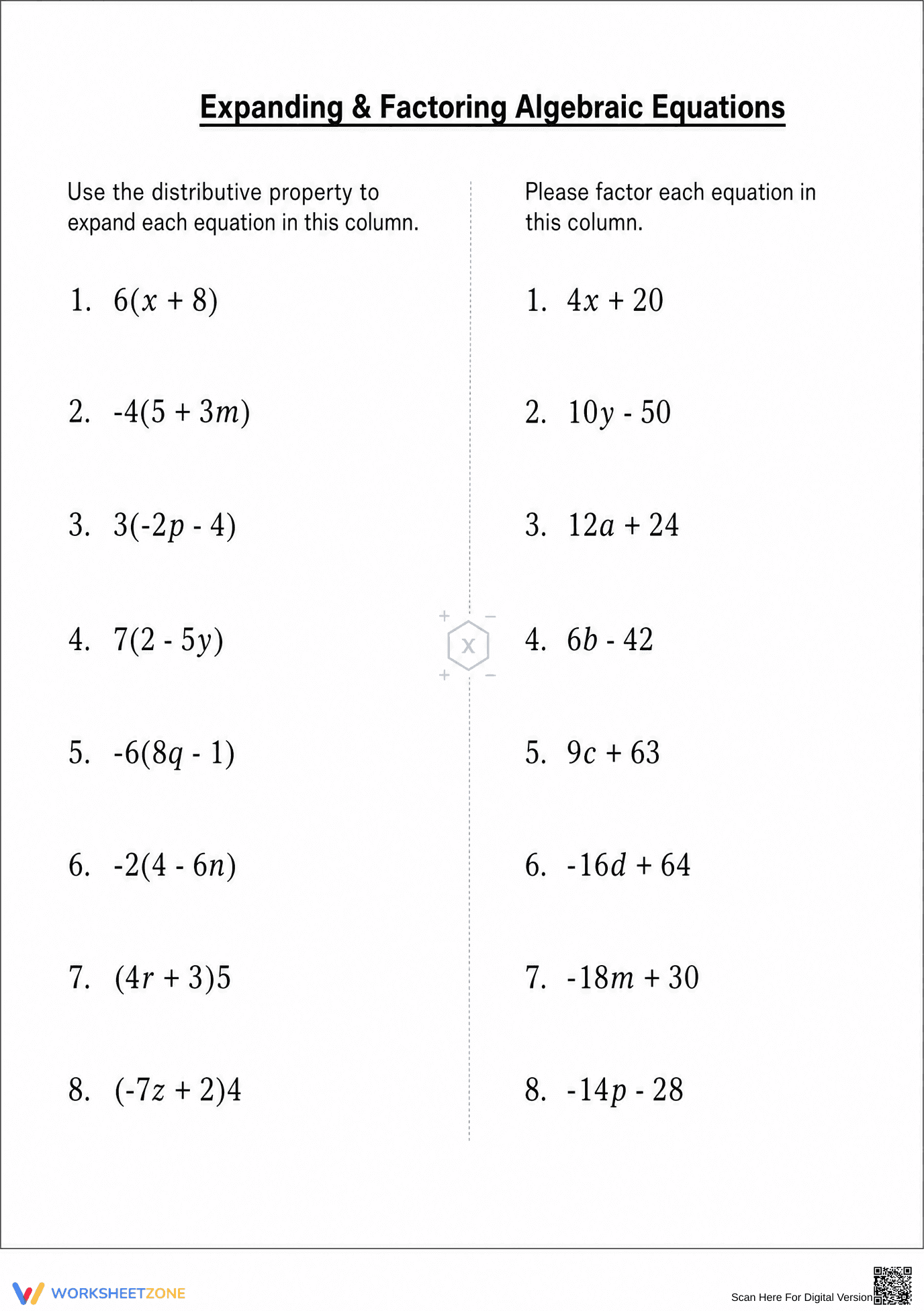

Grade 7 Expanding Expressions — Printable No-Prep Worksheet

Paste this activity's link or code into your existing LMS (Google Classroom, Canvas, Teams, Schoology, Moodle, etc.).
Students can open and work on the activity right away, with no student login required.
You'll still be able to track student progress and results from your teacher account.
This Grade 7 algebra worksheet provides targeted practice for students to master expanding and factoring linear expressions. By applying the distributive property and identifying greatest common factors, learners will build the foundational algebraic manipulation skills required for solving complex equations and understanding advanced mathematical concepts.
At a Glance
- Grade: 7 · Subject: Math
- Standard:
CCSS.MATH.CONTENT.7.EE.A.1— Factor and expand linear expressions with rational coefficients- Skill Focus: Expanding and Factoring Expressions
- Format: 1 page · 16 problems · Answer key included · PDF
- Best For: Independent practice or homework
- Time: 15–20 minutes
This single-page resource features a clean, two-column layout designed to minimize cognitive overload while maximizing skill repetition. The left column contains eight expressions requiring students to use the distributive property to expand equations, including those with negative coefficients. The right column presents eight expressions for students to factor by identifying the greatest common factor. A complete answer key is included to facilitate quick grading and immediate feedback.
Zero-Prep Workflow
Designed for immediate classroom implementation:
- Print (1 minute): Simply download the PDF and print a class set. The design ensures crisp copies.
- Distribute (1 minute): Hand out the worksheet as a standalone assignment. The instructions are clear and self-explanatory, requiring no additional direct instruction to begin.
- Review (3 minutes): Use the provided answer key to quickly check student work or project it on the board for self-correction.
With a total teacher prep time of under two minutes, this worksheet is an ideal emergency sub plan or last-minute practice activity.
Standards Alignment
This worksheet is strictly aligned to CCSS.MATH.CONTENT.7.EE.A.1: Apply properties of operations as strategies to add, subtract, factor, and expand linear expressions with rational coefficients. It specifically targets the dual skills of distributing values into parentheses and factoring out common terms. Both standard codes can be copied directly into lesson plans, IEP goals, or district curriculum mapping tools.
How to Use It
Formative Assessment: Assign this worksheet after your initial lesson on the distributive property. As students work, circulate the room and observe whether they are correctly applying negative signs when distributing or factoring. This provides immediate data on who needs small-group reteaching.
Homework Assignment: Send this page home for independent reinforcement. The straightforward layout allows students to complete the 15 to 20-minute task without parental assistance.
Who It's For
This resource is primarily designed for seventh-grade math students, though it serves as an excellent review tool for eighth and ninth graders entering Algebra I. For students needing differentiation, teachers can assign only the positive-coefficient problems first before introducing the negative integers. It pairs perfectly with an anchor chart detailing the steps for finding the greatest common factor.
Mastering the ability to factor and expand linear expressions with rational coefficients is a critical stepping stone in middle school mathematics. According to EdReports 2024, students who engage in focused practice on the distributive property demonstrate higher retention rates when transitioning to multi-step equations. This targeted worksheet directly supports CCSS.MATH.CONTENT.7.EE.A.1 by isolating these two inverse operations—expanding and factoring—allowing learners to see the structural relationship between them. Clear problem sets reduce cognitive load, helping students focus on algebraic manipulation. Consistent exposure to these specific problem types ensures that learners build the automaticity required for higher-level high school math courses, ultimately bridging the gap between basic arithmetic and advanced algebraic reasoning.


