


























Views
Downloads



Essential Equivalent Expressions Worksheet | Grade 8 Math
Paste this activity's link or code into your existing LMS (Google Classroom, Canvas, Teams, Schoology, Moodle, etc.).
Students can open and work on the activity right away, with no student login required.
You'll still be able to track student progress and results from your teacher account.
This "Basic Operations & Equivalent Expressions" worksheet provides eighth-grade students with intensive practice in algebraic manipulation. By simplifying and factoring expressions, learners develop the fluency required to recognize mathematical equivalency across various structures. This resource ensures students can confidently navigate complex algebraic equations and prepare for higher-level mathematics.
At a Glance
- Grade: 8 · Subject: Algebra
- Standard:
CCSS.MATH.CONTENT.7.EE.A.1— Factor and expand linear expressions with rational coefficients using operations properties- Skill Focus: Distributive property and GCF factoring
- Format: 3 pages · 13 problems · Answer key included · PDF
- Best For: Algebra foundational skill reinforcement
- Time: 25–35 minutes
This comprehensive 3-page PDF features 13 carefully constructed problems divided into three distinct sections. Students begin with a matching exercise to build recognition, transition into open-ended simplification and factoring tasks, and conclude with multiple-choice identification of equivalent forms. A full answer key is provided to facilitate rapid grading or student self-assessment.
- Guided Practice: Five matching problems (1–5) provide immediate feedback as students pair expanded expressions with their factored counterparts, reinforcing the visual structure of equivalency.
- Supported Practice: Four open-ended problems (6–9) require students to actively apply the distributive property or extract the greatest common factor (GCF) without a predefined list of answers.
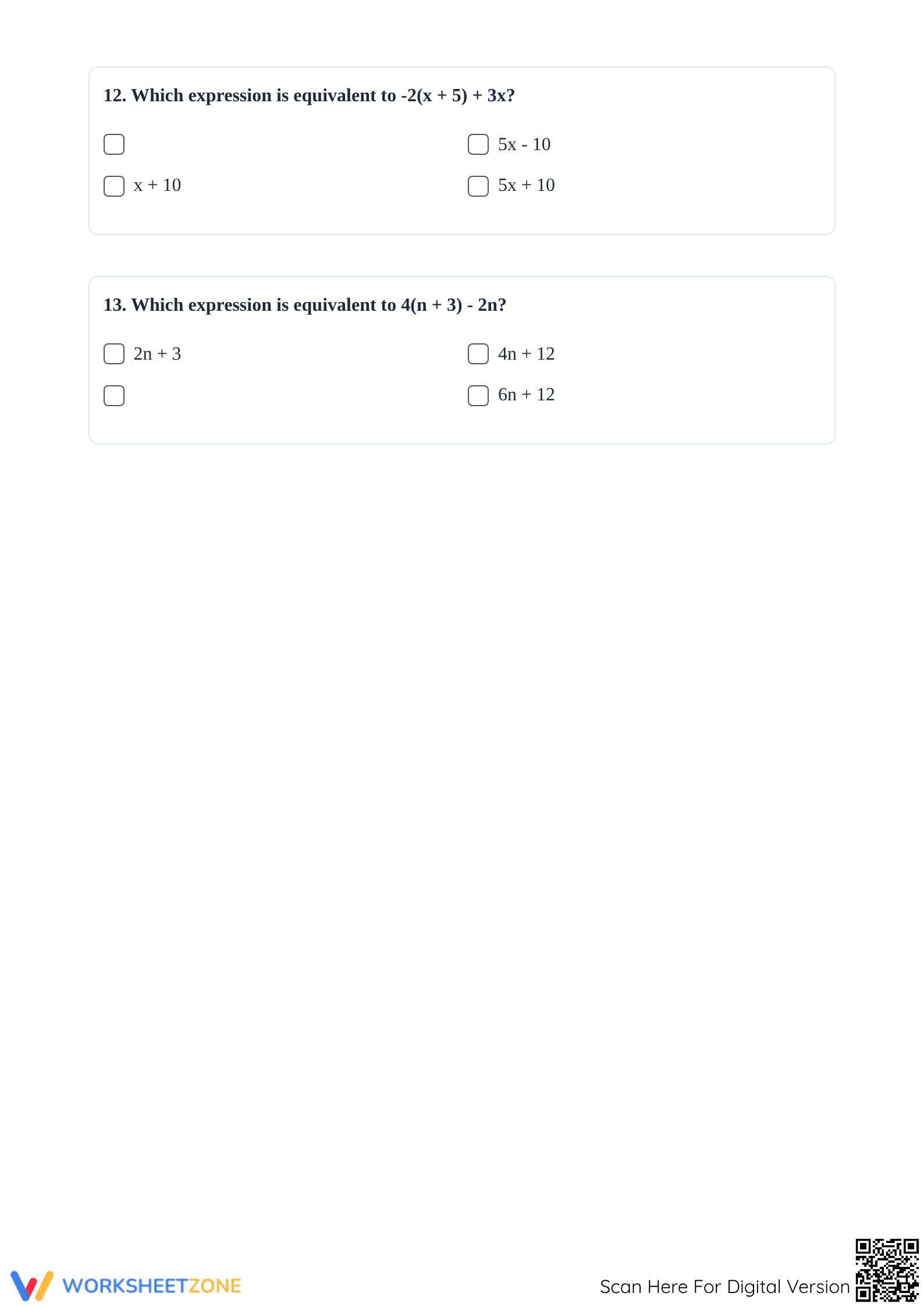
- Independent Practice: Four complex multiple-choice questions (10–13) challenge students to evaluate several potential options, including expressions requiring multiple steps of simplification.
This sequence follows the gradual-release model, moving from simple recognition to autonomous algebraic manipulation through an I Do, We Do, You Do instructional framework.
The primary focus is CCSS.MATH.CONTENT.7.EE.A.1, which requires students to apply properties of operations as strategies to add, subtract, factor, and expand linear expressions with rational coefficients. It also supports CCSS.MATH.CONTENT.8.EE.C.7 by building the prerequisite skills needed to solve linear equations. Both standard codes can be copied directly into lesson plans, IEP goals, or district curriculum mapping tools.
Assign this worksheet during the active practice phase of a lesson on algebraic properties. It serves as an excellent formative assessment; teachers should observe if students struggle more with the expansion (distributive property) or the contraction (factoring GCF) of terms. Completion typically takes 30 minutes, making it an ideal mid-unit check.
Designed for Grade 8 and Grade 9 Algebra students, this resource is particularly effective for those needing concrete practice with variables and coefficients. It pairs naturally with a visual anchor chart demonstrating the expansion method for distribution or a T-chart for finding common factors.
Standard CCSS.MATH.CONTENT.7.EE.A.1 focuses on the expansion and factoring of linear expressions, a cornerstone of algebraic literacy. According to research from EdReports (2024), student mastery of equivalent expressions is a significant predictor of success in secondary mathematics, as it bridges the gap between arithmetic operations and abstract variable manipulation. This worksheet provides the repetitive, focused practice necessary to internalize these operational properties. By engaging with 13 diverse tasks—ranging from matching to multi-step multiple choice—learners build the symbol sense required to perceive algebraic structures rather than just isolated characters. This targeted approach aligns with evidence-based instructional designs that prioritize the gradual-release of responsibility to ensure long-term retention of mathematical concepts.


