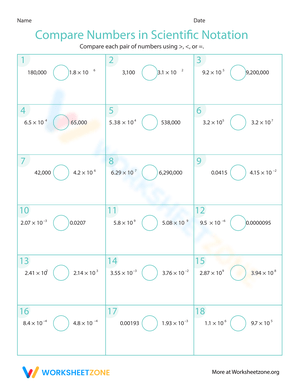
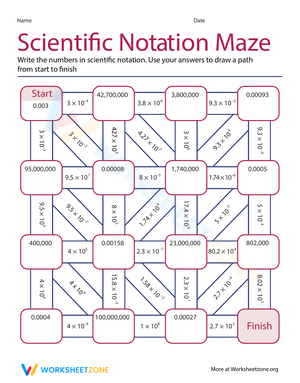
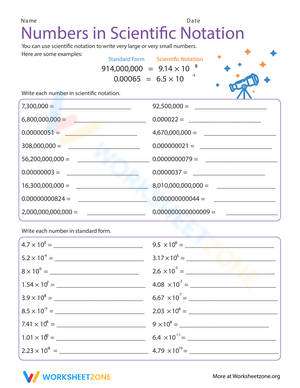
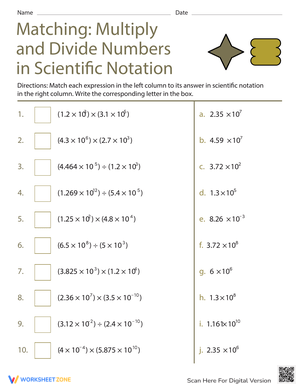
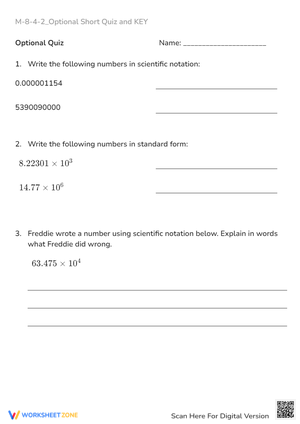
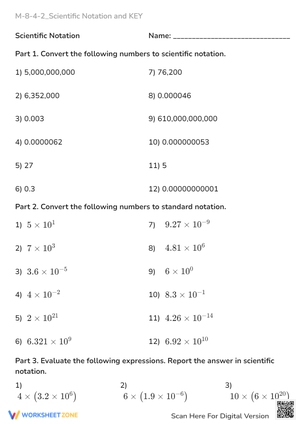
These scientific notation worksheets for 8th grade cover the full progression teachers need — from initial conversion practice through operations and real-world application — and they adapt to multiple lesson structures without requiring prep changes between uses. Each worksheet targets a specific skill, so teachers can pull exactly what the moment of instruction calls for.
The Specific Skills These Worksheets Build
The set moves through skills in a deliberate order, starting where 8th graders are most often shaky and building toward tasks that require reasoning rather than step recall.
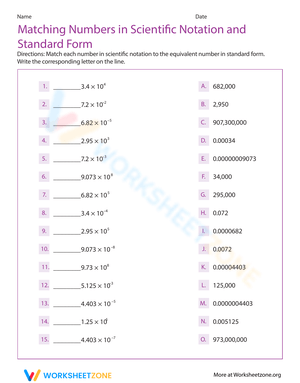
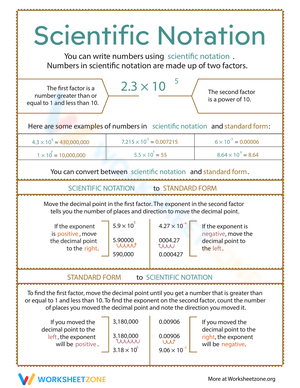
- Converting standard form to scientific notation: Students reposition the decimal so the leading factor falls between 1 and less than 10, then determine the correct exponent by counting how far the decimal moved. Items vary number size so students work with very large and very small values in equal measure.
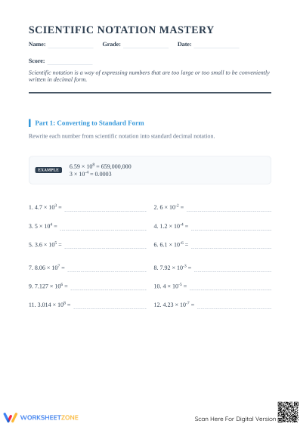
- Converting scientific notation to standard form: Students read the exponent, determine direction, and shift the decimal. Negative-exponent items appear in enough quantity to surface the error pattern before the unit assessment rather than during it.
- Comparing and ordering values: Items ask students to rank four or five numbers, deliberately mixing values with different exponents and different leading coefficients. Reasoning lines prompt written explanations rather than circled answers.
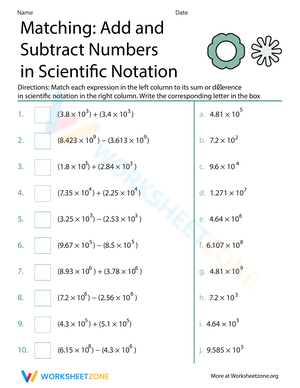
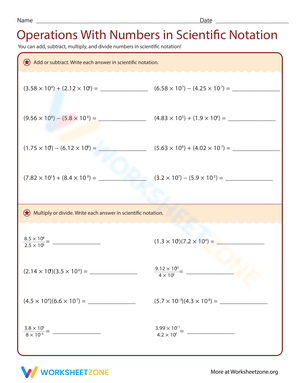
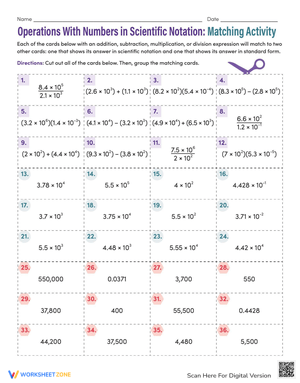
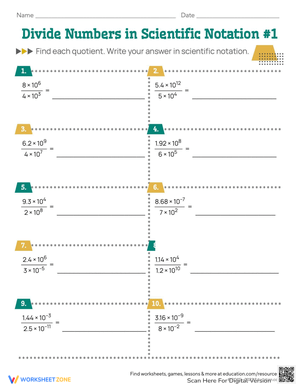
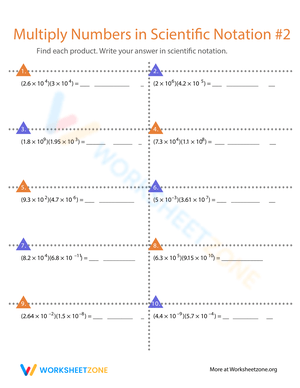
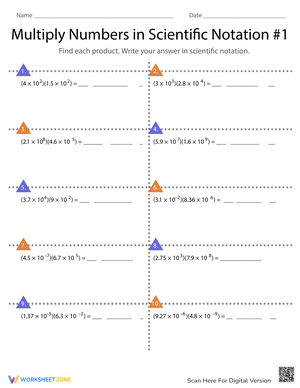
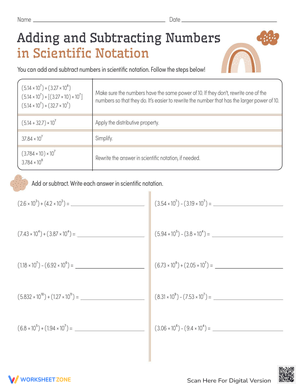
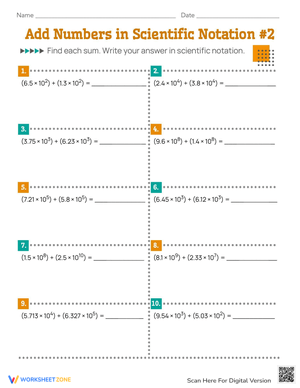
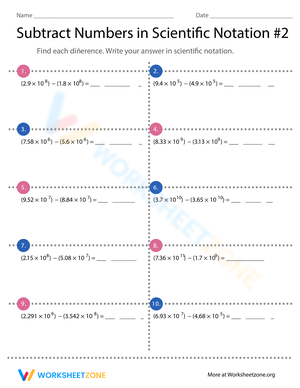
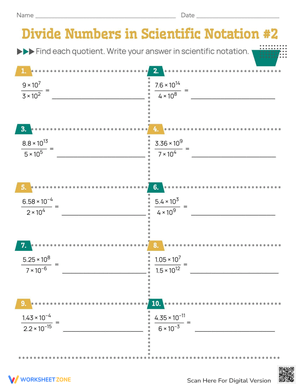
- Multiplying and dividing in scientific notation: These worksheets connect exponent rules to powers of 10 and follow conversion practice — students who haven't secured conversion accuracy first tend to struggle here in ways that create bad habits rather than progress.
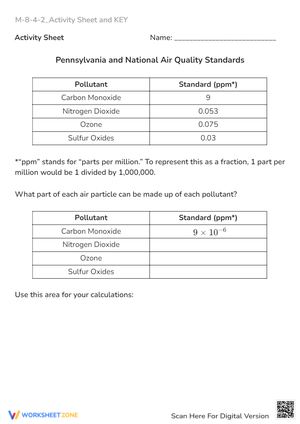
- Context-based problems: Distances in the solar system, sizes of blood cells, and national population figures give students a reason to interpret notation rather than only produce it.
One worksheet in the set functions as a mixed review, cycling through all five skill types. Teachers tend to use it the day before a unit assessment, when students need to activate several procedures rather than drill a single one.
Errors Worth Catching Before the Unit Assessment
The errors we see most often in 8th grade scientific notation work cluster around three moves, and knowing them before instruction begins makes the worksheets considerably more useful. The most persistent involves the leading coefficient: students identify the significant digits correctly but leave the decimal in the wrong position, producing a leading factor outside the required range. A student converting 5,000,000 will often write 50 times 10 to the fifth and see nothing wrong with it, because 50 seems plausible sitting next to a large exponent. That error appears across performance levels — not only among students who are already struggling.
Negative exponents create a different problem. Some students read a negative exponent as a signal that the result is itself a negative number, writing a large negative value where a small positive decimal belongs. Others understand conceptually that a negative exponent signals a small number but still shift the decimal in the wrong direction when converting. Both errors look identical on paper — they produce the same wrong answer — but come from entirely different misunderstandings. Asking students to narrate their reasoning in writing is usually the fastest way to tell which one is underneath the mistake.
Comparison tasks reveal a third habit: evaluating only the leading coefficient and ignoring the exponent entirely. A student who sees 3.2 times 10 to the fourth alongside 8.9 times 10 to the third will sometimes mark the second value as greater because 8.9 is greater than 3.2. Worksheets that include a short written explanation requirement catch this before it calcifies into a test-day error.
How to Build These Worksheets Into Your Lesson Plans
Short conversion practice — four to six problems — works well as a Monday warm-up after initial instruction. By Thursday or Friday of that same week, a mixed-review worksheet surfaces what has actually stuck and what needs another look before the assessment. That rhythm runs about eight minutes per session and fits inside longer lesson blocks without displacing direct instruction time.
One approach that cuts reteaching time noticeably: sort the set by error type rather than by unit sequence. Keep one worksheet for decimal-direction mistakes, one for negative-exponent confusion, and one for comparison reasoning. When a student misses a specific quiz item, hand them the worksheet that matches that exact error — not a general review — and the follow-up conversation becomes shorter and more precise.
For exit tickets, three items cover the most diagnostic ground in the least class time: one conversion from standard form, one conversion to scientific notation, and one comparison. That combination tells you whether students understand notation structure or are executing a memorized sequence without tracking what it means. Scientific notation worksheets for 8th grade used as exit tickets this way take less than five minutes but generate information you can act on before the next lesson starts.
Standard Alignment
These worksheets address CCSS 8.EE.A.3 and 8.EE.A.4, both within the Expressions and Equations domain. The first standard covers reading, writing, comparing, and estimating numbers in scientific notation; the second adds operations — multiplying and dividing values in that form. In classroom sequence, 8.EE.A.3 arrives early in the unit when students are converting and comparing; 8.EE.A.4 follows once conversion fluency is in place, typically within the same instructional unit. Both standards appear on end-of-year state assessments, often embedded in multi-step problems that pair scientific notation with ratio or proportional reasoning rather than testing the notation in isolation — which is one reason mixed-application worksheets matter as much as focused conversion practice.
Adjusting These Worksheets for Different Levels in the Same Room
For students who need additional support before the scientific notation unit fully gets rolling, the most practical adjustment is a reference column alongside the worksheet — a strip showing what each power of 10 looks like written out in standard form. Students use it as a check rather than a shortcut, which reduces the cognitive demand of one step so they can concentrate on the conversion logic itself. Once accuracy becomes consistent without it, remove the reference.
Students who convert accurately but lose track during operations benefit from a worksheet where the coefficient and the power of 10 are handled in two separate labeled columns before combining into a final answer. That structure slows the process down visibly and makes each move trackable before students are expected to run the whole procedure in one pass.
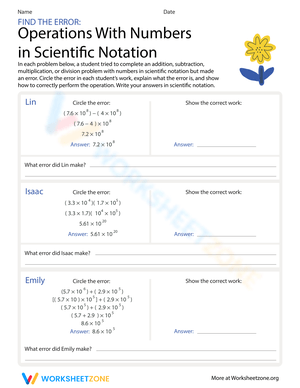
At the extension end, scientific notation worksheets for 8th grade work well with estimation tasks — "which of these three answers is most reasonable, and explain your reasoning" — or error-analysis items where students identify what is wrong with a given expression and describe the correction. Both task types push past procedural accuracy into the sustained reasoning the standards are actually after.
Frequently Asked Questions
What skills does the set cover, and can I use individual worksheets out of sequence?
The set covers conversion in both directions, comparing and ordering, multiplication and division in scientific notation, and context-based application. Each worksheet works independently as the lesson demands, though using them in the progression above generally produces stronger results — especially before students reach the operations worksheets, which assume conversion fluency is already in place.
How is the operations worksheet different from the conversion worksheets?
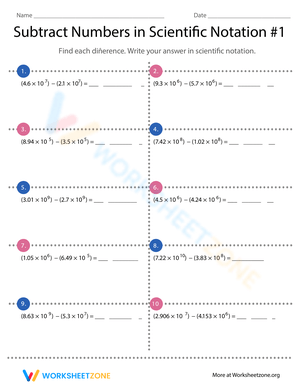
Conversion worksheets focus on reading and writing notation correctly. The operations worksheets ask students to multiply or divide values already written in scientific notation, applying exponent rules to the powers of 10 while managing the coefficients separately. Students need reliable conversion accuracy before the operations worksheets produce much learning — introducing them too early tends to create confusion rather than build on existing understanding.
Do these worksheets work for small-group intervention?
They work particularly well in that context because each worksheet covers a focused skill. Pull the worksheet that matches the specific error rather than restarting a full unit review from the beginning. For students who need foundational support with place value, the reference-column adjustment described above addresses the underlying gap without requiring a completely separate resource.
Do these come with answer keys?
Each worksheet in the set includes a matching answer key formatted to align with the student-facing layout, which makes checking work fast during a planning period or during whole-class review. The scientific notation worksheets for 8th grade in this set are print-ready and need no additional formatting before use.













 Interactive Worksheet Maker
 Quiz Maker
 Word Search Maker
 Crossword Puzzle Maker
 Word Scramble Generator
 Sentence Scramble Generator
 Handwriting Worksheet Generator
 Name Tracing Generator
 Fill In The Blank Generator