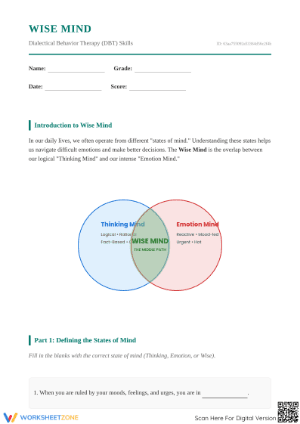
These social skills pdf worksheets for 8th grade put realistic middle school scenarios at the center of every task — friction inside a group project, a text message read in the worst possible tone, a rumor picking up speed before anyone can correct it, or the moment a student has to push back respectfully with an adult. Each worksheet asks students to read the situation, weigh their options, predict consequences, and commit to a specific written response. That format gives every debrief something concrete on the page — which matters when the topic is social behavior and students are quick to drift into the abstract.
What the Set Covers
The worksheets address the social demands that show up most often in 8th grade classrooms, not a broad inventory of character traits. Students practice active listening, perspective-taking, conflict resolution, teamwork, digital communication, and self-advocacy — and because these skills overlap constantly in real situations, many worksheets require more than one at a time.
- Active listening and tone: Students identify where a conversation broke down, then rewrite the exchange using clarifying questions instead of reactive statements.
- Empathy and perspective-taking: Scenario tasks ask students to name what a second or third person in the situation is most likely feeling — and why — before deciding on a course of action.
- Conflict resolution: Students identify what each party in a disagreement actually wants, name the obstacle between them, and map two or three approaches to resolution with predicted outcomes attached to each.
- Teamwork and shared responsibility: Worksheets target specific friction points — unequal effort in group tasks, giving peer feedback without blame, and staying focused when group energy collapses mid-project.
- Digital communication: Several worksheets include a fictional text exchange or comment thread, because 8th graders are doing a significant share of their social negotiating in those spaces and need practice reading tone and intent there.
- Self-advocacy: Students practice articulating how to ask for help, request an accommodation, or raise a concern with a teacher without escalating the situation.
Common Student Mistakes These Worksheets Help Teachers Catch
The most predictable error in 8th grade social skills work is the performed response. Ask students what they would do if a classmate spread a rumor about them, and a large share will write "I would talk to them calmly and explain how it made me feel" — not because they would actually do that, but because they know it reads well. Worksheets that follow the initial response with a prompt like "What usually stops you from doing that?" pull the real thinking out. That secondary prompt is where honest work lives, and where a class debrief gets actual traction.
Empathy tasks surface a different error: students write "I feel bad for him" and consider the job done. That's sympathy, not perspective-taking. A prompt reframed as "What is he most likely thinking right now, and what detail in the situation tells you that?" produces far more specific responses. The quality of the question determines the depth of the thinking — every time.
On conflict resolution, students frequently land on "talk to an adult" as their resolution strategy, not because they believe it will work, but because it feels like the expected answer. A follow-up prompt — "If going to an adult isn't an option right now, what's one thing you could handle yourself?" — breaks the habit and places students in the more demanding position of actually reasoning through their choices.
Fitting These Worksheets Into the School Week
Advisory is the most natural home. A single worksheet fits a 15–20 minute advisory block when students complete the written portion independently — about 8 minutes for most — followed by partner or small-group discussion. The written step matters: it gives quieter students something to say before the room fills with louder voices, and it keeps the conversation from becoming three or four students talking while the others wait it out.
Social skills pdf worksheets for 8th grade also make reliable sub plans. Each worksheet is self-contained — scenario, reflection prompts, exit question — and requires no teacher pre-teaching to make sense. A two-sentence note on the board ("Read the situation, complete the worksheet, be ready to share two takeaways") is enough. Students who would dismiss a sub's verbal instruction often engage with a well-constructed scenario because the situation itself draws them in.
In counseling and tier-two behavior intervention settings, conflict resolution and self-advocacy worksheets do their most focused work. After a hallway incident or classroom blowup, walking a student through a scenario that is similar — but not identical — to what actually happened allows reflection without the defensiveness that comes from reviewing their own incident directly. That slight distance is often what makes honest self-examination possible at this age.
Content teachers can also use the teamwork and communication worksheets the day before launching a collaborative project. Running a brief worksheet on shared effort and peer feedback isn't a detour from the content — it's part of making the collaboration worth anything.
Keeping the Work From Feeling Too Young
This is the concern that surfaces most in middle school, and it usually comes down to two things: scenario realism and prompt design. Worksheets that use sanitized situations — everyone apologizes, everyone forgives, the conflict resolves neatly in five minutes — lose 8th graders almost immediately. Students are more honest, and more engaged, when a scenario doesn't have a single obvious correct answer. Good conflict resolution tasks present situations where both people have legitimate grievances, because that matches what students are actually living through.
One classroom move that reliably improves buy-in: before students begin, ask them to rate the scenario for realism on a 1–3 scale and explain their rating in a single sentence. When a student decides whether a situation could actually happen at their school, they're already thinking critically about the social dynamics — and the worksheet becomes a genuine discussion starter rather than an exercise they're tolerating. Teachers can also reframe the purpose: these skills come up in group projects, job interviews, team sports, and conflicts with college roommates. That framing lands differently at this age than "today we're working on being kind."
Differentiating the Worksheets Across Ability Levels
Students reading significantly below grade level can still access the core reasoning when a teacher or aide reads the scenario aloud before independent work begins. The reflection prompts are intentionally short, so the writing demand doesn't outweigh the social reasoning task. For students with IEPs that include social-behavioral goals, completed worksheets also function as work samples documenting skill instruction over time — useful for progress monitoring and annual reviews.
For students who finish quickly and write surface-level responses, the adjustment isn't adding more scenarios — it's adding depth requirements to the same one. Ask those students to argue for the opposite choice they made, predict a second possible outcome, or rewrite the scenario with one variable changed and explain how that shift affects the available options. That keeps them inside the same thinking framework at a meaningfully higher level of demand.
Students who push back because the scenario doesn't match their experience — because the social context depicted is genuinely unfamiliar — can be invited to describe what would happen in their version of the situation. That alternate-experience response often becomes the most valuable thing a class discusses, because it surfaces the real social variation that exists in any actual group of 8th graders.
Frequently Asked Questions
Can these worksheets be used after a conflict, or only as proactive instruction?
Social skills pdf worksheets for 8th grade work well in both directions. The set runs proactively in advisory or as project-launch prep, but conflict resolution and self-advocacy worksheets are equally effective after an incident. The key is selecting a scenario adjacent to the actual event rather than a direct replay of it — that distance makes structured reflection possible rather than defensive.
How much time should a teacher set aside for each worksheet?
Most students complete the written portion in 8–12 minutes. A 10–15 minute discussion follows comfortably inside a 25-minute advisory period. In counseling or behavior intervention settings where deeper processing is the goal, a single worksheet can anchor a full 30-minute session without running out of material.
Do the worksheets connect to CASEL competencies?
The skills covered — self-awareness, social awareness, responsible decision-making, relationship skills, and self-management — map directly to the five CASEL core competencies. Social skills pdf worksheets for 8th grade that focus on perspective-taking and conflict resolution fall most squarely under social awareness and relationship skills, the two competencies most consistently tested in day-to-day middle school interactions.
What's the best way to handle a student who refuses to engage with the scenario?
Refusal usually points to one of two things: the scenario feels irrelevant to that student's actual experience, or the topic feels too close and too risky to examine in a group setting. In the first case, the realism-rating move described above often breaks the standoff. In the second, a low-stakes written prompt — even a single sentence about what the person in the scenario is probably thinking — keeps the student inside the task without requiring personal disclosure.
















 Interactive Worksheet Maker
 Quiz Maker
 Word Search Maker
 Crossword Puzzle Maker
 Word Scramble Generator
 Sentence Scramble Generator
 Handwriting Worksheet Generator
 Name Tracing Generator
 Fill In The Blank Generator