


























Views
Downloads

Printable Review of Fear Worksheet | Grade 8 SEL
Paste this activity's link or code into your existing LMS (Google Classroom, Canvas, Teams, Schoology, Moodle, etc.).
Students can open and work on the activity right away, with no student login required.
You'll still be able to track student progress and results from your teacher account.
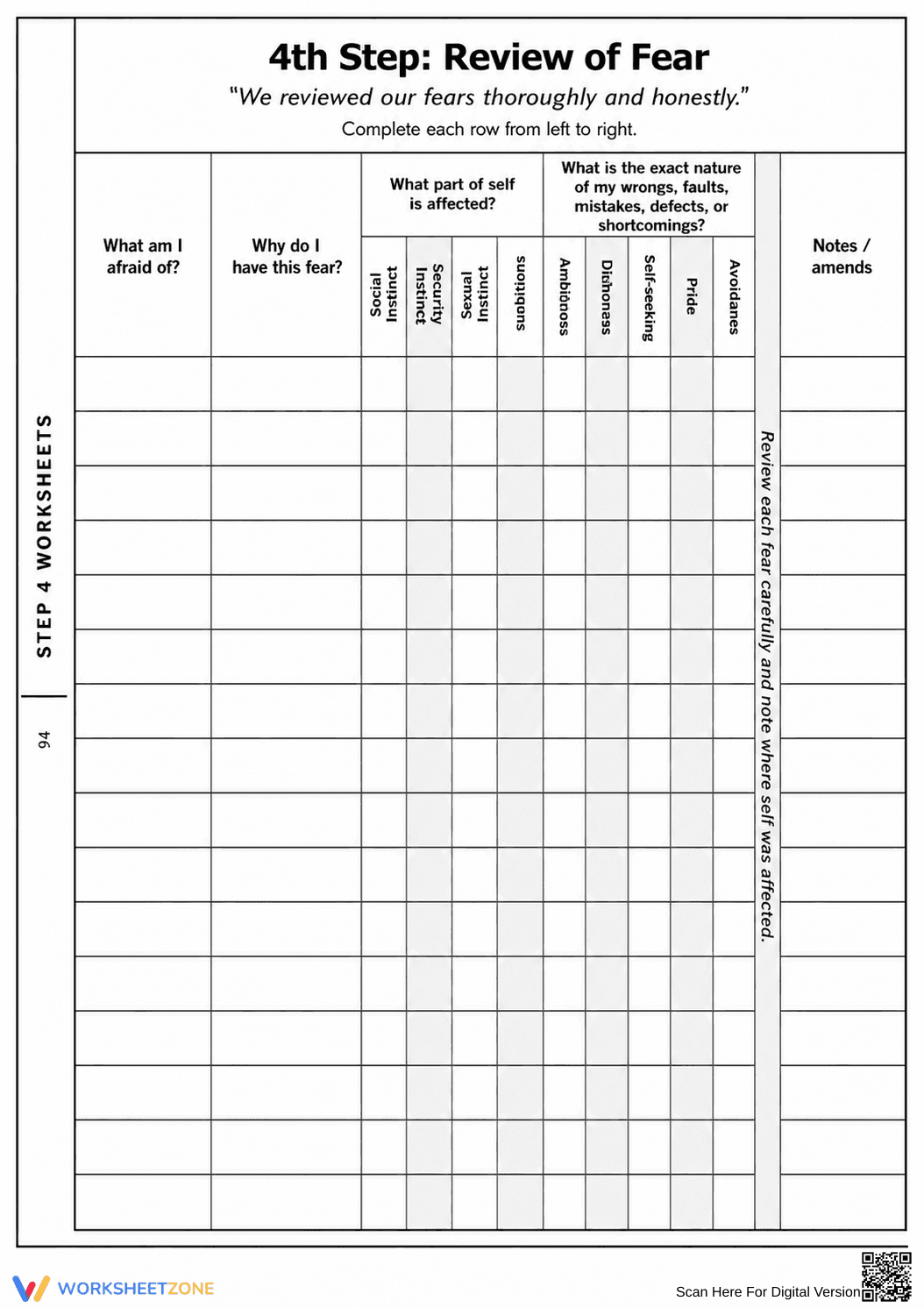
This Grade 8 social skills worksheet guides students through a structured self-reflection process to analyze their fears. By breaking down anxieties into specific categories, students develop critical self-awareness and emotional regulation skills. This exercise encourages honest reflection and helps identify the root causes of personal challenges.
At a Glance
- Grade: 8 · Subject: Social Skills
- Standard:
CCSS.ELA-LITERACY.W.8.4— Produce clear writing appropriate to task and purpose- Skill Focus: Emotional regulation and self-reflection
- Format: 1 page · 14 problems · No answer key · PDF
- Best For: Independent reflection and SEL blocks
- Time: 20–30 minutes
This single-page resource features a 14-row grid designed for deep personal inventory. The table includes columns prompting students to identify what they are afraid of, explain the underlying reasons, and categorize which part of their identity is affected. Additional columns guide learners to examine personal shortcomings like pride or avoidance, culminating in a section for notes. Because this is a personal reflection exercise, an answer key is not included.
This resource is designed for immediate classroom implementation with a zero-prep workflow.
- Print (1 minute): Simply download the PDF and print a class set. The single-page layout is highly efficient.
- Distribute (1 minute): Hand out the worksheets during a dedicated social-emotional learning (SEL) period or advisory block.
- Review (1 minute): Briefly explain the column headers and establish a safe, quiet environment for independent work.
Total teacher preparation requires under two minutes, making this an excellent option for emergency sub plans or spontaneous advisory activities.
This activity aligns with CCSS.ELA-LITERACY.W.8.4, requiring students to produce clear and coherent writing in which the development, organization, and style are appropriate to task, purpose, and audience. By articulating complex internal emotions into structured written responses, students practice essential expressive writing skills. Both standard codes can be copied directly into lesson plans, IEP goals, or district curriculum mapping tools.
Teachers can utilize this worksheet during dedicated SEL blocks to help students process anxiety or interpersonal conflicts. It serves as an excellent independent activity after a group discussion on emotional intelligence or coping strategies. As a formative assessment observation tip, educators can monitor students' ability to sustain focus during independent reflection, though the actual written content should remain private to ensure honest self-assessment. Expect students to spend 20 to 30 minutes completing the inventory.
This resource is primarily designed for middle school students in grades 6 through 8 who are developing their emotional intelligence and self-awareness. It is particularly beneficial for school counseling groups, behavioral intervention plans, or advisory classes. For differentiation, teachers can allow students to complete only a few rows or pair this worksheet with an anchor chart defining complex terms like "self-seeking" or "avoidance."
Integrating structured emotional reflection tools like this worksheet directly supports students in mastering CCSS.ELA-LITERACY.W.8.4, as they produce clear writing appropriate to task and purpose. According to a recent RAND AIRS 2024 report, consistent implementation of social-emotional learning activities significantly improves students' self-regulation and academic focus. When learners are given dedicated time to articulate their fears and identify the root causes of their anxieties, they build resilience and emotional vocabulary. This specific exercise moves beyond simple journaling by requiring analytical categorization of emotions, which strengthens both cognitive processing and emotional intelligence. Providing adolescents with a safe, structured format to examine their personal challenges fosters a more supportive classroom environment and equips them with lifelong coping mechanisms.


