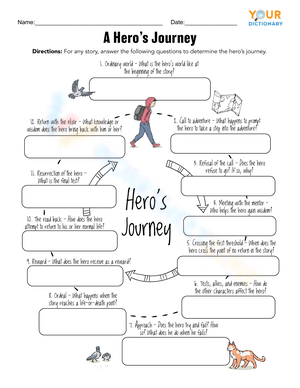
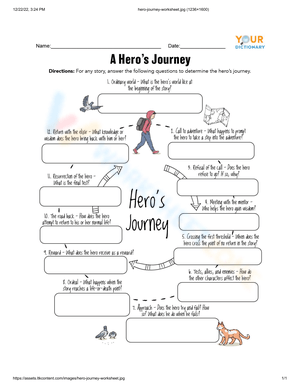
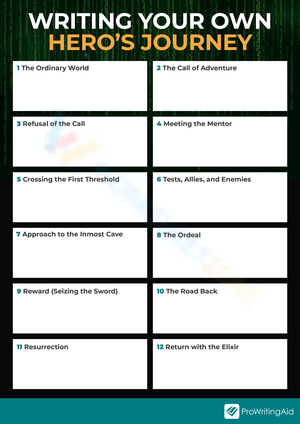
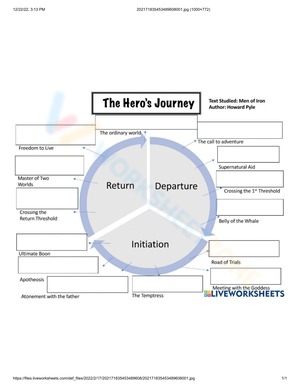
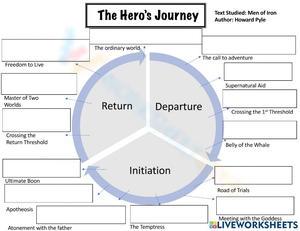
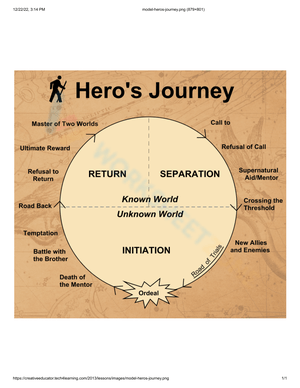
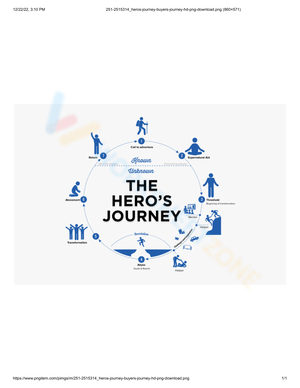
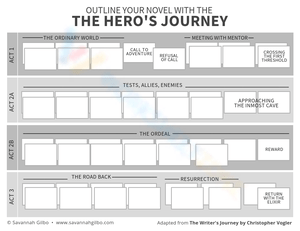
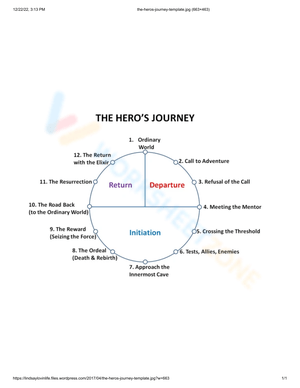
These 8th grade heros journey worksheets printable resources give ELA teachers a structured entry point into narrative analysis — one that connects plot, character development, and theme without asking students to memorize an unwieldy list of stages. The set includes five distinct worksheet formats, each built for a different instructional purpose.
What's Inside the Set
All five worksheets use a six-phase framework — ordinary world, call to adventure, crossing into challenge, trials and helpers, transformation, and return — rather than the full monomyth. Joseph Campbell's original model lists as many as 17 stages; condensed academic versions often run eight or more. That level of detail pushes 8th graders toward label-hunting rather than genuine analysis. Six phases keeps the focus on interpretation while remaining short enough that students can hold the whole arc in working memory as they track a protagonist through a chapter.
Stage-matching tasks pair story events with journey phases and work well as warm-ups or quick comprehension checks after direct instruction. Graphic organizers ask students to sequence events, cite evidence at each stage, and explain what each turning point reveals about the protagonist's internal change. A short-passage analysis worksheet asks students to read a focused excerpt, locate the hero within the journey, and defend their placement in writing. A text-to-film comparison worksheet traces how the same structural pattern appears differently across two media — well-suited to units pairing a novel with a film adaptation. A narrative planning worksheet guides students through creating an original hero story using the same six-phase arc.
Skills the Set Builds in Middle School ELA
Labeling stages is relatively straightforward once students know the framework. The demanding move comes after: why does this scene belong here, and what does it reveal about the protagonist? That pairing of stage identification with written justification is exactly what RL.8.3 requires, and it's where most student analytical writing breaks down in practice.
- Narrative structure: Students identify turning points and trace how one event shapes the next through cause and effect.
- Character development: Students pinpoint when and through what experience internal change becomes visible in the text — not just that the hero changed, but the specific moment the text signals it.
- Theme: Students connect repeated trials and transformation to the story's central message, moving out of plot summary into interpretation.
- Evidence-based writing: Students quote or paraphrase specific moments and explain their significance to the argument they are making.
- Narrative composition: Students apply the arc to original stories, using the framework as a planning structure rather than a critical label.
Mistakes Students Make That These Worksheets Help You Catch
The most consistent error we see in student work is misplacing the transformation stage. Students tend to label the climactic action scene — the final battle, the confrontation, the escape — as the transformation, when the actual internal shift often happens quietly afterward, in a single line of reflection that students skim past. A graphic organizer that asks students to quote the specific moment of change forces them to find the text that shows it, not just the action that surrounds it.
A second persistent problem: students confuse the call to adventure with the inciting incident. In The Hunger Games, students reliably label Katniss volunteering at the reaping as the call — but a closer reading suggests the call was Prim's name being drawn, and the volunteering is the crossing into challenge. The matching worksheet surfaces exactly this kind of distinction by requiring students to choose between two plausible options and explain the difference. Worth anticipating as well: students who apply the framework so literally they announce a text has no Hero's Journey because the protagonist doesn't physically return to a starting location, missing that the return is often internal rather than geographical.
Building These Worksheets Into a Unit Sequence
The most effective use of 8th grade heros journey worksheets printable materials is as a short lesson sequence rather than a one-time handout. On day one, introduce the six-phase framework using a myth or film clip students already know — removing the reading load lets students focus entirely on recognizing the pattern. Use the matching worksheet with the whole class. On day two, move to partner work with a chapter from the class novel, using the graphic organizer. On day three, assign the independent passage analysis worksheet, which requires students to cite evidence and explain the hero's transformation in writing. The narrative planning worksheet belongs at the end of that sequence; students who have spent two or three days analyzing structure in someone else's story approach the planning task with real ideas rather than generic hero plots.
For the Friday block before a literary analysis assessment, the matching worksheet doubles as a low-stakes retrieval exercise — students finish in eight to ten minutes, and it surfaces any remaining confusion about stage boundaries before they write an essay.
Adjusting the Set for Different Learner Levels
When setting up 8th grade heros journey worksheets printable materials for a mixed-readiness class, the six-phase framework proves flexible enough to support a range of students without requiring entirely separate resources. For students who need more support, reduce the graphic organizer to three stages, add sentence frames (The call to adventure happens when... or This trial matters because...), and include a word bank. On-level students work well with the standard organizer — short-answer responses, textual evidence required, no frames. For advanced students, add a comparison prompt: two protagonists from different texts side by side, or a question asking students to evaluate where the journey pattern resists easy application in the text they're analyzing. That last prompt tends to generate the most substantive written responses because it treats the framework as an interpretive tool rather than a checklist.
Standard Alignment
These worksheets address three Common Core State Standards for 8th grade ELA. CCSS.ELA-LITERACY.RL.8.3 — analyzing how particular incidents propel action, reveal character, or provoke decisions — is addressed directly by the graphic organizer and passage analysis worksheets, which require students to explain what each stage reveals about the protagonist. CCSS.ELA-LITERACY.RL.8.5 — comparing how differing text structure contributes to meaning and style — is targeted by the text-to-film comparison worksheet. CCSS.ELA-LITERACY.W.8.3 — writing narratives with well-structured event sequences — is practiced through the narrative planning worksheet. In classroom terms, most teachers begin with RL.8.3 because it connects the Hero's Journey directly to character analysis rather than treating it as a pure plot-labeling exercise.
Frequently Asked Questions
Do these worksheets require a specific text or novel?
No. Each worksheet centers on the Hero's Journey framework, not a single title. Teachers use the set with myths, short stories, class novels, dystopian fiction, and film clips. Texts with a clear protagonist and a central conflict work best — especially those where the protagonist changes in a textually visible way. Realistic fiction can be trickier if the arc is subtle, but the passage analysis worksheet still functions well because it asks students to locate and justify the hero's position in the journey, which generates productive discussion even when the framework doesn't fit cleanly.
How many class periods do these worksheets cover?
A matching worksheet takes eight to twelve minutes as a warm-up. A graphic organizer paired with a longer text can anchor a full 45- to 60-minute class period. Spread across a unit, the full set supports four to six days of instruction — direct instruction, guided practice, independent analysis, and a narrative writing task. Individual worksheets also work as standalone resources for sub plans, stations, or review before a literary analysis essay.
Are these worksheets appropriate for advanced 8th graders?
The 8th grade heros journey worksheets printable set works for on-level students as written. For advanced students, the comparison and open-ended analysis extensions push the challenge in a meaningful direction — particularly the prompt asking students to evaluate where the framework breaks down in the text they're analyzing, which requires literary reasoning well beyond stage identification and produces some of the most substantive student writing in the unit.












 Interactive Worksheet Maker
 Quiz Maker
 Word Search Maker
 Crossword Puzzle Maker
 Word Scramble Generator
 Sentence Scramble Generator
 Handwriting Worksheet Generator
 Name Tracing Generator
 Fill In The Blank Generator