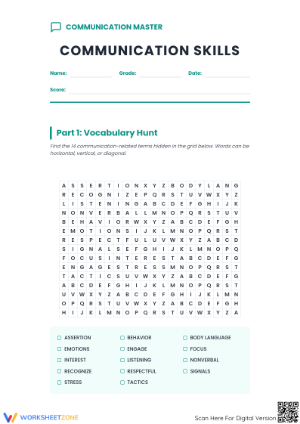
8th grade teaching communication skills printable worksheets give teachers a structured way to address the specific social and academic pressures that surface in middle school — group projects that dissolve into side conversations, peer feedback that stings instead of helps, and class discussions where three students carry the load while others quietly disengage. These resources slow communication down enough to make it visible: students analyze a scenario, practice response language, and reflect on what actually happened rather than receiving a generic reminder to "be a better listener."
The Specific Skills Targeted
Each worksheet addresses one communication habit rather than mixing several concepts into a single task. That narrower focus gives students a realistic chance to notice the skill, practice it on paper, and carry it into a real conversation without being overwhelmed.
- Active listening: Students read a short dialogue, mark the moments where the listener interrupted, paraphrased, or missed a cue, and rewrite the exchange using stronger listening moves.
- Clear speaking: Students revise vague or reactive statements — "You always mess up the group work" — into specific, calm language appropriate for a peer or teacher.
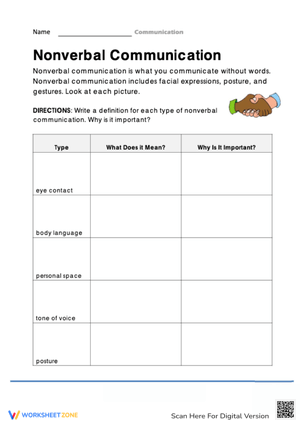
- Reading nonverbal cues: Students interpret posture, eye contact, and facial expression in brief illustrated scenarios, then explain how those signals shift meaning even when the words stay the same.
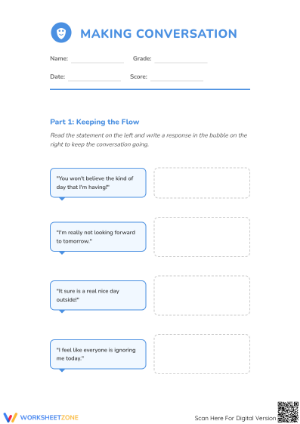
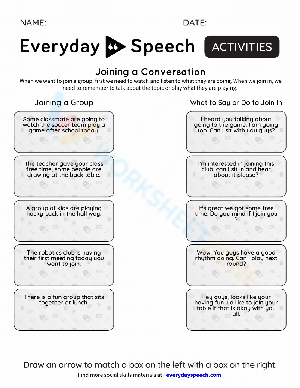
- Academic discussion language: Students practice sentence structures for agreeing, pushing back respectfully, asking for clarification, and building on a peer's point during class discussion.
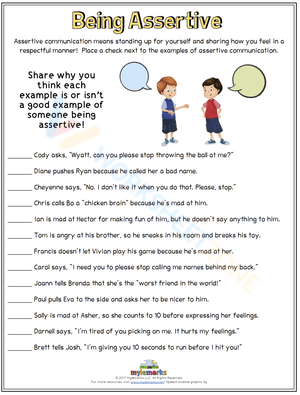
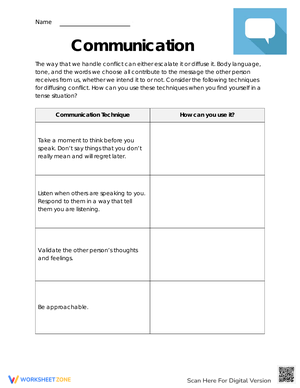
- Conflict-resolution scenarios: Students map out a response to realistic peer situations — being excluded from a group chat, receiving blunt presentation feedback, or feeling talked over in a project meeting.
- Digital tone: Students compare the same message written as a text, an email to a teacher, and a formal letter, then annotate the specific word choices that signal respect, informality, or carelessness.
Mistakes Students Make That These Worksheets Help You Catch
The most stubborn misconception 8th graders bring to communication work is that listening means staying quiet. Students who wait silently for their turn often score themselves full marks on listening checklists — because they weren't technically interrupting — while missing what the speaker actually said. The listening worksheets surface that gap immediately by asking students to write down what the speaker communicated before they respond. If they can't do it, they weren't listening.
Digital tone trips up a different subset. Students who handle in-person conversation well often send emails to teachers that read as dismissive — not from disrespect, but because they're importing text-message habits into a formal register without realizing the shift is required. The digital communication worksheets use side-by-side comparison tasks that make register differences concrete. Students annotate specific word choices rather than just labeling a message "informal" or "formal," which is the difference between seeing the pattern and being able to reproduce it.
A third pattern shows up consistently in conflict-resolution work: students read a scenario and immediately evaluate who was wrong rather than identifying what each person actually communicated. Redirecting that evaluative instinct — from judging the characters to analyzing the communication moves — takes repeated practice. Pointing to a specific line and asking "what did this person say here, and how might the other person have heard it?" moves students past the blame response faster than any general discussion prompt.
How to Work These Worksheets Into Your Lesson Planning
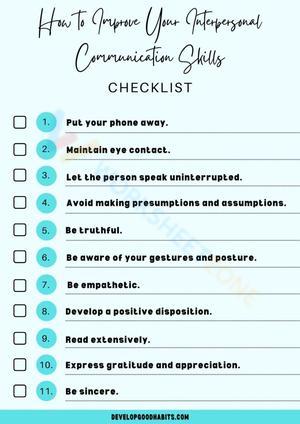
The most effective approach is to match each worksheet to a classroom moment that's already predictable. If group work goes sideways in the first five minutes, hand out the turn-taking checklist before students move to their groups — not after the problem happens. If peer feedback during writing conferences tends to surface as "it was good" or "I don't know," use the speaking-clearly worksheet the morning of revision day. 8th grade teaching communication skills printable worksheets do their best work when they connect directly to something students are about to do, not something they did three days ago.
In ELA, these resources fit naturally into speaking and listening units, literature circle discussions, and Socratic seminar prep. In advisory or homeroom, a single worksheet can anchor a 12-minute lesson without requiring any additional materials. In counseling or behavior support groups, the scenario-based tasks give students a low-stakes way to rehearse a response before they face the real version — which matters for students who have learned to react before thinking.
A four-step cycle works consistently across these settings: introduce the specific skill in plain language, analyze a scenario together, let students practice with the sentence stems or checklist on the worksheet, then reflect briefly — what did you try, what was hard, what would you do differently? That cycle fits inside 15 to 20 minutes, which keeps it viable for advisory blocks and the beginning or end of an ELA period without cutting into core instructional time.
Adjusting the Set for Mixed-Ability Classrooms
8th grade teaching communication skills printable worksheets work across a wider range of learners when teachers make a few targeted adjustments rather than swapping out the task entirely. The skill goal stays the same; the access route changes.
For students who struggle with reading load, shortening scenario text and bolding key vocabulary makes the task manageable without reducing its intellectual demand. Offering two or three response choices before asking for an open-ended answer gives students an entry point when a blank line feels paralyzing. Reading the scenario aloud while students follow along removes a decoding barrier that otherwise blocks the communication work the worksheet is actually trying to build.
Students who understand content but miss social cues benefit from having the nonverbal communication worksheets paired with a visual reference — a printed guide to posture and facial expressions they can consult across multiple activities. For students in SPED settings, predictable routines matter more than variety, so repeating the same discussion sentence stems across several lessons builds comfort before introducing new language.
Students who are reluctant to speak aloud often make the most visible progress when given writing time first. A worksheet that lets them plan wording, anticipate how a peer might respond, and rehearse phrasing before saying anything out loud reduces performance anxiety enough to increase real participation — which is the point of all of this.
Standard Alignment
These worksheets align directly with the Common Core State Standards for ELA Speaking and Listening at grade 8, particularly SL.8.1, which requires students to engage in collaborative discussions with diverse partners, build on others' ideas, and express their own thinking clearly. The active listening, discussion sentence stem, and conflict-resolution worksheets target the specific sub-skills named in SL.8.1's production and distribution components: coming prepared, following discussion norms, posing questions that connect to the topic, and acknowledging new information while qualifying or justifying their own views. In classroom terms, that means these worksheets are doing the pre-work for any discussion-based activity — they build the habits students need before the discussion starts.
SL.8.4 — presenting claims and findings using relevant evidence and appropriate eye contact, volume, and pronunciation — maps onto the speaking clearly and nonverbal communication worksheets. SL.8.6, which covers adapting speech to a variety of contexts and tasks, aligns directly with the digital tone worksheets that ask students to shift register across different communication situations. Teachers in states using CASEL social-emotional learning frameworks will also find these worksheets relevant to the Social Awareness and Relationship Skills competency areas.
Frequently Asked Questions
Can these worksheets be used outside of ELA class?
Advisory, homeroom, counseling groups, and behavior intervention settings are among the most natural fits. The scenario-based tasks don't require prior ELA content knowledge, so any teacher or support staff running a social-emotional or group skills lesson can use them without coordinating with the English department. School counselors in particular find the conflict-resolution and digital tone worksheets useful for individual or small-group sessions.
How many worksheets are typically in a set like this?
Sets covering the core skills — listening, speaking, nonverbal cues, conflict resolution, discussion language, and digital tone — typically include six to twelve worksheets. Teachers generally use them individually as standalone practice rather than working through the set in sequence, which is why each worksheet is built to make sense on its own without requiring the others first.
Are these resources appropriate for students who are already strong communicators?
Strong communicators benefit most from the digital tone and conflict-resolution worksheets, which surface nuances that competent students often overlook — specifically, that what they intend to communicate and what others actually receive can be very different things, especially in written exchanges. The work here isn't remedial. It reflects real complexity that trips up confident 8th graders on a regular basis.
How do I track student growth without creating a separate assessment?
Many teachers use 8th grade teaching communication skills printable worksheets as informal formative checkpoints rather than gradable assessments. Collecting a student's written responses across three or four worksheets over several weeks reveals more than any single score. One of the clearest indicators of growth is whether scenario responses shift from blame-focused answers — "he was rude first" — to communication-focused ones that name specific moves and alternative choices. That shift is worth more than a percentage grade.












 Interactive Worksheet Maker
 Quiz Maker
 Word Search Maker
 Crossword Puzzle Maker
 Word Scramble Generator
 Sentence Scramble Generator
 Handwriting Worksheet Generator
 Name Tracing Generator
 Fill In The Blank Generator