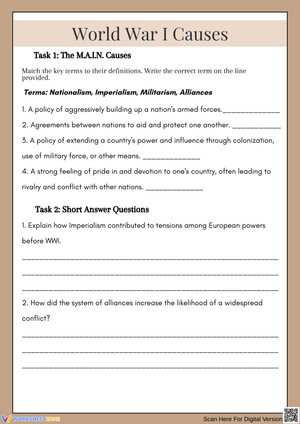
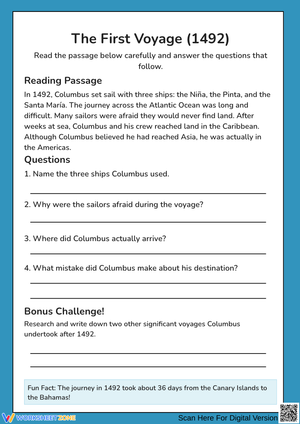
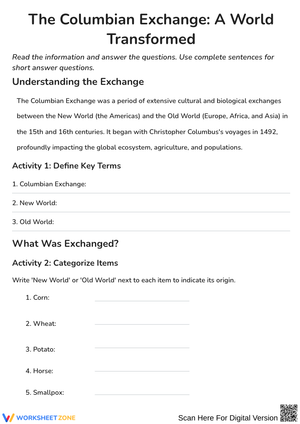
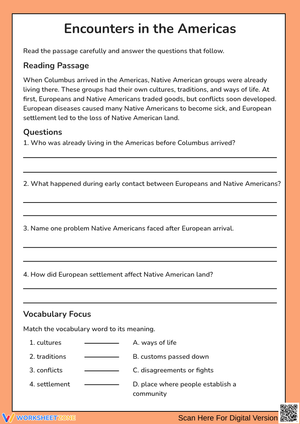
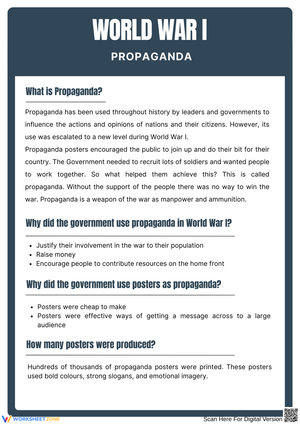
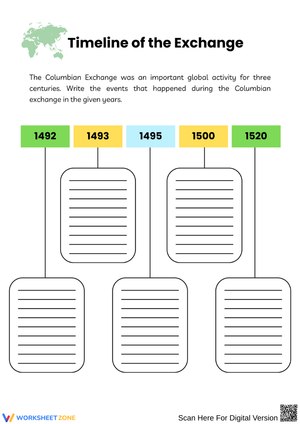
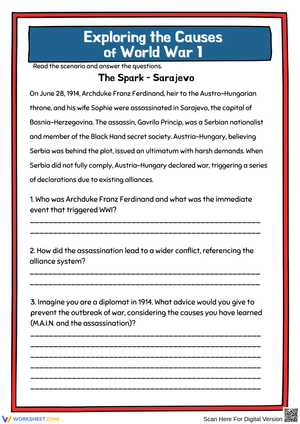
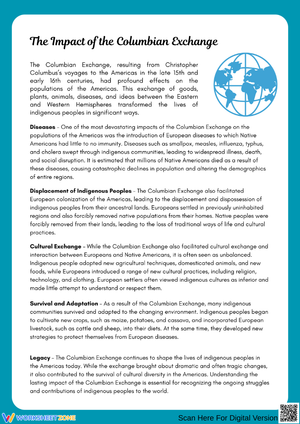
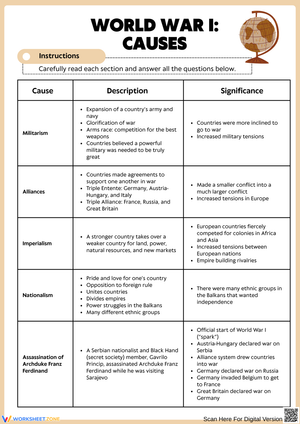
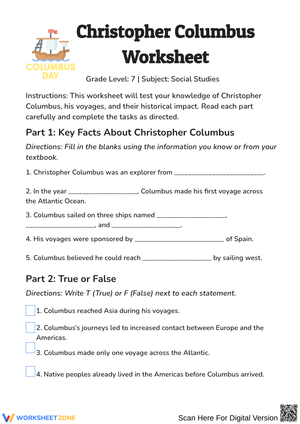
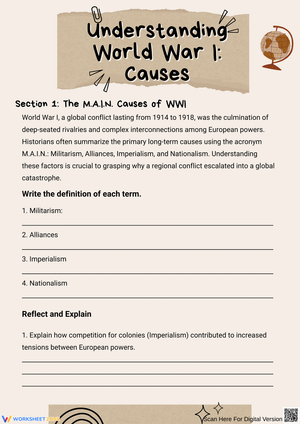
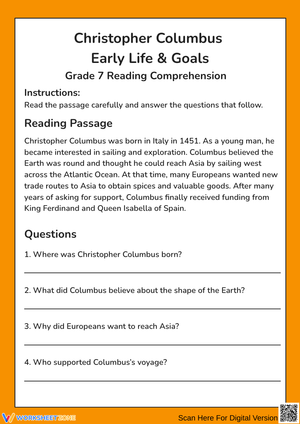
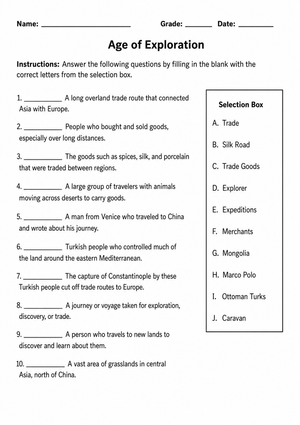
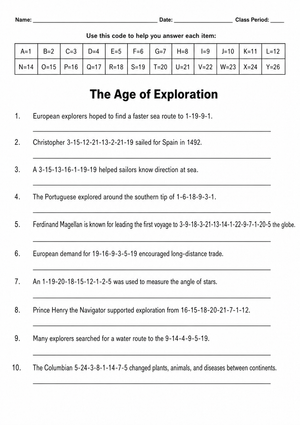
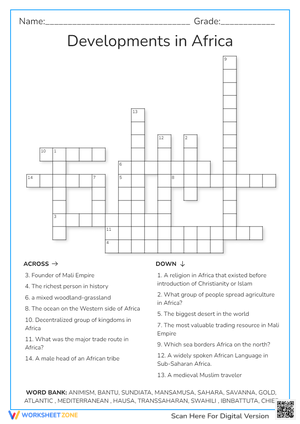
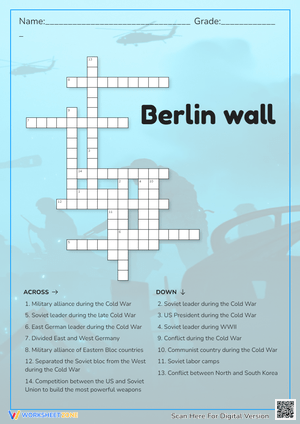
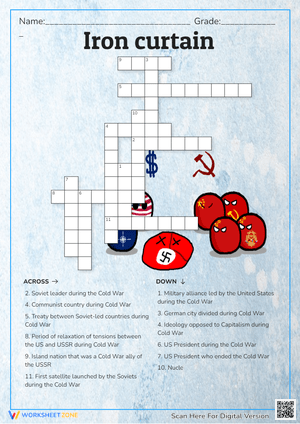
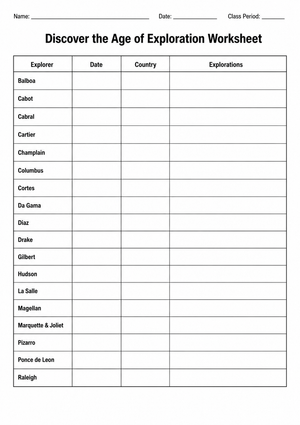
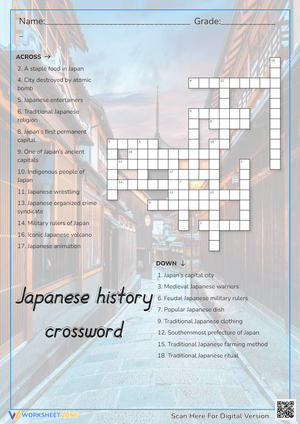
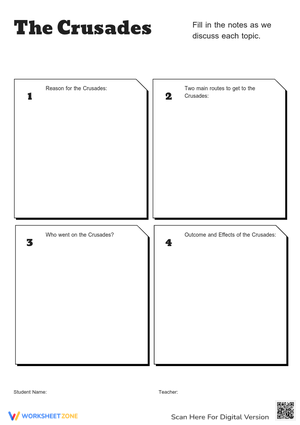
These world history worksheets pdf for 7th grade give teachers printable resources built around the actual demands of the course — short historical readings with text-dependent questions, map labeling, timeline sequencing, vocabulary work, and guided primary source analysis. The set spans content from ancient river valley civilizations through the Age of Exploration, organized by topic rather than a locked sequence, so teachers pull only what their current unit requires. Each worksheet centers on a focused objective, which makes the materials practical for bell ringers, independent practice, station rotations, and sub plans without any modification.
The Specific Skills Targeted
Seventh graders are developmentally ready to handle longer historical spans and more abstract causal reasoning than they were in elementary school, but they are not yet equipped for the document analysis demands of upper-level coursework. These worksheets land in that middle space — they ask students to do real historical thinking while providing enough structure to make that thinking visible and teachable.
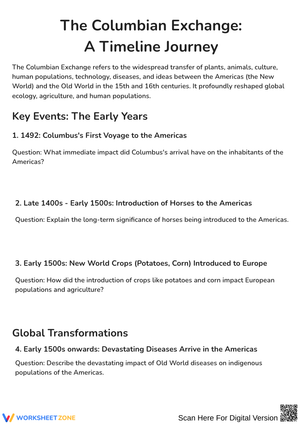
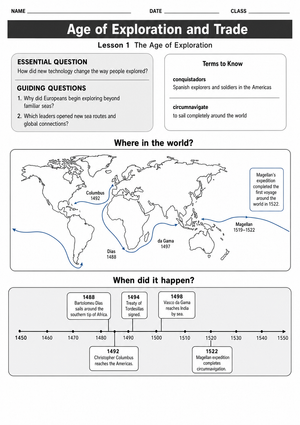
- Chronological reasoning: Timeline activities that span BCE and CE dates, requiring students to grapple with the direction of time before the common era — not just arrange events in a list.
- Geographic context: Map worksheets that ask students to label river valleys, empire boundaries, trade routes, and exploration paths so that place and event connect rather than exist as separate pieces of information.
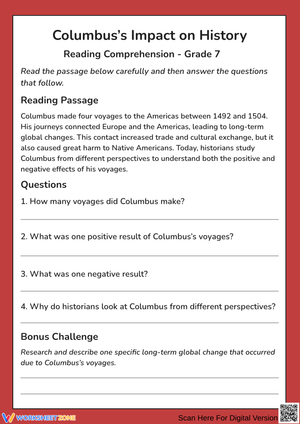
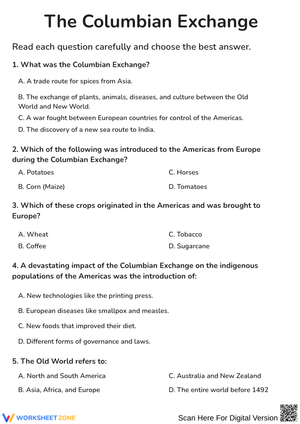
- Historical reading comprehension: Short informational passages followed by text-dependent questions that require students to locate evidence in the text, not simply recall the general idea.
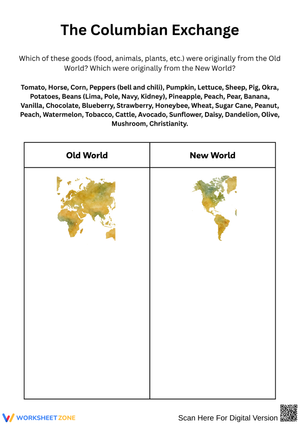
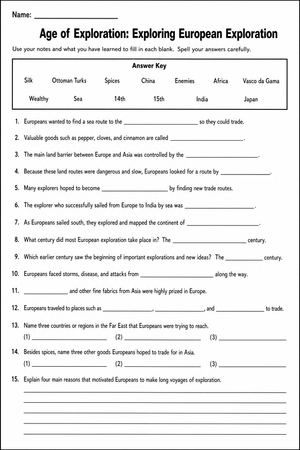
- Vocabulary in context: Terms like republic, monotheism, feudalism, and humanism appear in sentence frames, sorting tasks, and short-response prompts — not simple matching exercises.
- Cause-and-effect analysis: Graphic organizer worksheets that trace how a single event — the fall of Rome, the Black Death, a major trade disruption — produced multiple outcomes across different regions and groups.
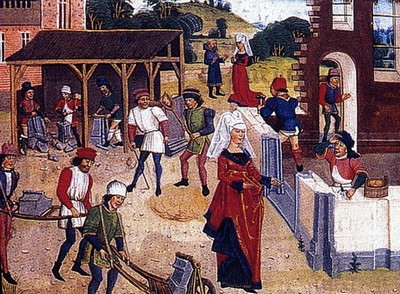
- Primary source work: Short excerpts and images paired with sourcing questions: who created this, for what audience, and what does it reveal about the historical moment?
Topic Coverage Across the Set
Because district pacing guides for 7th grade world history differ considerably — some begin with Mesopotamia, others open with a review of prehistory, others start in the classical world — the worksheets are organized by topic rather than as a fixed course sequence. Teachers can use them in whatever order their curriculum demands.
- River valley civilizations: Mesopotamia, Egypt, Indus Valley, ancient China
- Ancient Greece — city-states, democracy, and the Persian Wars
- The Roman Republic and Empire through the decline of the Western Roman state
- World religions in historical context: Judaism, Christianity, Islam, Hinduism, Buddhism
- The Byzantine Empire and medieval European feudalism
- Islamic civilizations and trans-Saharan and Indian Ocean trade networks
- African kingdoms — Ghana, Mali, Songhai, Great Zimbabwe
- East and South Asian developments, including the Tang and Song dynasties and the Mongol Empire
- Renaissance and Reformation in Europe
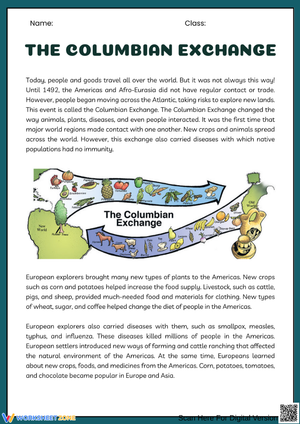
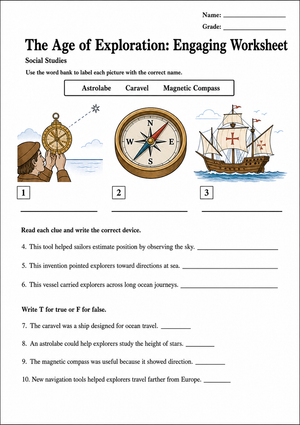
- Age of Exploration and the Columbian Exchange
That range allows a teacher whose district front-loads classical civilizations in September and saves the Renaissance for spring to draw from the same set across the full year, returning to it for review before unit tests as well.
Frequent Student Errors Worth Watching For
The most persistent error in 7th grade world history is not factual — it is chronological. Students who can tell you that ancient Greece "came before" Rome will still place 300 BCE after 100 BCE on a timeline without hesitation, because the numeral increases and that feels like forward movement. The timeline worksheets in this set deliberately span both BCE and CE dates and require students to place events in true historical order, which surfaces this misconception where it can be corrected directly rather than hidden inside a paragraph-length response.
A second pattern we see regularly in actual student work: students tend to merge distinct civilizations into a single mental category labeled "ancient." A student might write that the Romans built the pyramids, or attribute Greek philosophy to Egyptian scholars — not from carelessness but from a genuine absence of mental separation between civilizations encountered in the same unit. Map tasks that anchor each civilization to a specific region and reading worksheets that open with a brief geographic frame help students build the distinctions that prevent this blending.
Primary source worksheets expose a third error worth correcting early. Students asked "what does the author believe?" will quote a line from the document rather than interpret it. Worksheets that separate the sourcing question from the content question — first, who created this and for what purpose; then, what argument does it make — teach students that those are genuinely different moves, and that copying is not the same as analyzing.
Building These Worksheets Into Your Lesson Plans
The format that produces the most consistent results is using each worksheet as a bridge between instruction and discussion rather than a replacement for either. After a 10-minute direct-instruction segment on the Silk Road, a map worksheet asking students to label key stops and answer two cause-and-effect questions gives them time to consolidate before the class moves into discussion or group activity. The worksheet functions as a visible thinking checkpoint — teachers can scan the room and see within a minute or two who made the connection and who is still guessing at the task.
Station rotations work particularly well with this set. A worksheet anchoring one station does not require teacher presence to run: one group labels a map, another works through a primary source excerpt, a third sequences a timeline. Each station carries a self-contained task, which frees the teacher to pull a targeted small group without managing all three rotations simultaneously.
For sub plans, world history worksheets pdf for 7th grade organized by topic and printed as PDFs give substitutes a clear, structured task connected to whatever the class is currently studying. A reading worksheet on feudalism with a short glossary and four guided questions needs almost no setup, and students stay connected to the unit rather than sitting through unrelated material.
Adjusting the Set for Different Student Levels
The most practical approach here is to adjust the task output rather than rewrite each worksheet from scratch. A class working through the same passage on Roman government can complete different tasks: students who need more language support annotate a version with bolded key terms and a word bank, then answer two factual questions; on-level students handle a mix of recall and cause-and-effect prompts; students ready for more depth add a short written comparison to a second government structure they have studied. The content stays consistent — what changes is the depth of the written response and the amount of language support built in.
For English learners and developing readers, the map and timeline worksheets are typically the most accessible entry points. Visual tasks lower the language demand without removing the historical reasoning. A student who cannot yet write a fluent paragraph can accurately sequence five events or correctly label three trade routes — and that success builds the content knowledge they will need when text-heavy tasks arrive later in the unit.
Extension prompts at the bottom of each worksheet give fast finishers a genuine challenge without requiring a separate assignment. Prompts like "Compare the spread of Islam to the spread of Christianity across the same time period" or "Identify one long-term effect of Roman law in a modern government system" push students well beyond the base objective while keeping them rooted in the same content the rest of the class is working through.
Standard Alignment
These world history worksheets pdf for 7th grade align directly with the College, Career, and Civic Life (C3) Framework for Social Studies State Standards, particularly the Dimension 2 History standards D2.His.1 through D2.His.5. D2.His.1 asks students to analyze how unique circumstances shaped historical developments; D2.His.5 focuses on explaining how and why people's perspectives have changed over time. The primary source worksheets and cause-and-effect graphic organizers in this set give students repeated, content-specific practice with both of those moves — which is exactly where those skills transfer.
The reading and written-response worksheets also address CCSS Literacy in History/Social Studies standards for grades 6–8, specifically CCSS.ELA-LITERACY.RH.6-8.1, which requires citing textual evidence to support analysis, and RH.6-8.2, which focuses on determining central ideas in a historical text. In practical terms, this means teachers can document reading skill growth within the social studies block — useful in schools where ELA and social studies departments share accountability for literacy outcomes.
Frequently Asked Questions
Are the worksheets organized by era, by topic, or by skill type?
Each worksheet is organized by topic — ancient Egypt, the Roman Republic, medieval Europe, the Renaissance, and so on — and targets a specific skill within that topic: reading comprehension, map analysis, vocabulary, timeline sequencing, or primary source work. Teachers do not need to use them in any fixed order, and no worksheet depends on another to make sense.
Do the worksheets work for mixed-ability 7th grade classrooms?
Yes. The base task on each worksheet is accessible to on-level students, and the extension prompts at the bottom push advanced students further without requiring a second assignment. The differentiation approach described above — adjusting task output rather than rewriting content — keeps preparation manageable while meeting a range of learners in the same classroom.
How well do these hold up as sub plans?
A reliable sub plan needs clear directions, self-contained content, and predictable formatting — world history worksheets pdf for 7th grade deliver all three. A reading worksheet with a built-in glossary and structured response questions needs almost no setup from the substitute, and the students stay connected to the unit rather than sitting through something unrelated to their current work.
What role do these worksheets play in literacy instruction within the social studies block?
The reading comprehension worksheets directly address CCSS.ELA-LITERACY.RH.6-8.1 and RH.6-8.2, which means teachers working under a cross-content literacy framework can document those reading skills as part of the social studies block rather than treating them as the exclusive territory of the ELA classroom. For schools tracking 6–8 literacy growth across departments, that alignment matters.