


























Views
Downloads
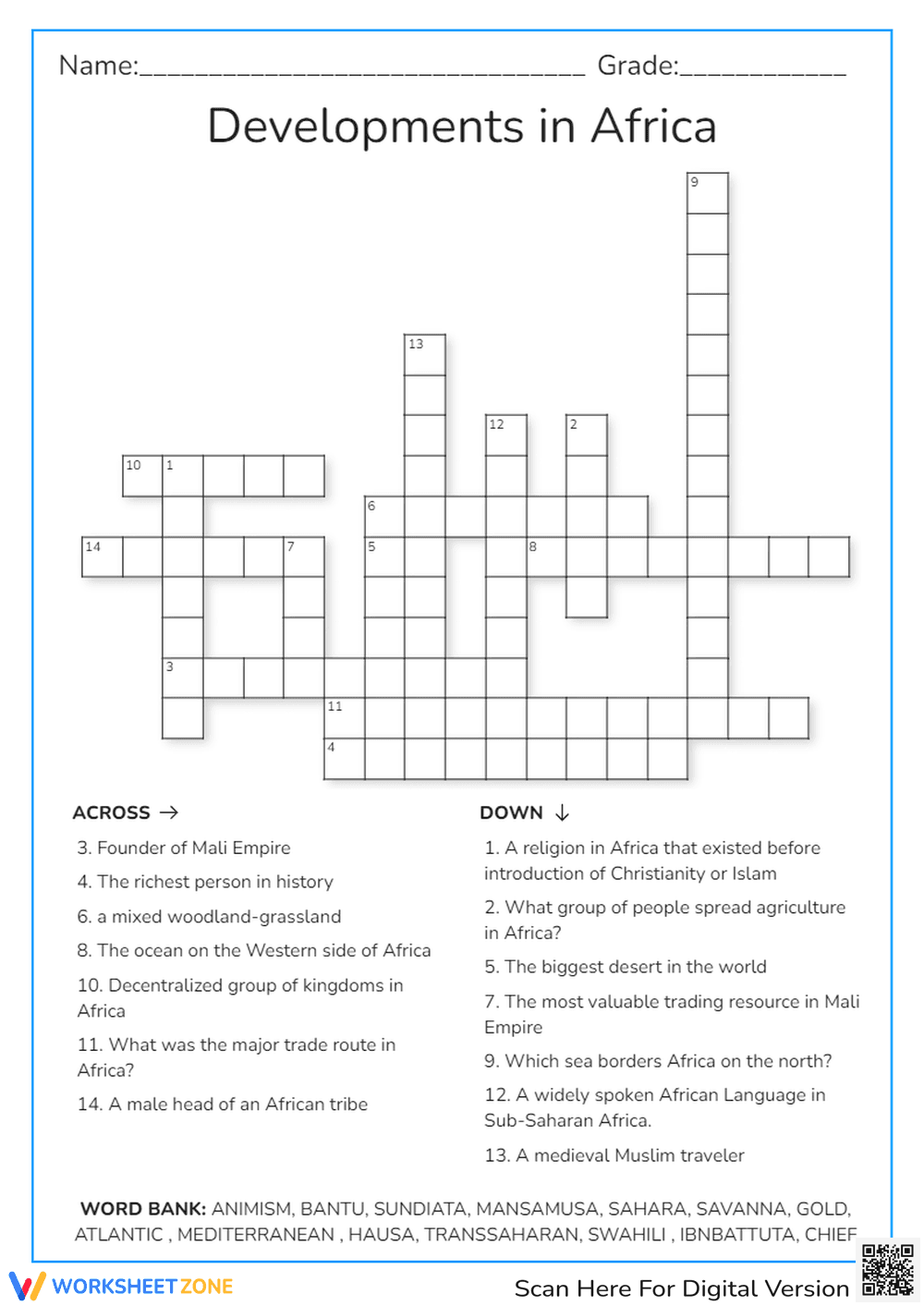

Developments in Africa Crossword | Grade 7-10 Essential
Paste this activity's link or code into your existing LMS (Google Classroom, Canvas, Teams, Schoology, Moodle, etc.).
Students can open and work on the activity right away, with no student login required.
You'll still be able to track student progress and results from your teacher account.
This Grade 7-10 Developments in Africa crossword provides a structured way for students to reinforce their understanding of medieval African history. By connecting clues to specific historical figures, geographical landmarks, and cultural shifts, learners solidify their grasp of the Mali Empire and trans-Saharan trade. It is an effective tool for building domain-specific literacy.
At a Glance
- Grade: 7-10 · Subject: World History
- Standard:
RH.6-8.4— Determine the meaning of domain-specific vocabulary in history and social studies- Skill Focus: Medieval African Civilizations
- Format: 1 page · 14 problems · Answer key included · PDF
- Best For: Vocabulary review or sub plans
- Time: 15–20 minutes
What's Inside
This single-page PDF features 14 unique clues covering across and down orientations. To support diverse learners, a comprehensive word bank is included at the bottom, featuring terms like Mansa Musa, Swahili, and Ibn Battuta. The layout is clean and professional, ensuring that students can focus entirely on the historical content without visual distraction or unnecessary clutter.
Zero-Prep Workflow
- Print: Generate class sets in under 30 seconds.
- Distribute: Hand out to students for immediate engagement with zero setup.
- Review: Use the included answer key for a rapid 5-minute peer-review or whole-class check.
Total prep is under two minutes, making it perfect for sub plans or transition activities.
Standards Alignment
The primary standard addressed is `CCSS.ELA-LITERACY.RH.6-8.4`, which requires students to determine the meaning of symbols, key terms, and other domain-specific words and phrases as they are used in a historical context. This worksheet specifically targets the vocabulary of African civilizations. This code can be copied into lesson plans or IEP goals.
How to Use It
Assign this crossword as a formative assessment after a lecture on the Mali and Songhai empires to gauge vocabulary retention. Alternatively, use it as a "bell-ringer" activity to activate prior knowledge before starting a unit on global trade networks. Completion typically ranges from 15 to 20 minutes depending on student familiarity with the word bank.
Who It's For
This resource is tailored for middle and high school students in World History or Geography courses. It provides necessary scaffolding for English Language Learners (ELL) through the word bank while challenging general education students to recall specific historical facts. Pair with a map of African trade routes for a complete lesson.
According to Fisher & Frey (2014), the use of word-play and puzzles like crosswords significantly enhances the acquisition of domain-specific vocabulary in the social studies classroom. This Developments in Africa worksheet directly supports the `RH.6-8.4` standard by requiring students to synthesize historical clues into correct terminology. By engaging with 14 distinct concepts—ranging from the Trans-Saharan trade routes to the linguistic influence of the Bantu migrations—students move beyond rote memorization toward a more integrated understanding of historical developments. Research indicates that providing a word bank, as seen in this resource, reduces cognitive load and allows students to focus on the semantic relationships between historical events and their definitions. This approach is particularly effective for Grade 7 through Grade 10 learners who are developing the complex literacy skills required for high school history success. The worksheet serves as a reliable evidence-based tool for reinforcing curriculum-aligned content.


