


























Views
Plays

Medieval City Life Quiz | Grade 7 History Essential
Paste this activity's link or code into your existing LMS (Google Classroom, Canvas, Teams, Schoology, Moodle, etc.).
Students can open and work on the activity right away, with no student login required.
You'll still be able to track student progress and results from your teacher account.
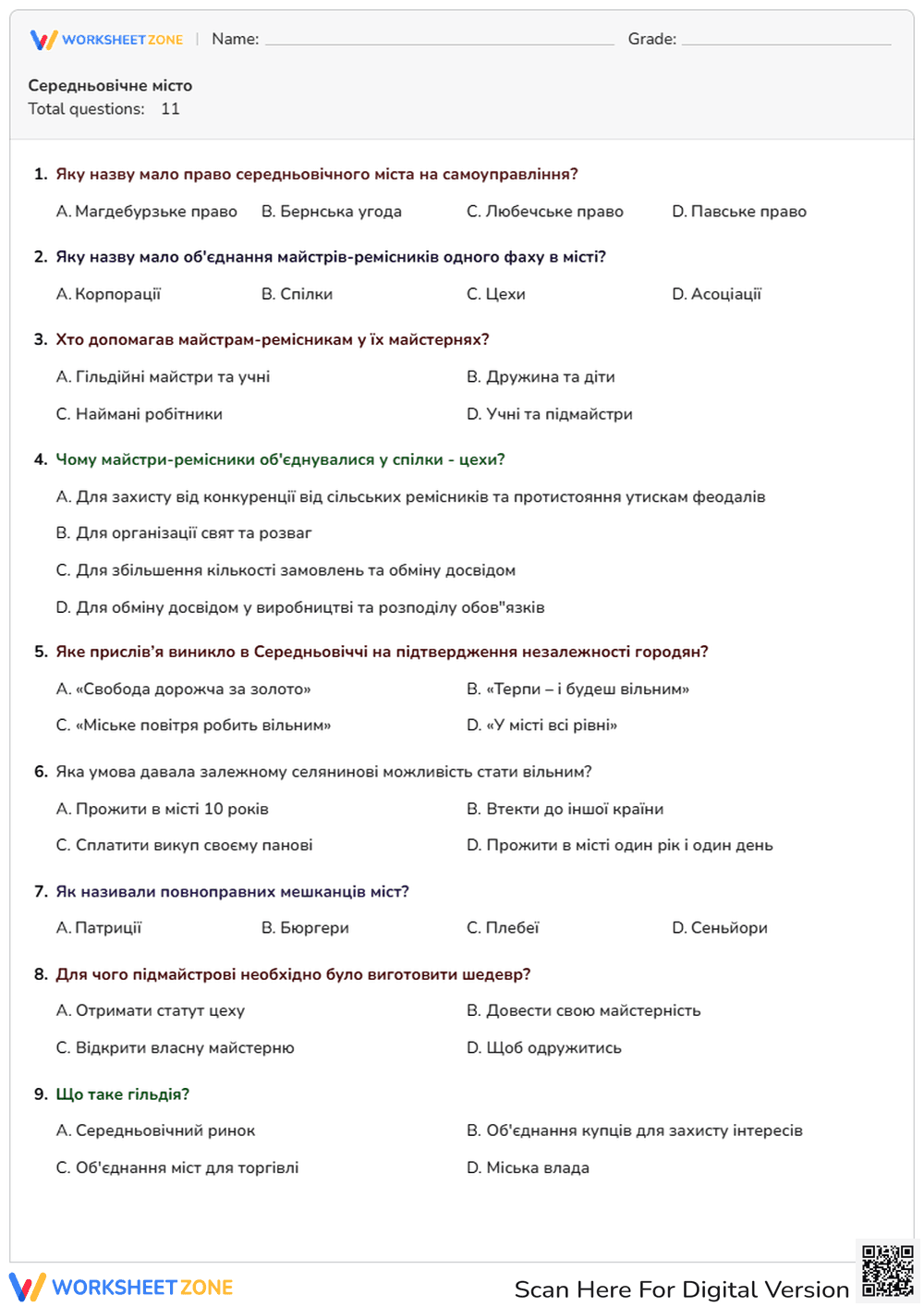
This Grade 7 history worksheet provides a comprehensive assessment of student understanding regarding the development and organization of medieval cities. Students demonstrate mastery of historical concepts including the Magdeburg rights, the role of craft guilds, and the social hierarchy of urban dwellers. It serves as a rigorous tool for evaluating historical literacy and conceptual retention.
At a Glance
- Grade: 7 · Subject: World History
- Standard:
CCSS.ELA-LITERACY.RH.6-8.4— Determine the meaning of domain-specific words related to medieval history and social studies- Skill Focus: Medieval urban development and social structures
- Format: 2 pages · 11 problems · Answer key included · PDF
- Best For: Formative assessment or end-of-unit review
- Time: 20–30 minutes
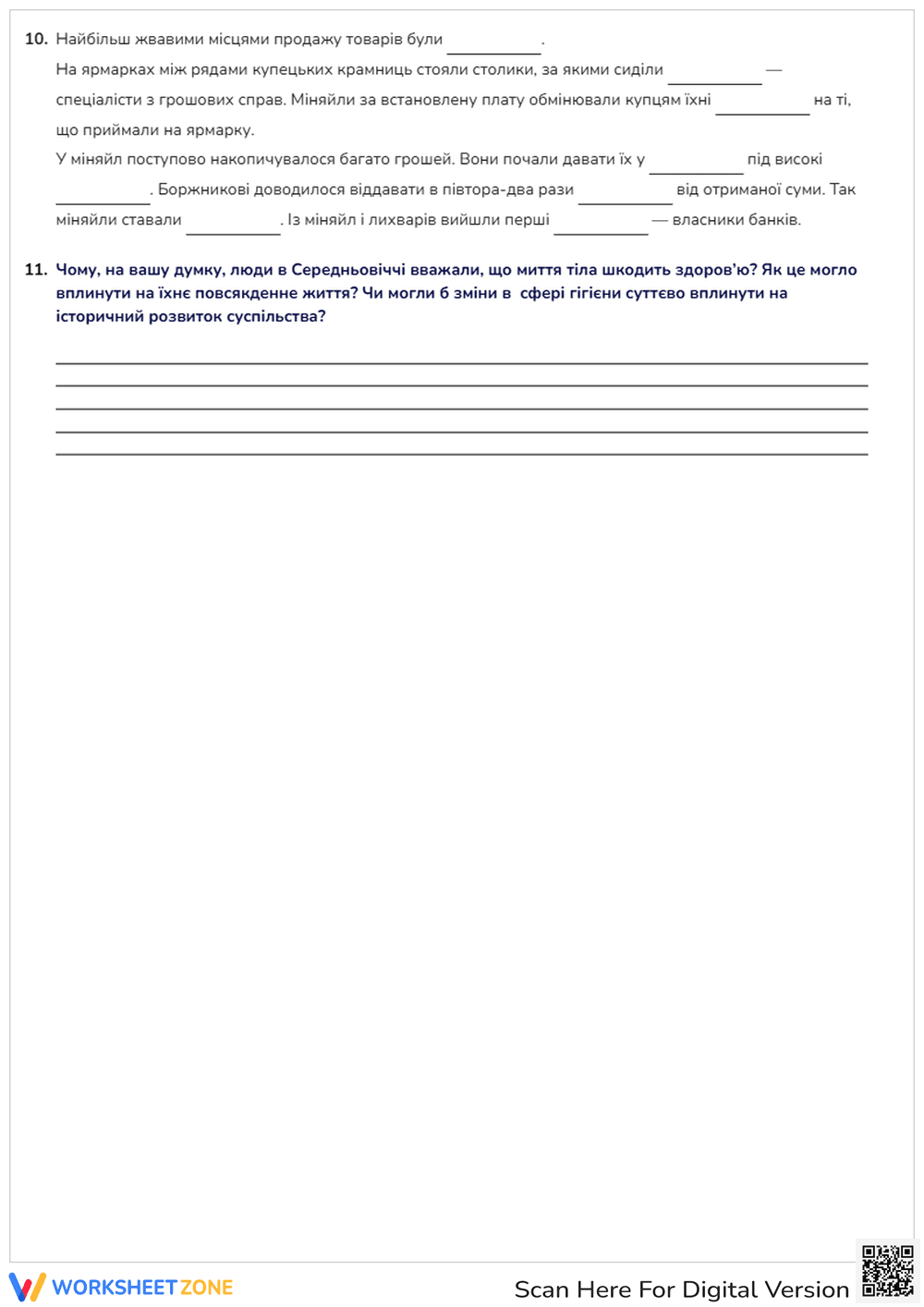
What's Inside: This two-page resource features 11 distinct tasks designed to probe deep historical understanding. The first page contains 9 multiple-choice questions focusing on specific terminology like 'guilds' and 'patricians.' The second page transitions to a complex cloze-style paragraph regarding the evolution of banking and a final open-ended critical thinking prompt about medieval hygiene and its societal impact. A full answer key is provided for rapid grading.
Zero-Prep Workflow: This worksheet is designed for immediate classroom implementation with a total teacher preparation time of under 2 minutes. First, print the required number of double-sided copies for your cohort. Second, distribute the materials at the start of the period as a quiet independent assessment. Finally, review the multiple-choice section as a whole group to provide immediate feedback, using the essay prompt as a springboard for a larger class discussion on historical living conditions.
Standards Alignment: The primary focus is CCSS.ELA-LITERACY.RH.6-8.4, which requires students to determine the meaning of domain-specific words and phrases as they are used in a historical context. Additionally, the final prompt supports RH.6-8.1 by requiring students to cite specific evidence to support analysis of primary and secondary sources. Both standard codes can be copied directly into lesson plans, IEP goals, or district curriculum mapping tools.
How to Use It: This resource is most effective when used as a formative assessment following direct instruction on the Middle Ages. It can also serve as a high-quality sub plan due to its self-explanatory nature. During the session, observe students as they tackle the cloze paragraph to identify misconceptions about the transition from bartering to banking. Expect most students to complete the multiple-choice section in 12 minutes and the written response in 10 minutes.
Who It's For: This worksheet is tailored for Grade 7 social studies students studying European history. It is particularly useful for general education classrooms, though the clear structure and vocabulary-heavy focus make it an excellent choice for English Language Learners (ELL) who are building academic language. It pairs naturally with a primary source reading on city charters or a visual anchor chart of a medieval manor.
Research indicates that the inclusion of domain-specific vocabulary assessment is a critical predictor of long-term historical literacy. This worksheet addresses that need by isolating 11 specific historical concepts, including the legal frameworks of city self-governance and the economic impact of the guild system. By moving from multiple-choice identification to critical analysis in the final prompt, the resource mirrors the cognitive shifts required for secondary-level history mastery. Such structured assessments help bridge the gap between simple recall and the complex synthesis of historical events. This resource provides the necessary scaffolding to ensure students can articulate the relationship between urban growth and the eventual decline of feudalism, making it a vital component of any Grade 7 history curriculum focused on the medieval era.


