


























Views
Downloads

Age of Exploration Worksheet | Grade 7 Printable
Paste this activity's link or code into your existing LMS (Google Classroom, Canvas, Teams, Schoology, Moodle, etc.).
Students can open and work on the activity right away, with no student login required.
You'll still be able to track student progress and results from your teacher account.
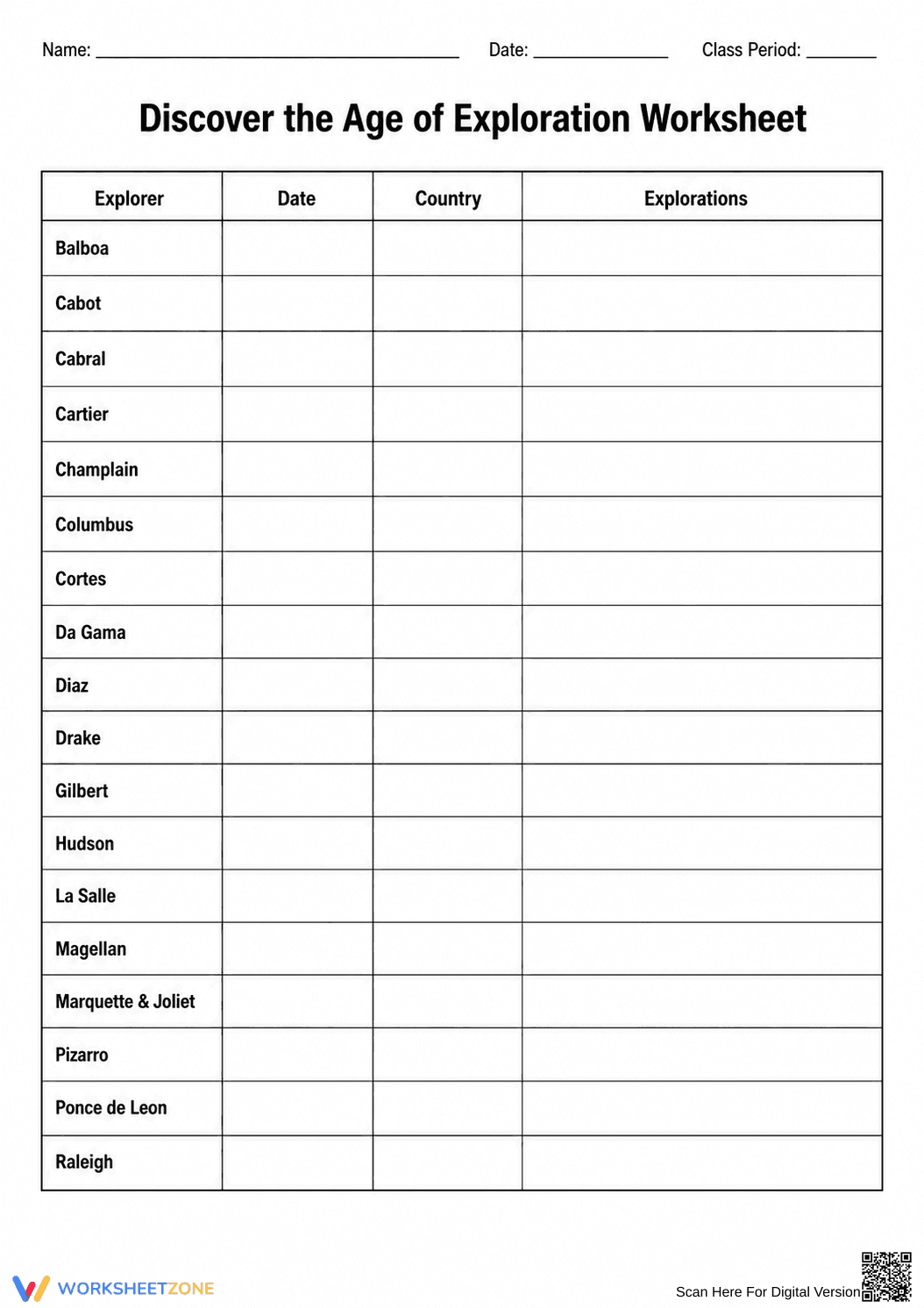
This Age of Exploration worksheet provides students with a structured framework to research and document key historical figures. By completing the organizer, learners synthesize historical data, identify global exploration routes, and connect specific explorers to their sponsoring countries and significant discoveries during this pivotal era.
At a Glance
- Grade: 7 · Subject: History
- Standard:
CCSS.ELA-LITERACY.WHST.6-8.7— Conduct short research projects to answer a question- Skill Focus: Historical research and data organization
- Format: 1 page · 18 problems · Answer key included · PDF
- Best For: Independent research and study guides
- Time: 30–45 minutes
Inside this resource, educators will find a single-page graphic organizer featuring eighteen historically significant explorers, including Magellan and Hudson. The table contains four columns: Explorer, Date, Country, and Explorations. Students fill in the three blank columns for each individual. A complete answer key is provided for accurate grading and self-assessment.
This resource offers a highly efficient zero-prep workflow:
- Print (1 min): Print the single-page PDF and answer key.
- Distribute (1 min): Hand out the organizer alongside textbooks or digital databases.
- Review (2 mins): Explain the headers and model the first row (e.g., Balboa) to set expectations.
With teacher prep under two minutes, this is an excellent option for emergency sub plans.
This activity aligns to CCSS.ELA-LITERACY.WHST.6-8.7, requiring students to conduct short research projects to answer a question, drawing on several sources. It supports historical comprehension by contextualizing major global expeditions. Both standard codes can be copied directly into lesson plans, IEP goals, or district curriculum mapping tools.
Teachers can deploy this worksheet during direct instruction as a guided note-taking tool, or assign it as an independent research project after introducing the Age of Exploration unit. When used as an independent assignment, expect students to spend between 30 and 45 minutes gathering and recording their findings. As a formative assessment observation tip, monitor students while they research to ensure they are identifying the correct sponsoring country rather than just the explorer's country of birth, which is a common point of confusion.
This resource is primarily designed for middle school students in seventh or eighth grade studying world history or early American history. It naturally differentiates for diverse learners by allowing them to use varied research materials, from simplified texts to advanced historical databases, depending on their reading levels. It pairs perfectly with an introductory slide deck or a direct instruction lesson on the motivations behind European global expansion.
Integrating structured graphic organizers into historical research assignments significantly enhances student retention of complex factual data. According to a recent EdReports 2024 analysis of middle grades social studies curricula, providing students with pre-formatted categorization tools reduces cognitive load, allowing them to focus entirely on synthesizing source material rather than formatting their notes. This worksheet directly supports CCSS.ELA-LITERACY.WHST.6-8.7 by requiring learners to conduct short research projects to answer a question. By systematically documenting the dates, sponsoring nations, and specific achievements of eighteen distinct explorers, students build a comprehensive mental map of the era. This structured approach not only reinforces foundational historical knowledge but also cultivates essential academic research habits that are critical for success in high school and beyond. The clear, predictable format ensures that all learners can successfully master the historical details of the Age of Exploration.


