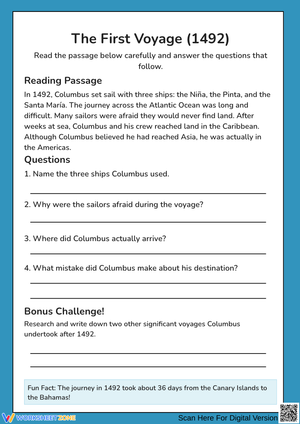
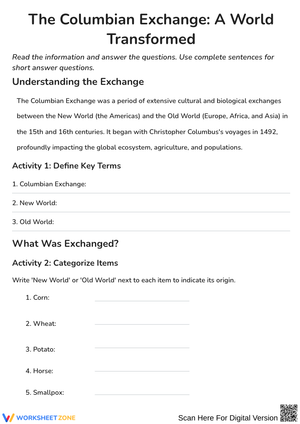
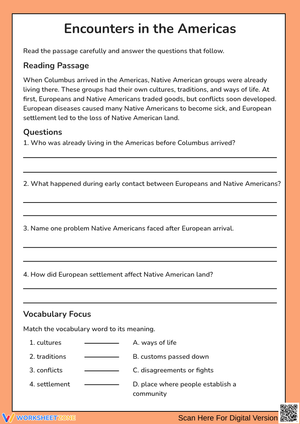
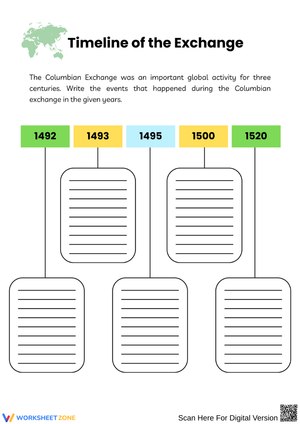
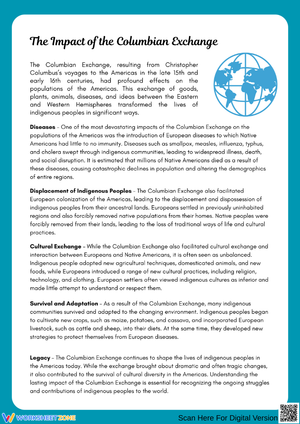
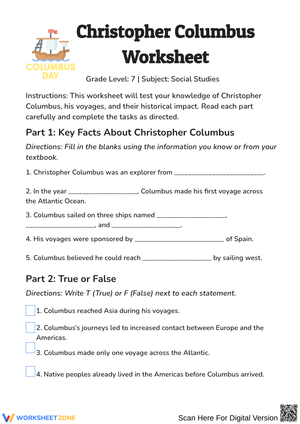
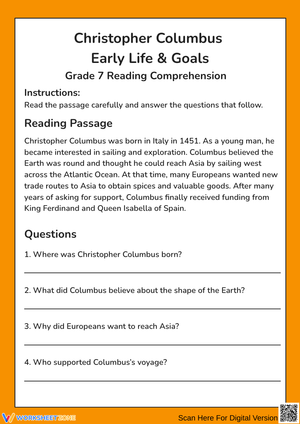
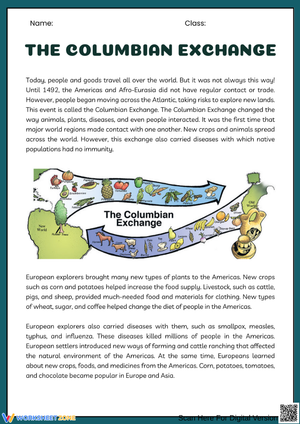
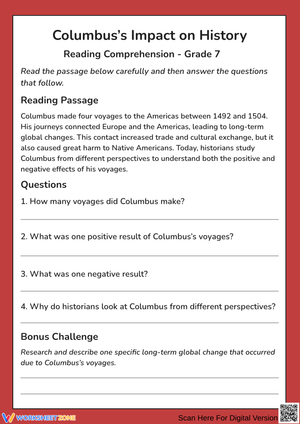
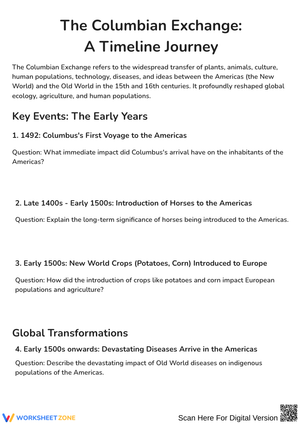
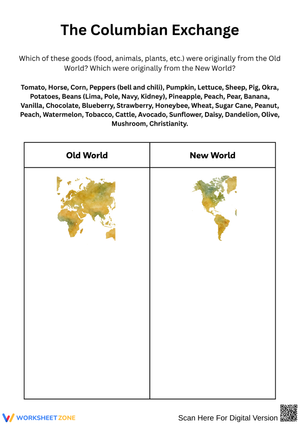
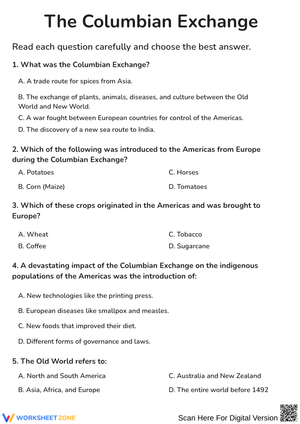
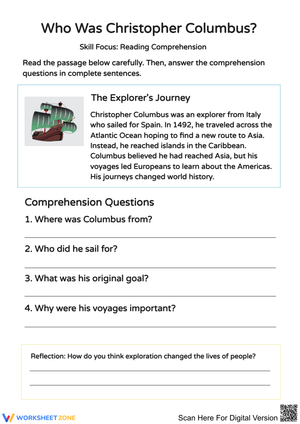
These columbian exchange worksheets printable for 7th grade cover the full scope of what this topic demands in a middle school social studies classroom — reading passages on the movement of crops, animals, and disease, graphic organizers that push students to categorize and analyze rather than simply list, blank map activities tracing Atlantic trade routes, and cause-and-effect frameworks that thread the Exchange into later colonial history. Teachers can deploy the worksheets across a two-to-three week unit or pull individual ones for warm-ups, guided practice, or review.
The Specific Skills These Worksheets Build
The set addresses the four core threads that 7th grade frameworks consistently require: New World crops transforming European and Asian agriculture, Old World livestock reshaping Indigenous life in the Americas, the catastrophic spread of disease, and the long-term consequences linking the Exchange to colonization and the transatlantic slave trade. Most teachers find that covering all four threads in a single lesson overwhelms students; these worksheets are organized so each thread gets concentrated attention before students synthesize across them.
Specific tasks across the set include:
- Sorting charts where students categorize goods, animals, and diseases by region of origin
- Annotation exercises on short reading passages — students underline evidence of specific consequences rather than reading for general understanding alone
- Blank maps where students draw and label trade routes, color-coded by direction of movement
- Flowcharts tracing a single commodity — sugarcane, for instance — through plantation agriculture and into the demand for enslaved labor
- Primary source excerpts from explorers' journals, modified for readability, with guided questions on perspective and historical reliability
Frequent Student Errors Worth Watching For and Correcting
The most consistent mistake in student work on sorting tasks is directional confusion about crops that have become strongly associated with a culture that did not originate them. Students who correctly place corn and potatoes in the "New World" column will often sort tomatoes into the "Old World" because they associate tomatoes with Italian cooking. That surface-level reasoning — Italian food, therefore European origin — is exactly what these worksheets are structured to disrupt. A brief pre-teach clarifying that a food's current cultural home and its geographical origin are two separate facts prevents this from derailing the sorting activity before it gets started.
The disease component generates a different problem. Students frequently read the population collapse of Indigenous peoples as an unfortunate accident rather than as a dynamic that European colonizers later exploited deliberately. The cause-and-effect worksheets in the set push students through a specific sequence: epidemic, weakened governance, military conquest, colonial consolidation. That chain is harder to read as neutral once students have mapped it out step by step.
How to Work These Worksheets Into Your Unit Sequence
The food-origin activity earns its place as a unit opener, not a midpoint lesson. Write a list of familiar ingredients on the board — wheat, tomatoes, corn, beef, chocolate, potatoes, sugar — and ask students to mark each one as Old World or New World before they open anything. The guesses are almost always wrong in at least three places, and that surprise creates productive confusion that makes subsequent reading passages stick. The columbian exchange worksheets printable for 7th grade land with more traction when students have already discovered how much they assumed incorrectly — even eight to ten minutes of that prior-knowledge disruption changes how carefully they read what comes next.
Sequence also matters across the set. Teachers who assign the disease worksheets before the crop and livestock worksheets report that students struggle to connect epidemic spread to the broader exchange network. Moving in order — agricultural transfer first, livestock second, disease third, long-term consequences last — mirrors the historical logic and reduces the confusion that surfaces when students encounter cause-and-effect chains spanning multiple decades.
Differentiating Across the Range of Learners in Your Classroom
Students reading below grade level benefit from receiving the graphic organizers — specifically the T-charts and sorting charts — before they encounter the reading passages, not after. When the categories are already visible, a student knows what evidence to hunt for, which reduces the strain of processing unfamiliar vocabulary and historical content simultaneously. That small structural shift keeps below-level readers engaged without changing the intellectual demand of the task itself.
Students reading above grade level can use the same primary source excerpts to write a short comparative paragraph — two explorers' accounts of the same encounter, analyzed for perspective and contradiction. The worksheet is identical; the extension task adds synthesis. The map worksheets differentiate naturally as well. Students who need more support label a pre-drawn map using a word bank and color-code by region. Students ready for a challenge draw their own routes, annotate them, and write a sentence explaining the economic logic behind each one — connecting geography to trade incentives rather than just recording them.
Standard Alignment
The reading and analysis tasks in these worksheets address CCSS.ELA-LITERACY.RH.6-8.1 — citing specific textual evidence from historical sources — and CCSS.ELA-LITERACY.RH.6-8.7, which asks students to integrate information presented across different formats, including maps and written text. In most 7th grade pacing guides, the Columbian Exchange appears in the third or fourth quarter, positioned deliberately between the exploration unit and the colonization unit. That placement is intentional: students who understand the Exchange carry a causal framework into colonization rather than treating it as a fresh, disconnected topic. The range of tasks across the columbian exchange worksheets printable for 7th grade — sorting, annotating, mapping, chain reasoning — aligns directly with the historical thinking standards in NCSS frameworks for this grade band, particularly those related to causation, continuity and change, and context.
Frequently Asked Questions
Which goods are most important to prioritize at this grade level?
Focus on items with the most consequential downstream effects. From the New World: potatoes, corn, tomatoes, and tobacco, all of which restructured European economies and diets. From the Old World: horses, cattle, pigs, sugarcane, and the diseases that arrived alongside European contact — especially smallpox, measles, and influenza. The horse deserves particular attention because its introduction transformed mobility and warfare for Plains Indigenous nations, an effect students consistently find surprising and concrete enough to remember.
How should I handle the disease content accurately and with care?
Treat the demographic collapse of Indigenous populations as a matter of historical record rather than something to soften or rush past. The cause-and-effect worksheets frame it factually: communities with no prior exposure to these pathogens had no developed immune response, and the resulting death toll — in some regions greater than 90 percent of the population — disrupted political structures that had been stable for centuries. That context, presented clearly, helps students understand colonization as something that happened to already-destabilized societies rather than to an open frontier.
What graphic organizer formats work best for this topic?
T-charts handle the Old World versus New World categorization cleanly. Flowcharts are most effective for cause-and-effect chains — particularly the path from a single crop introduction through plantation agriculture and into the expansion of the transatlantic slave trade. Annotated maps cover the spatial reasoning that the topic demands. These three formats address the major cognitive moves the Exchange requires, and columbian exchange worksheets printable for 7th grade that use all three give students multiple entry points into the same underlying content, which helps the material consolidate more reliably across a full unit.
Can individual worksheets be used outside of a full unit?
Yes. The sorting and mapping worksheets work well as standalone warm-ups or sub plans because they do not require students to have completed earlier worksheets in the set. The flowchart and primary source worksheets are better suited to mid-unit or end-of-unit use, since they ask students to reason from a knowledge base that needs to be in place first. Pulling the sorting worksheet as a Monday warm-up before a lesson review is a common use — it re-activates the categorization knowledge quickly without needing any setup.












 Interactive Worksheet Maker
 Quiz Maker
 Word Search Maker
 Crossword Puzzle Maker
 Word Scramble Generator
 Sentence Scramble Generator
 Handwriting Worksheet Generator
 Name Tracing Generator
 Fill In The Blank Generator