


























Views
Downloads

The Crusades Notes Worksheet | Grade 6 Essential Guide
Paste this activity's link or code into your existing LMS (Google Classroom, Canvas, Teams, Schoology, Moodle, etc.).
Students can open and work on the activity right away, with no student login required.
You'll still be able to track student progress and results from your teacher account.
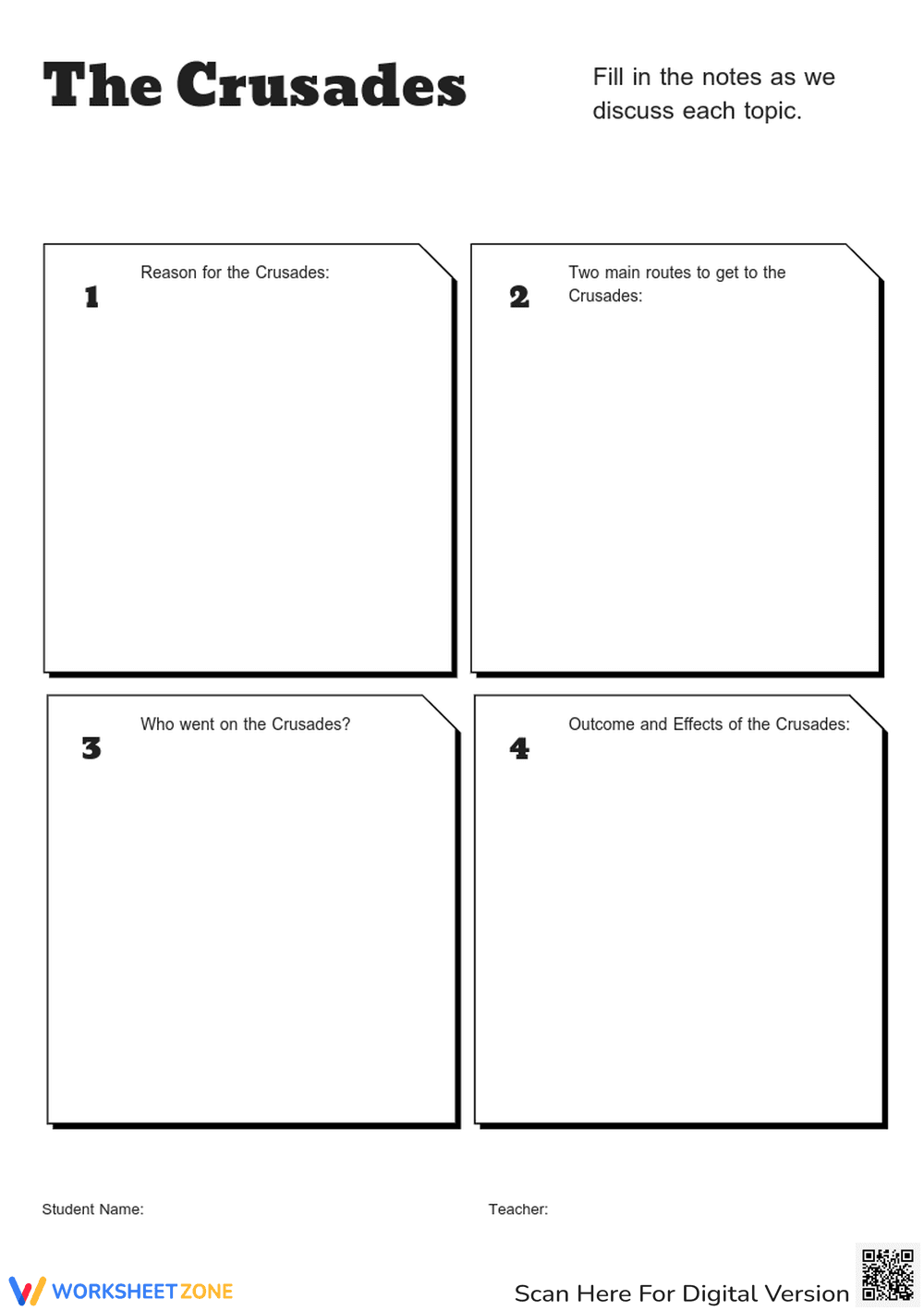
This Grade 6 Social Studies worksheet provides a structured framework for students to document key historical facts about the Crusades. By organizing information into four distinct categories, students develop a clearer understanding of the motivations, logistics, and long-term consequences of these medieval conflicts. It ensures students capture essential details during lectures or independent reading.
At a Glance
- Grade: 6 · Subject: Social Studies
- Standard:
CCSS.ELA-LITERACY.RH.6-8.2— Determine the central ideas or information of a primary or secondary source- Skill Focus: Historical Note-Taking
- Format: 1 page · 4 sections · No answer key · PDF
- Best For: Lecture support and guided reading
- Time: 20–30 minutes
The worksheet features a clean, four-quadrant graphic organizer designed to minimize visual distraction. Each box is clearly labeled with a specific inquiry: the reasons for the Crusades, the main travel routes, the participants involved, and the eventual outcomes. This single-page PDF is optimized for black-and-white printing, making it an efficient resource for high-volume classroom use.
The zero-prep workflow for this resource is designed for maximum efficiency. First, print the single-page PDF (30 seconds). Second, distribute the sheets to students as they begin a unit on the Middle Ages (1 minute). Third, review the completed notes during a whole-class wrap-up to ensure accuracy (5 minutes). This structure makes it an ideal choice for emergency sub plans or sudden schedule changes.
This resource aligns with CCSS.ELA-LITERACY.RH.6-8.2, which requires students to determine the central ideas or information of a secondary source. By categorizing information into reasons, routes, and effects, students practice identifying key details within a historical narrative. This standard code can be copied directly into lesson plans, IEP goals, or district curriculum mapping tools.
Use this worksheet as a guided note-taking tool during a direct instruction lecture on the Middle Ages. As you discuss each topic, prompt students to summarize the information in the corresponding box. Alternatively, use it as a formative assessment after students watch a short documentary or read a textbook chapter to check for comprehension of the core historical concepts.
This worksheet is designed for Grade 6 students but is appropriate for middle school learners in Grades 7 and 8 who require scaffolding for historical analysis. It is particularly effective for English Language Learners (ELLs) who benefit from the clear, segmented layout. Pair this resource with a map of the Mediterranean or a timeline of the Crusades for a comprehensive lesson.
Research by Fisher & Frey (2014) emphasizes that structured note-taking is a critical component of the gradual release of responsibility model, helping students transition from teacher-led instruction to independent mastery of complex historical texts. This worksheet facilitates that transition by providing a clear organizational schema for the Crusades, a topic often overwhelming due to its chronological and geographical breadth. By focusing on CCSS.ELA-LITERACY.RH.6-8.2, the resource ensures students are not just recording facts but are identifying the central ideas regarding the motivations and outcomes of the medieval period. According to the RAND AIRS 2024 report, graphic organizers significantly improve retention in social studies by reducing cognitive load during the initial acquisition of information. This printable guide serves as a reliable scaffold for Grade 6 students to build a foundational understanding of world history, ensuring they can accurately describe the reasons, routes, and participants of the Crusades in a concise, one-page format.


