




























Views
Downloads

Printable Fahrenheit to Celsius Conversion | Math Worksheet

Paste this activity's link or code into your existing LMS (Google Classroom, Canvas, Teams, Schoology, Moodle, etc.).
Students can open and work on the activity right away, with no student login required.
You'll still be able to track student progress and results from your teacher account.
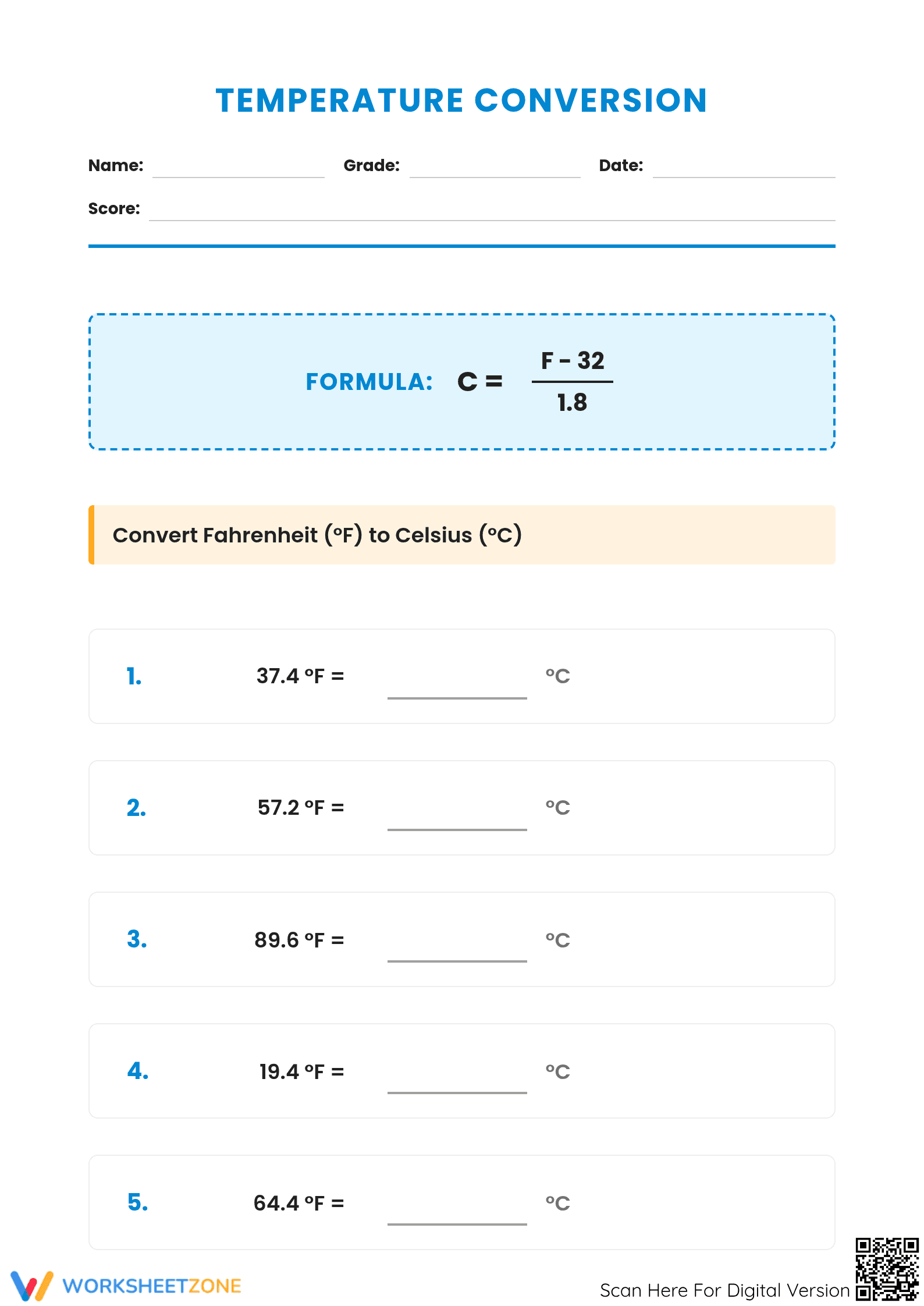
This essential temperature conversion worksheet helps students master the transition from Fahrenheit to Celsius using a standardized mathematical formula. By completing 16 targeted problems, learners build fluency in decimal division and subtraction while gaining a practical understanding of thermal measurement. It is an ideal resource for upper elementary and middle school classrooms focused on measurement systems.
At a Glance
- Grade: 5–7 · Subject: Math · Measurement
- Standard:
CCSS.MATH.CONTENT.5.MD.A.1— Convert measurement units within a given measurement system- Skill Focus: Fahrenheit to Celsius Conversion
- Format: 3 pages · 16 problems · Answer key included · PDF
- Best For: Independent practice or math centers
- Time: 20–30 minutes
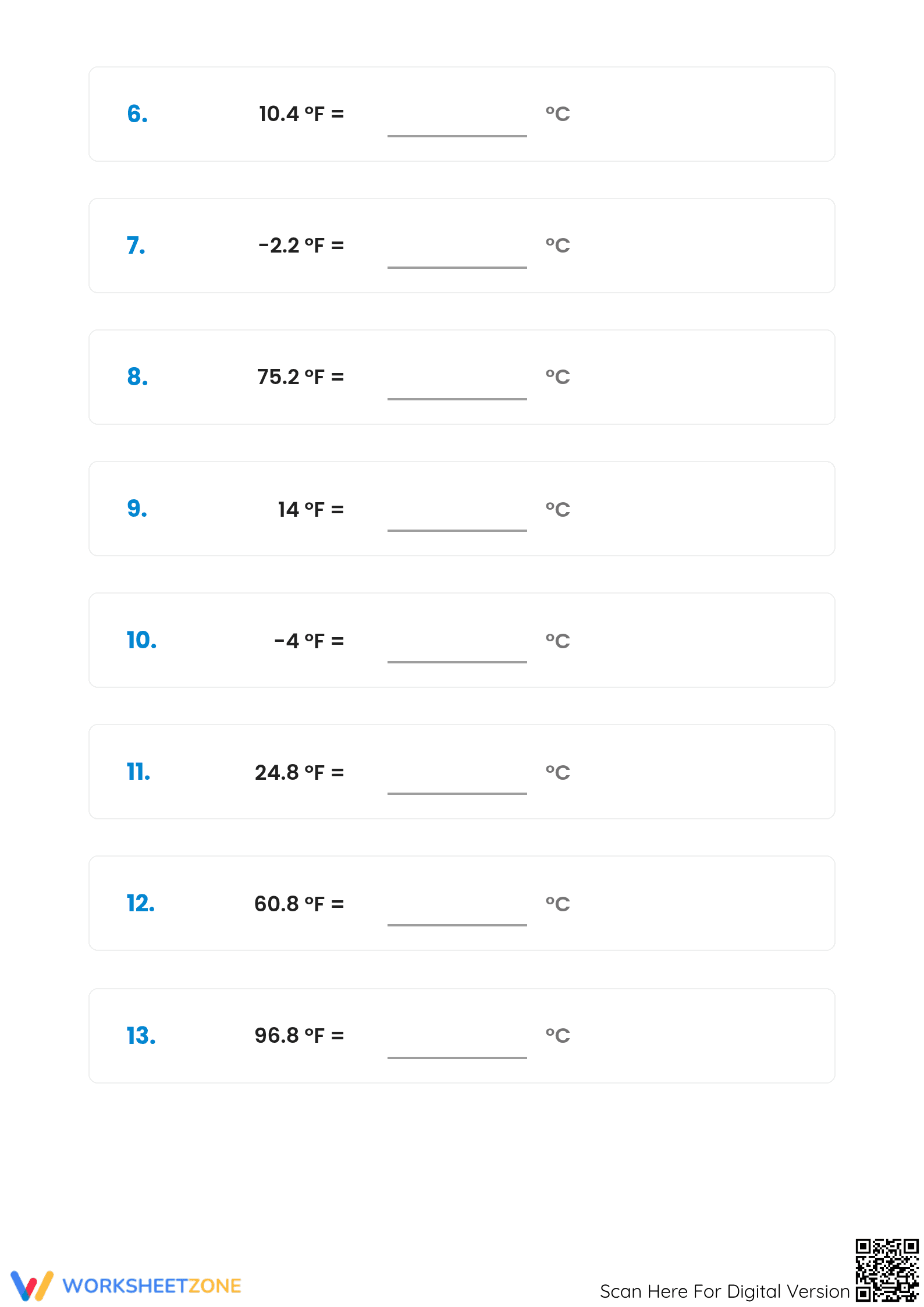
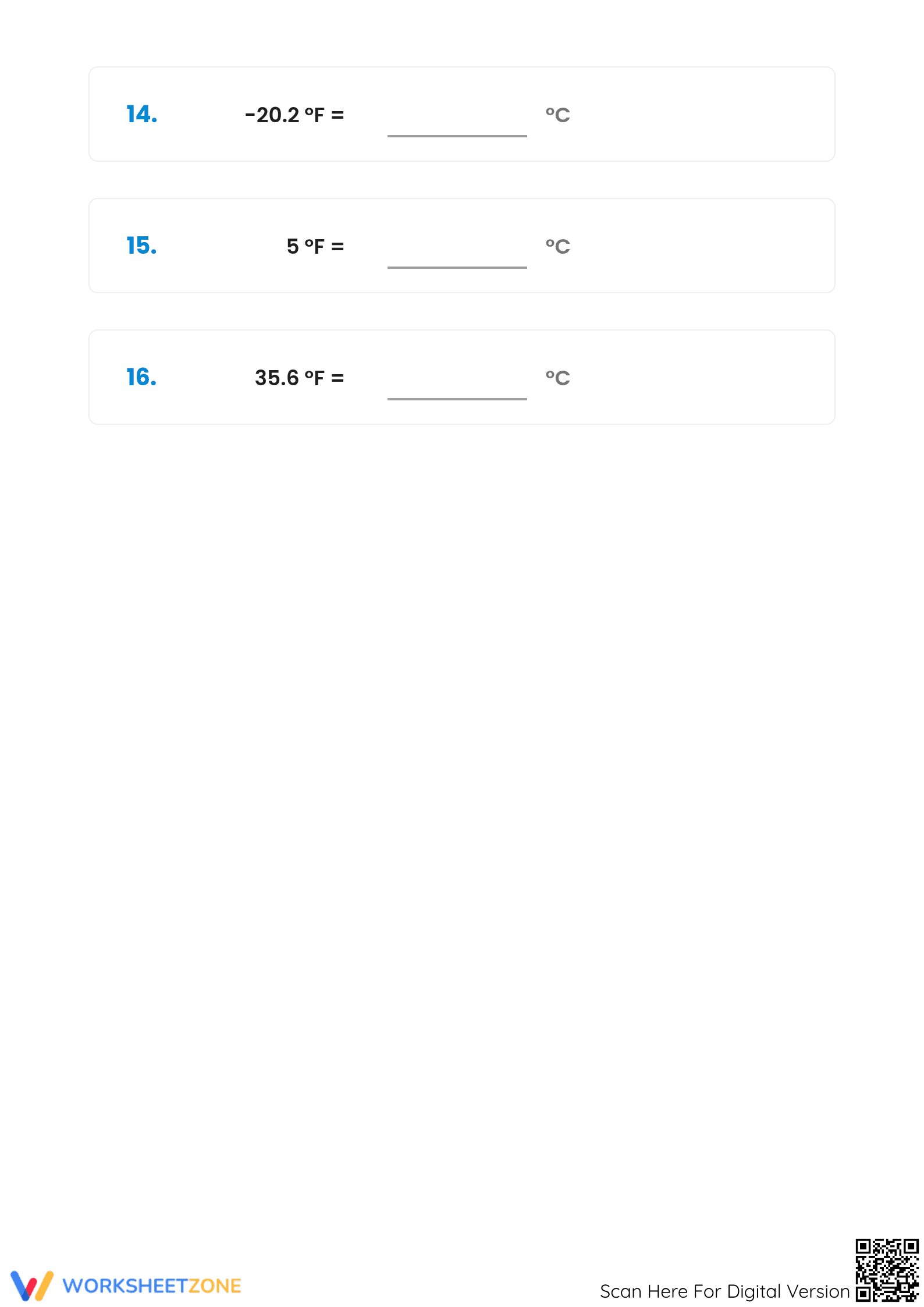
This three-page PDF includes a clear, boxed formula at the top of the first page to guide student work: C = (F - 32) / 1.8. The worksheet contains 16 unique conversion problems, ranging from positive integers to negative values, providing a comprehensive challenge. The layout offers ample white space for calculations, and a complete answer key is provided to facilitate quick grading or student self-correction.
Zero-Prep Workflow
The zero-prep workflow is built for teacher efficiency. First, print the three-page document (30 seconds). Second, distribute the worksheets, pointing out the formula at the top (1 minute). Third, review the answers using the included key or have students self-assess (5 minutes). This process ensures that instructional time is prioritized over preparation.
Standards Alignment
Primary alignment is with CCSS.MATH.CONTENT.5.MD.A.1, which requires students to convert among different-sized standard measurement units within a given system. This worksheet extends that logic to temperature, requiring precise calculation and application of algebraic rules. Both standard codes can be copied directly into lesson plans, IEP goals, or district curriculum mapping tools.
How to Use It
Use this worksheet as a direct follow-up to a lesson on measurement systems or as a supplemental activity during a science unit on weather. It serves as an excellent formative assessment; teachers should observe if students are correctly applying the order of operations within the formula. The estimated completion time is 25 minutes, making it perfect for a "bell-ringer" or exit ticket activity.
Who It's For
This resource is designed for students in grades 4 through 7 who are developing their measurement and decimal computation skills. It is particularly helpful for learners who require a structured guide, as the formula is always visible. Pair this worksheet with a physical thermometer or a digital weather app lesson to provide real-world context for the conversions.
The transition between measurement systems is a critical milestone in numerical literacy, requiring students to bridge abstract formulas with physical properties. According to RAND AIRS 2024, structured worksheets providing visible formulas reduce cognitive load, allowing students to focus on the procedural accuracy of decimal computation. This worksheet aligns with standard CCSS.MATH.CONTENT.5.MD.A.1 by requiring students to convert thermal units within a measurement system. The inclusion of 16 distinct problems ensures enough repetition to move the skill from short-term memory to long-term procedural fluency. Educators can rely on this tool to provide high-quality, standards-aligned practice that meets the rigorous demands of middle-grade mathematics while maintaining a user-friendly format. This systematic approach to measurement conversion is essential for success in higher-level science and mathematics courses.


