Temperature Conversion Printable Worksheets for 7th Grade
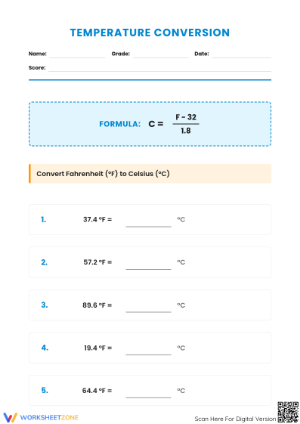
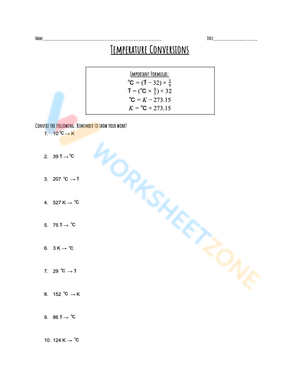
These temperature conversion printable worksheets for 7th grade give teachers a ready-to-use entry into one of middle school's more procedurally demanding measurement topics. Each worksheet covers converting between Celsius and Fahrenheit using both core formulas — C = (F − 32) × 5/9 and F = (C × 9/5) + 32 — through direct conversion problems, table completion exercises, and word problems grounded in weather, cooking, and travel. Answer keys are included so teachers can use these in stations, assign them for homework, or pull them for quick small-group review without extra setup.
The Specific Skills Targeted
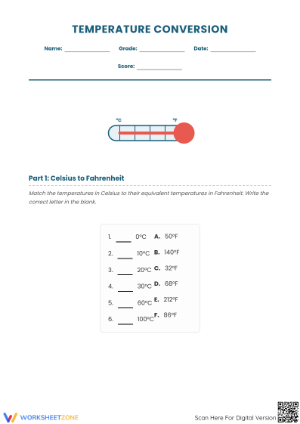
The surface topic is unit conversion, but the math students actually practice runs wider than that. Substituting a temperature value into a formula, tracking order of operations across multiple steps, and deciding which formula applies before writing the first number — these habits matter across 7th grade math, not just in measurement units. Students who move through the set also encounter benchmark relationships that help them self-check: 0°C equals 32°F, 100°C equals 212°F, and body temperature sits at roughly 37°C or 98.6°F. Recognizing those anchors tells a student immediately when something has gone wrong in a calculation.
Problem types across the worksheets progress deliberately. Some worksheets ask students to complete a conversion table — filling in Celsius values for a column of Fahrenheit readings — which builds fluency with the mechanics before context enters the picture. Others place the same operations inside a weather scenario or a cooking question, requiring students to first identify what they're converting and in which direction. That shift from procedural to applied is where many students stall, and the set addresses it directly.
Mistakes Students Make That These Worksheets Help You Catch
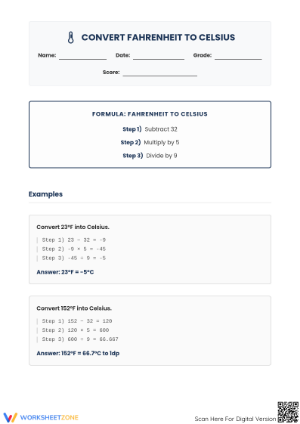
The two formulas produce a narrow set of predictable errors. The most common is the order-of-operations mistake when converting Fahrenheit to Celsius: students multiply by 5/9 before subtracting 32, rather than subtracting first. A student converting 77°F will write (77 × 5/9) − 32 instead of (77 − 32) × 5/9, arriving at 10.8 instead of the correct 25°C. They've used the right numbers and the right fraction — the parentheses are simply gone.
A second consistent error is fraction reversal. When the Celsius-to-Fahrenheit formula calls for multiplying by 9/5, students who feel less confident with fractions will reach for 5/9 because they've seen it more recently. Several worksheets include a "find the error" problem where a worked example shows exactly this mistake, prompting students to explain what went wrong rather than just solve another problem. That task catches students who can execute a procedure correctly but can't yet articulate why each step is necessary.
- Dropping the °C or °F unit from the final answer — a small habit that becomes a real issue when word problems ask students to compare two temperatures
- Rounding intermediate values before completing the calculation, which compounds the error by the final step
- Forgetting to add 32 at the end of a Celsius-to-Fahrenheit conversion — students complete the multiplication and stop
- Applying the Fahrenheit-to-Celsius formula when starting from a Celsius value, because they misread which quantity is given
How to Work These Worksheets Into Your Lesson Plans
The clearest entry point is direct instruction followed by paired practice on a formula-reference worksheet. Show one full Celsius-to-Fahrenheit conversion on the board — annotating each step aloud — then have students complete the matching Fahrenheit-to-Celsius example independently while you circulate. That sequence takes about 12 minutes and tells you immediately which students need a slower pace before moving to independent work.
For station rotations, three stations work cleanly: one group handles direct conversion drills, a second group fills in conversion tables and checks their answers against known anchor values, and a third group works through a word-problem worksheet involving weather or travel contexts. The rotation keeps all students moving through the same skill at different depths. The word-problem station typically takes longer than teachers expect — budget an extra 3 to 4 minutes for students who are also deciding which formula applies before they write anything down. Temperature conversion printable worksheets for 7th grade also fit naturally into Friday spiral review blocks, since the topic requires just enough mental effort to stay meaningful without dominating the period.
Standard Alignment
Temperature conversion sits within 7th grade standards under the expressions and equations domain. CCSS 7.EE.B.3 — solving real-life and mathematical problems using numerical and algebraic expressions — applies directly here, since each conversion requires substituting a value into a formula and simplifying using order of operations. Some teachers also connect the work to 7.RP.A (ratios and proportional relationships), particularly when discussing why Celsius and Fahrenheit don't share a purely proportional relationship due to the +32 shift. That nuance is worth a few minutes of class discussion: students who ask why they can't just multiply by a single ratio the way they do in other unit conversions are noticing something mathematically real, and the set gives teachers a natural moment to address it.
Adjusting the Worksheets for a Range of Learners
For students who are still unsteady with fraction multiplication, keeping the formula box visible on the worksheet and restricting starting values to multiples of 5 reduces the cognitive load to one challenge at a time: applying the formula correctly. Once those students can move through direct conversions with whole-number answers without stalling, introducing decimals or negative temperatures raises the difficulty without changing the underlying skill. Temperature conversion printable worksheets for 7th grade work especially well for tiered practice because the formula stays constant — only the numbers and context shift.
Students who finish early respond well to tasks that flip the question: instead of "convert 25°C to Fahrenheit," the worksheet asks "A city reports 104°F — show whether that is above or below 40°C." That requires choosing the formula, executing the conversion, and interpreting the result — three distinct moves that reveal genuine understanding rather than formula fluency alone. A few worksheets in the set include problems structured exactly this way.
Frequently Asked Questions
Do these worksheets include formula reference boxes, or are students expected to have the formulas memorized?
Each worksheet that introduces or practices the core conversions includes a formula reference box at the top. The reasoning is straightforward: early in the unit, cognitive load is already high from managing order of operations and fraction multiplication. Asking students to simultaneously retrieve formulas from memory adds a burden that slows learning without testing the skill these worksheets target. Students who work through the set repeatedly tend to internalize the formulas through repeated exposure anyway.
What number types do students encounter across the set?
The set moves from whole numbers to decimals and then to negative values. Early worksheets use temperatures like 20°C and 68°F, which produce clean answers. Later worksheets introduce values like −15°C or 98.6°F, which require more careful arithmetic and give teachers a clear read on which students are ready for multi-step challenge problems.
Can these worksheets function as a formative assessment during the unit?
Several worksheets are short enough to serve as exit tickets — three to five problems covering both conversion directions. For a more complete mid-unit check, the mixed word-problem worksheets show whether students can identify which formula to use in context, not just execute the steps when the direction is stated explicitly. That distinction matters for separating genuine understanding from procedural mimicry.
Are these useful for review before a unit test?
The mixed-format worksheets — combining direct conversions, table completion, and one or two context problems — work well as pre-test review. Teachers who use temperature conversion printable worksheets for 7th grade in the class period before an assessment give students a representative sample of what the test will ask, including the decision point of choosing the correct formula before solving.
Clear All