


























Views
Downloads
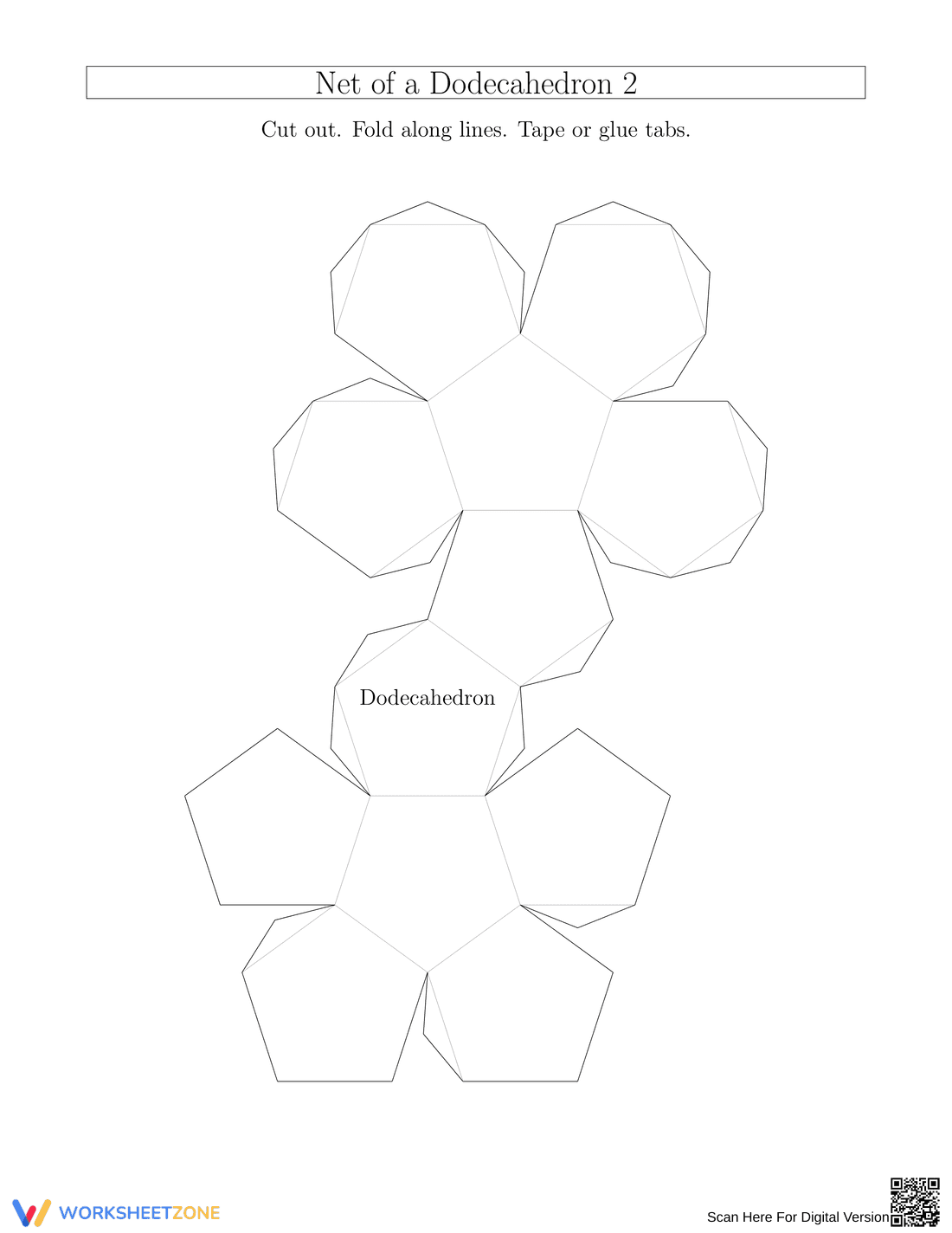

Printable Net of a Dodecahedron Geometry Worksheet
Paste this activity's link or code into your existing LMS (Google Classroom, Canvas, Teams, Schoology, Moodle, etc.).
Students can open and work on the activity right away, with no student login required.
You'll still be able to track student progress and results from your teacher account.
This printable geometry worksheet helps middle and high school students master spatial reasoning by constructing a three-dimensional dodecahedron from a flat two-dimensional net. Students actively engage with polyhedral geometry by cutting, folding, and assembling the shape, transforming abstract geometric concepts into a tangible, hands-on learning experience that reinforces spatial visualization skills.
At a Glance
- Grade: Grade 6, Grade 7, Grade 8, Grade 9 · Subject: Geometry
- Standard:
CCSS.MATH.CONTENT.6.G.A.4— Represent three-dimensional figures using nets to understand surface area and structure.- Skill Focus: Spatial reasoning and polyhedral construction
- Format: 1 page · 1 hands-on project · Visual template · PDF
- Best For: Geometry interactive notebooks or tactile math lessons
- Time: 15–25 minutes
This single-page PDF features a clean, high-resolution printable template of a regular dodecahedron net, composed of 12 congruent regular pentagons. The layout includes integrated folding tabs specifically designed for easy taping or gluing. Clear, concise instructions are printed directly at the top of the page, guiding students to cut out the perimeter, fold along the interior lines, and secure the tabs to form the final 3D solid.
The zero-prep workflow makes this activity exceptionally easy to integrate into any lesson plan. First, print the single-page template for your class, which takes less than 1 minute. Next, distribute the sheets along with scissors and glue or tape, requiring zero teacher setup. Finally, review the completed 3D models as a group to assess structural understanding. Total teacher preparation time is under 2 minutes, making this an ideal emergency sub plan or tactile geometry lab.
This activity aligns directly with `CCSS.MATH.CONTENT.6.G.A.4`, which requires students to represent three-dimensional figures using nets made up of polygons and use them to analyze geometric properties. It also supports high school geometry standards regarding the visualization of relationships between two-dimensional and three-dimensional objects. Both standard codes can be copied directly into lesson plans, IEP goals, or district curriculum mapping tools.
Use this worksheet during direct instruction on polyhedra or as a post-lesson formative assessment. Introduce the concept of regular solids, then have students assemble the net to discover how many faces, edges, and vertices a dodecahedron possesses. During the activity, observe how accurately students match the edges; difficulty aligning the pentagons often reveals gaps in spatial visualization. Expect a completion time of 15 to 25 minutes.
This resource is designed for students in grades 6 through 9 who are exploring spatial geometry, surface area, or Platonic solids. It provides excellent tactile differentiation for kinesthetic learners who struggle with abstract 2D drawings of 3D shapes. Pair this template naturally with a guided lesson on Euler's formula or a reference anchor chart detailing the properties of regular polyhedra.
Spatial reasoning and tactile manipulation of geometric nets are critical components of secondary mathematics education. According to research highlighted in the NAEP framework, hands-on construction of three-dimensional models from two-dimensional representations significantly improves structural visualization and geometric comprehension across diverse student populations. By physically folding the twelve pentagonal faces of this net, learners bridge the gap between abstract mathematical theory and concrete physical reality. This active learning methodology aligns with the CCSS.MATH.CONTENT.6.G.A.4 standard, ensuring that students develop a robust, intuitive grasp of spatial orientation and polyhedral characteristics. Utilizing verified physical templates reduces cognitive load during assembly, allowing students to focus entirely on the mathematical relationships governing regular solids, making it a highly effective tool for middle and high school geometry classrooms.


