




























Views
Downloads

Printable Missing Sides of Rectangular Prism Worksheet

Paste this activity's link or code into your existing LMS (Google Classroom, Canvas, Teams, Schoology, Moodle, etc.).
Students can open and work on the activity right away, with no student login required.
You'll still be able to track student progress and results from your teacher account.
Master the relationship between surface area and geometry with this comprehensive workbook. Students apply the surface area formula to calculate missing side lengths of rectangular prisms. By isolating variables, learners develop a deep conceptual understanding of 3D spatial measurements and mathematical problem-solving across various units of measure.
At a Glance
- Grade: 6-9 · Subject: Geometry & Math
- Standard:
CCSS.MATH.CONTENT.7.G.B.6— Solve real-world and mathematical problems involving surface area of 3D objects- Skill Focus: Calculating missing dimensions using surface area
- Format: 4 pages · 16 problems · Answer key included · PDF
- Best For: Geometry unit practice and formative assessment
- Time: 45–60 minutes
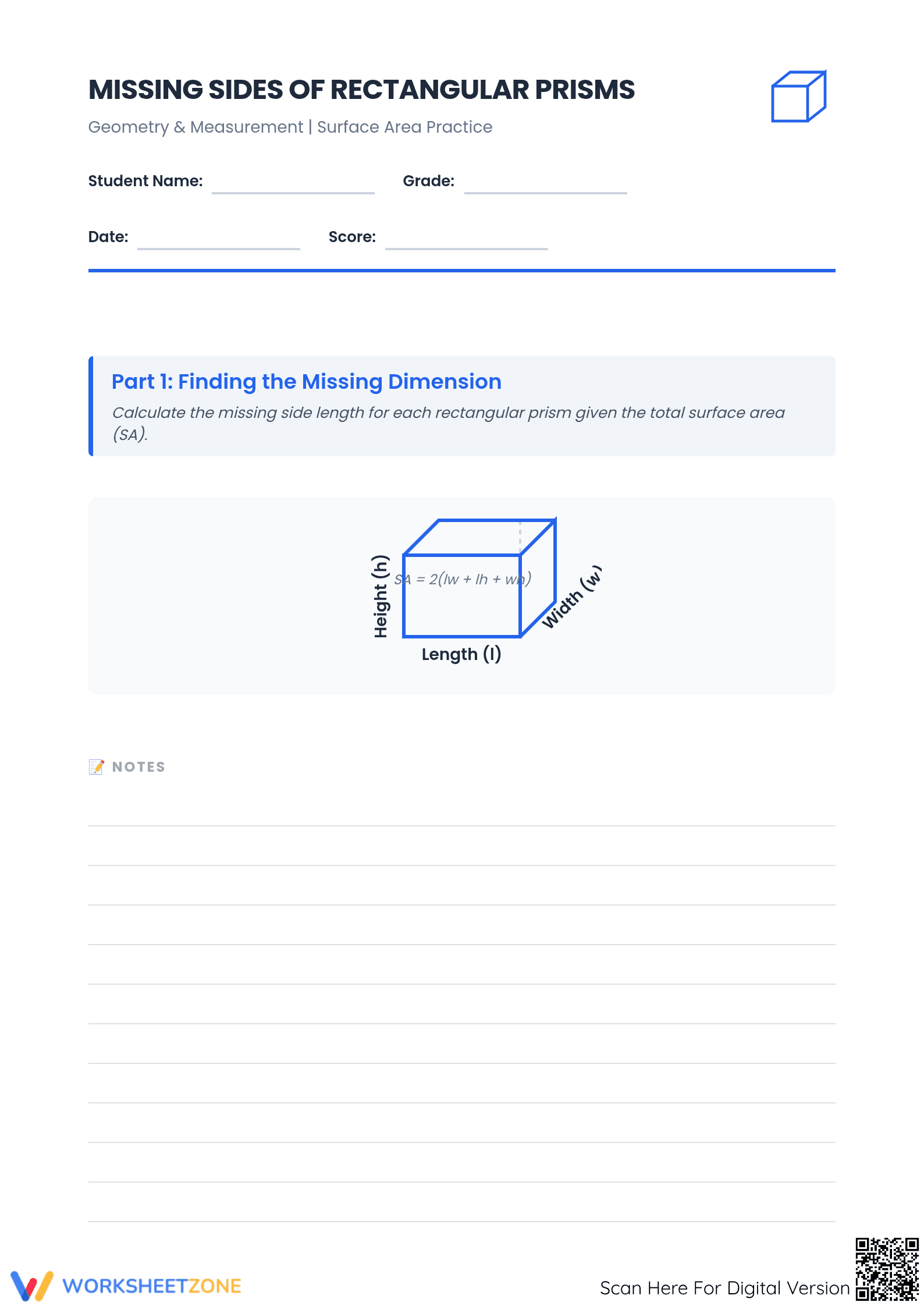
This resource provides sixteen rigorous problems organized into distinct segments. It includes a notes section, a clear formula diagram for reference, and an exhaustive answer key. The worksheet transitions from basic variable isolation to advanced multi-unit practice and concludes with complex real-world word problems and a cube-based challenge.
Skill Progression
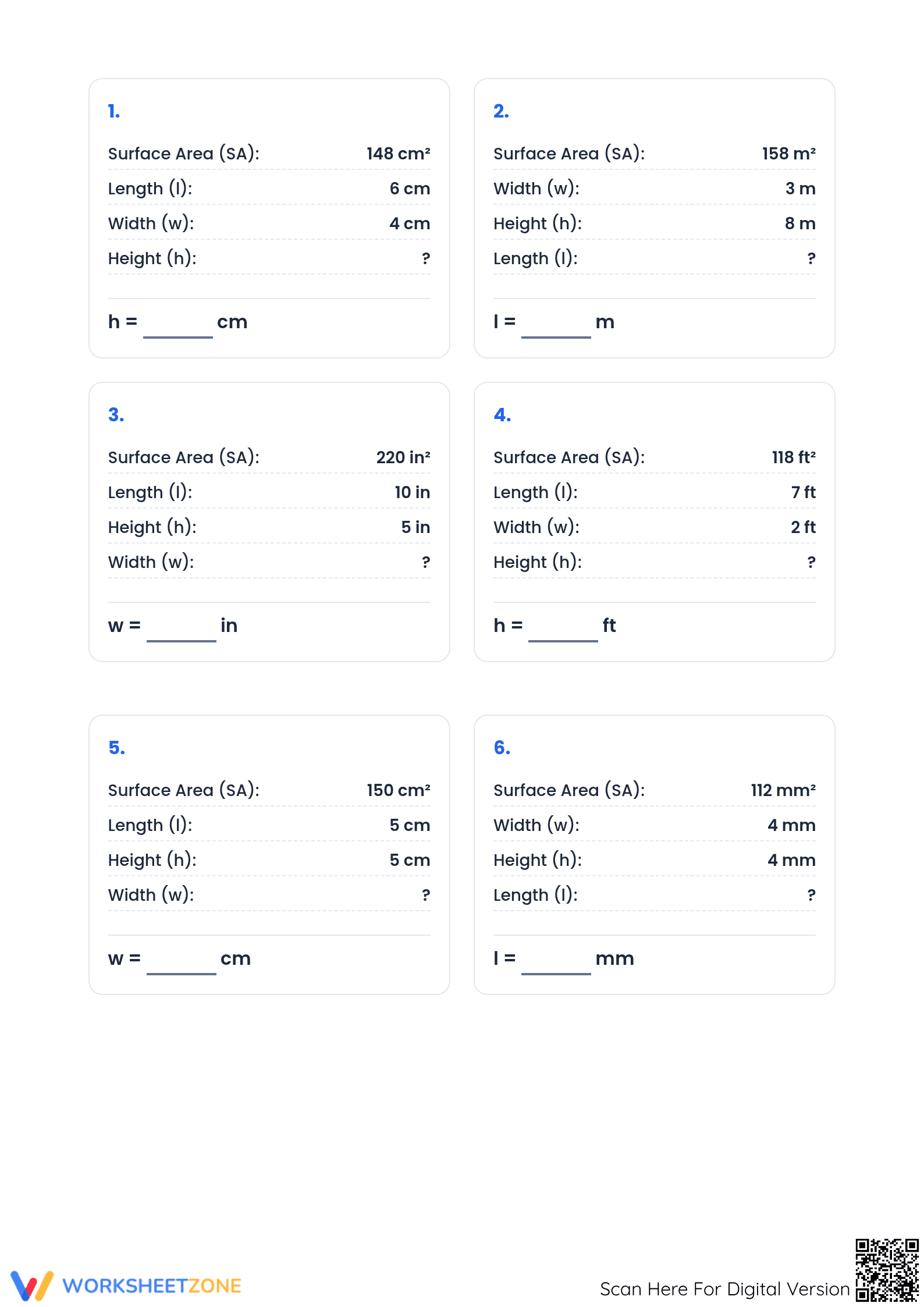
- Guided practice: Part one features six problems where students use surface area and two dimensions to find the missing height, width, or length.
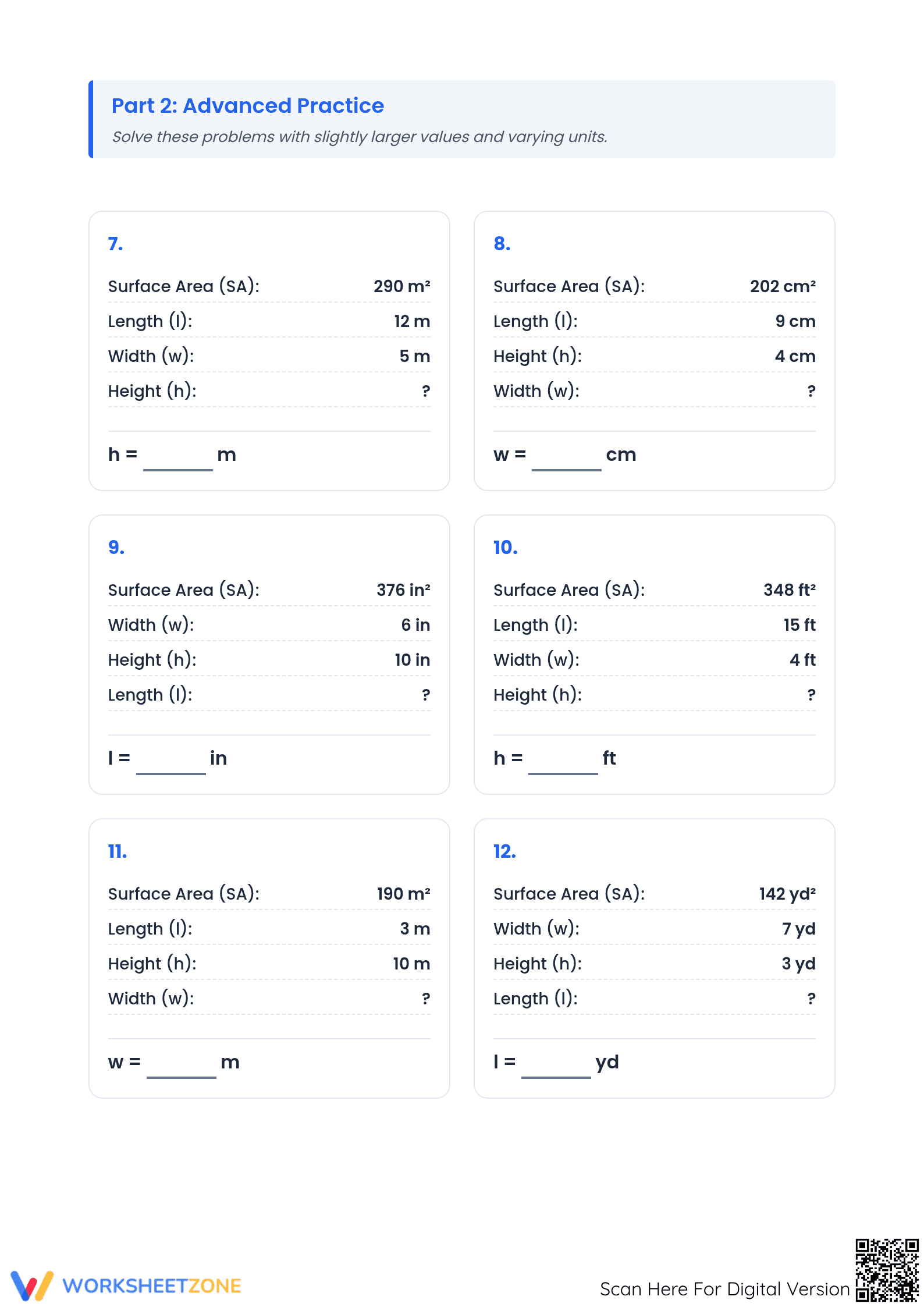
- Supported practice: The advanced section increases complexity with larger values and varying units (meters, inches, feet, yards), requiring precision across different measurement systems.
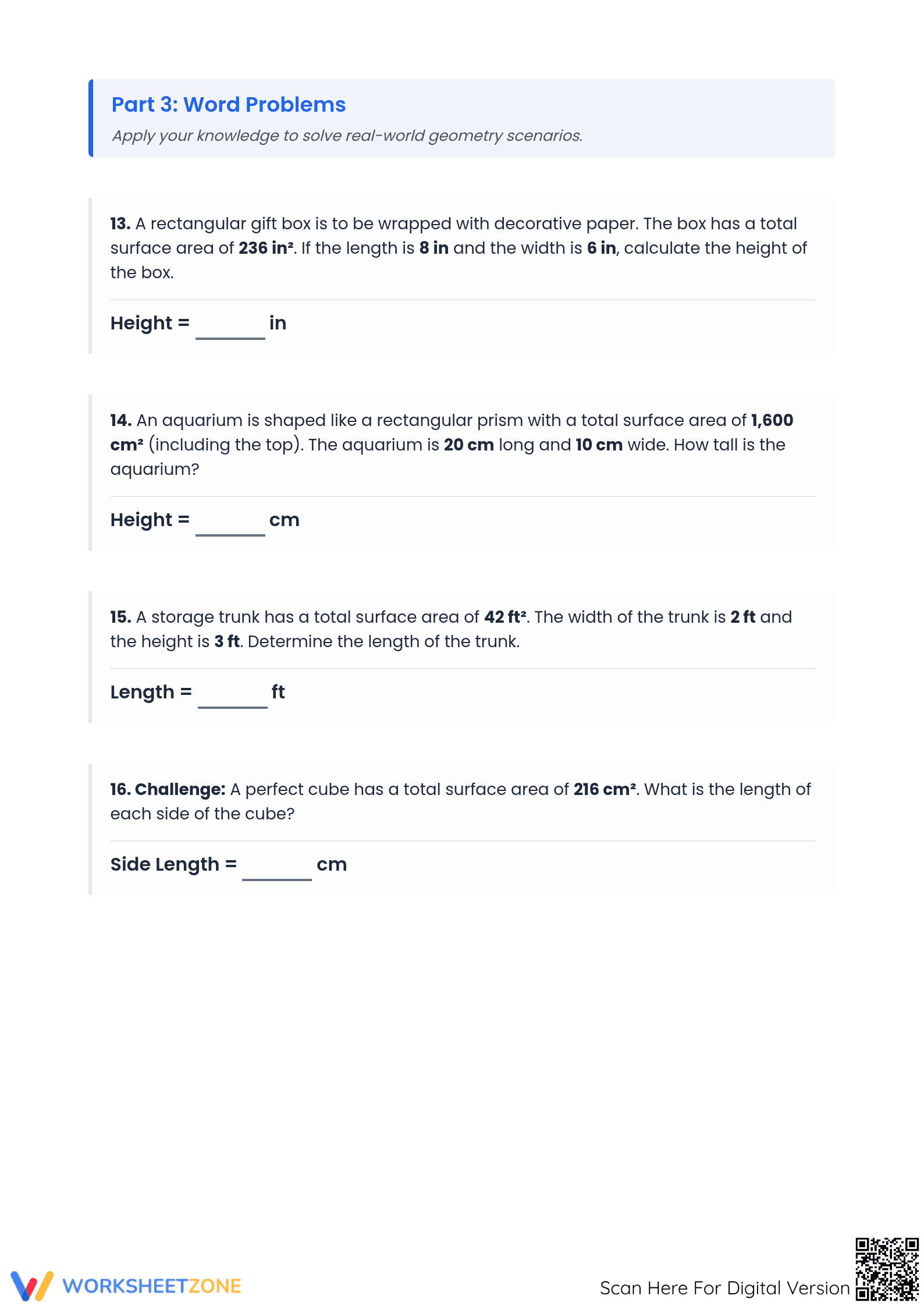
- Independent practice: Four word problems challenge students to translate scenarios into equations, including a challenge focused on side lengths for a perfect cube.
The resource follows a gradual-release model, moving from formulaic drills to abstract problem-solving.
Standards Alignment
This worksheet focuses on CCSS.MATH.CONTENT.7.G.B.6, solving real-world and mathematical problems involving surface area of three-dimensional objects. By finding missing sides from known surface areas, students also strengthen their understanding of CCSS.MATH.CONTENT.6.G.A.4. Both standard codes can be copied directly into lesson plans, IEP goals, or district curriculum mapping tools.
How to Use It
Use this worksheet after students master calculating total surface area. It serves as an excellent tool for formative assessment; observe how students handle the formula 2(lw + lh + wh) to identify algebraic errors early. Expected completion time is 45 to 60 minutes, whether word problems are used as a whole-class extension or independent work.
Who It's For
This resource is designed for Grades 6-9 students developing spatial reasoning and algebraic skills. It provides necessary scaffolding for learners struggling with abstract geometry while offering rigorous challenges for advanced students. It pairs naturally with an interactive 3D prism passage or a direct instruction lesson on solving multi-step equations.
According to a RAND AIRS 2024 study on middle school mathematics, the ability to manipulate geometric formulas is a critical predictor of success in high school algebra. This worksheet directly addresses this by requiring students to work backward from a surface area total to identify missing dimensions, a task that reinforces both spatial reasoning and the properties of operations. By integrating standard calculation drills with complex word problems, the resource ensures that students move beyond rote memorization toward conceptual mastery. Research from ScienceDirect TpT Analysis suggests that multi-page structured practice helps reduce cognitive load by organizing tasks from simple to complex. This resource aligns with CCSS.MATH.CONTENT.7.G.B.6, providing students with the necessary repetitions to internalize the relationship between a prism's dimensions and its total surface area. These sixteen problems provide measurable evidence of student proficiency in three-dimensional geometric modeling and variable isolation techniques required for college and career readiness.


