




























Views
Downloads

Grade 7 Volume & Area — Printable No-Prep Worksheet

Paste this activity's link or code into your existing LMS (Google Classroom, Canvas, Teams, Schoology, Moodle, etc.).
Students can open and work on the activity right away, with no student login required.
You'll still be able to track student progress and results from your teacher account.
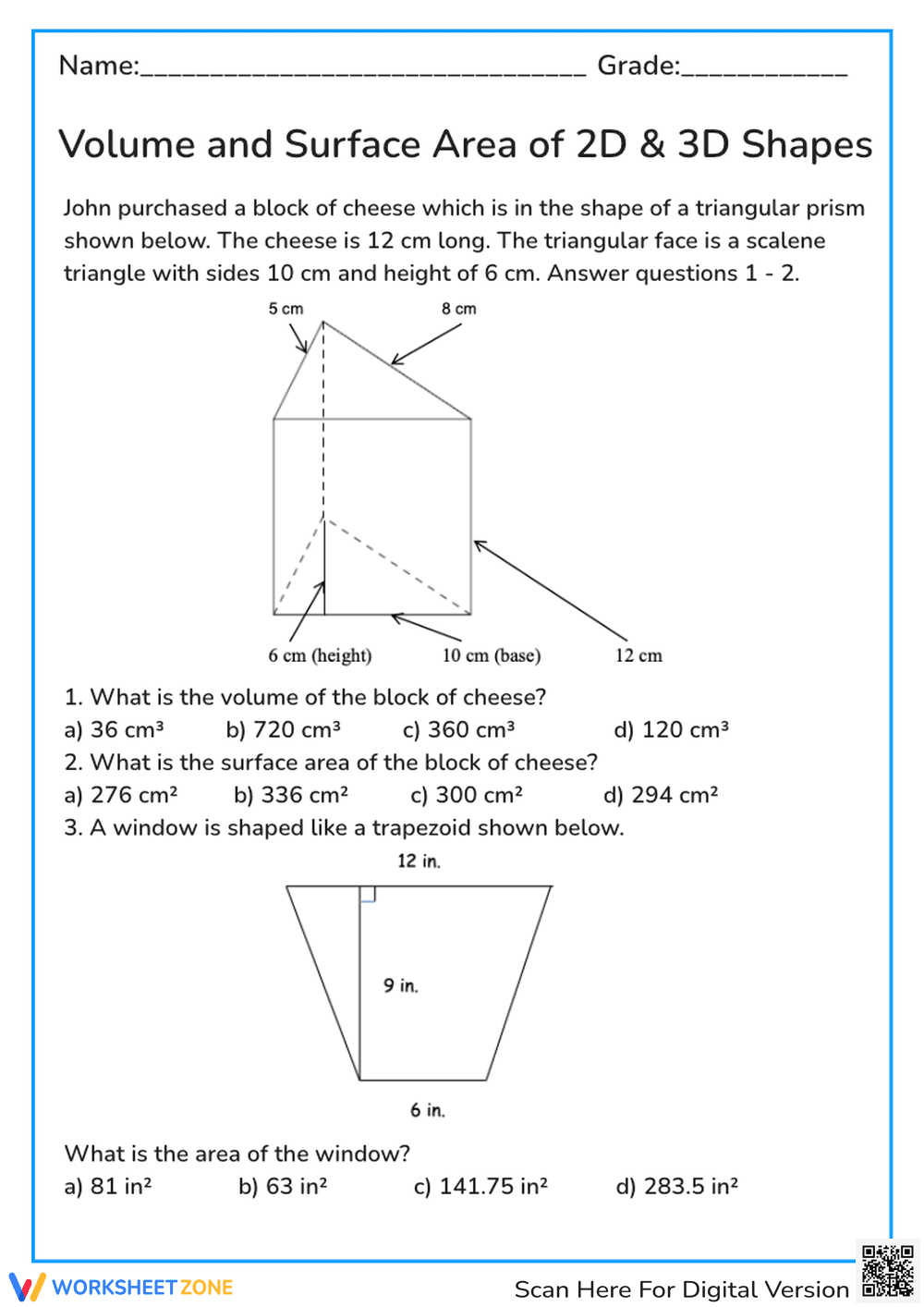
This Grade 7 math worksheet provides targeted practice on calculating the volume and surface area of 2D and 3D shapes. Students apply geometric formulas to real-world scenarios, including a triangular prism and a trapezoid, strengthening their spatial reasoning and problem-solving skills for middle school geometry.
At a Glance
- Grade: 7 · Subject: Math
- Standard:
CCSS.MATH.CONTENT.7.G.B.6— Solve real-world problems involving area, volume, and surface area- Skill Focus: Volume and surface area of prisms and trapezoids
- Format: 1 page · 3 problems · Answer key included · PDF
- Best For: Quick assessment or independent practice
- Time: 10–15 minutes
What's Inside
This single-page resource features three rigorous multiple-choice word problems. The first two questions require students to analyze a diagram of a triangular prism to determine its volume and surface area. The final question asks students to calculate the area of a trapezoidal window. A complete answer key is provided to ensure accurate grading and immediate feedback.
Zero-Prep Workflow
- Print (1 minute): Generate the PDF and print a class set directly from your computer.
- Distribute (1 minute): Hand out the single-page worksheet to students as they enter the room.
- Review (3 minutes): Use the included answer key to quickly check student responses or project it for self-grading.
Total teacher prep time is under two minutes. Because the instructions are clear and the diagrams are self-explanatory, this worksheet is an excellent option for emergency substitute teacher plans.
Standards Alignment
This resource is strictly aligned to CCSS.MATH.CONTENT.7.G.B.6: Solve real-world and mathematical problems involving area, volume and surface area of two- and three-dimensional objects composed of triangles, quadrilaterals, polygons, cubes, and right prisms. It specifically targets the application of these formulas to composite figures and real-life objects. Both standard codes can be copied directly into lesson plans, IEP goals, or district curriculum mapping tools.
How to Use It
Deploy this worksheet during independent practice after direct instruction on 3D geometry formulas. It serves as an effective exit ticket to gauge comprehension before moving on to more complex composite figures. Alternatively, use it as a warm-up activity the day after a lesson to reinforce retention. As a formative assessment tip, observe whether students correctly identify the base of the triangular prism versus the base of the triangular face. Expected completion time ranges from 10 to 15 minutes.
Who It's For
This worksheet is designed for Grade 7 math students mastering foundational geometry concepts. For students requiring accommodations, teachers can provide a reference sheet with the volume and area formulas. Advanced learners can be challenged to explain why incorrect multiple-choice options might have been generated by common calculation errors. Pair this resource with a hands-on lesson using physical 3D models to solidify spatial understanding.
Mastering the ability to solve real-world problems involving area, volume, and surface area is a critical milestone in middle school mathematics. Alignment with CCSS.MATH.CONTENT.7.G.B.6 ensures students are prepared for advanced high school geometry and practical spatial reasoning tasks. According to a 2024 report by EdReports, instructional materials that connect geometric formulas to tangible, real-world scenarios significantly improve long-term retention and conceptual understanding. When students calculate the dimensions of everyday objects like cheese blocks or windows, they bridge the gap between abstract mathematics and concrete reality. This targeted practice helps solidify the cognitive pathways required for complex problem-solving. By integrating visual diagrams with rigorous multiple-choice word problems, educators can effectively measure student proficiency, track progress accurately, and identify specific misconceptions related to formula application and spatial analysis.


