




























Views
Downloads
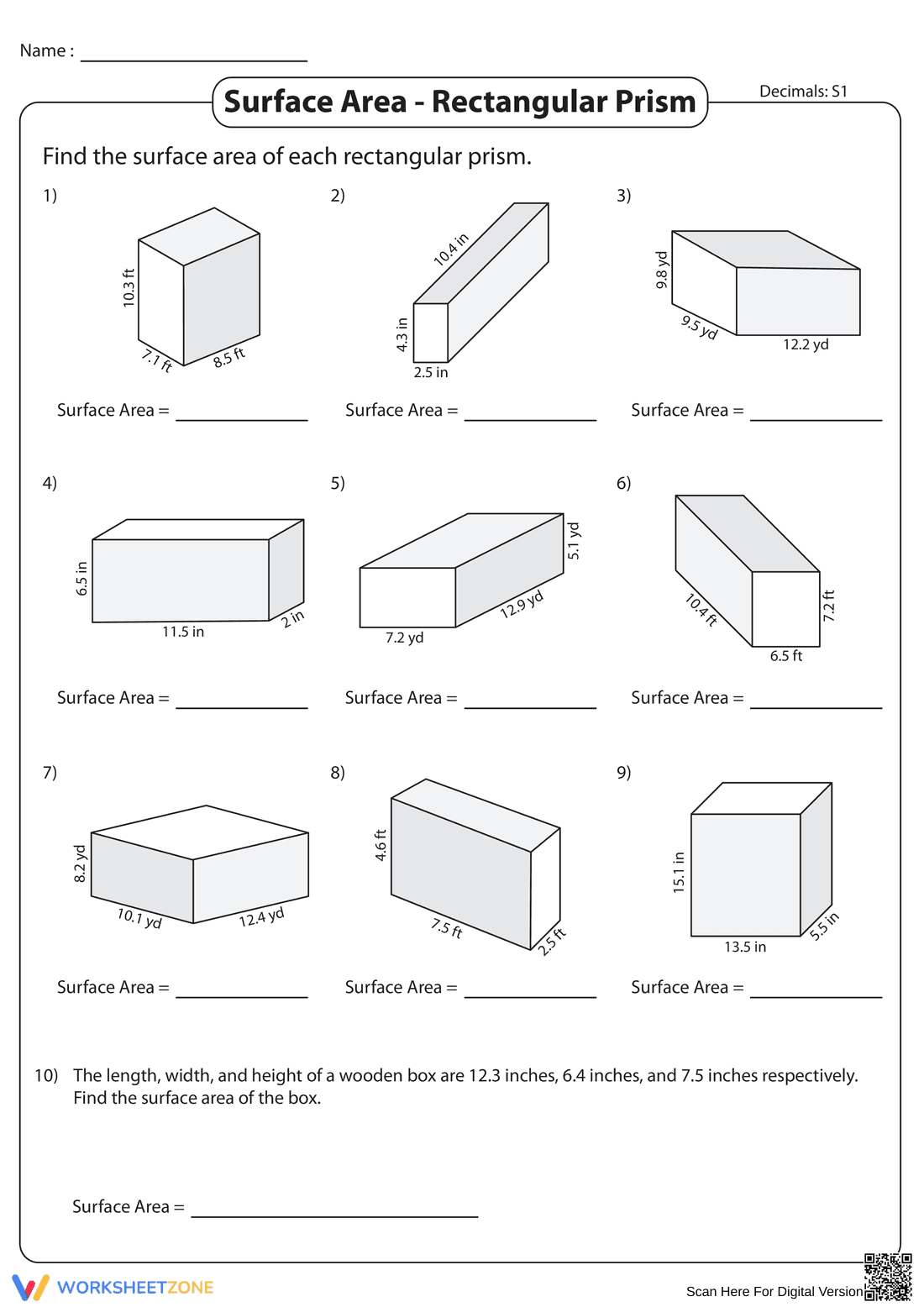

Printable Surface Area of Rectangular Prisms Worksheet

Paste this activity's link or code into your existing LMS (Google Classroom, Canvas, Teams, Schoology, Moodle, etc.).
Students can open and work on the activity right away, with no student login required.
You'll still be able to track student progress and results from your teacher account.
This printable geometry worksheet provides structured practice for students calculating the surface area of rectangular prisms with decimal dimensions. Students apply formulas to nine distinct diagrams and one word problem, mastering essential spatial reasoning and decimal computation skills.
At a Glance
- Grade: Grade 7 · Subject: Geometry
- Standard:
CCSS.MATH.CONTENT.7.G.B.6— Solve real-world and mathematical problems involving surface area of right prisms.- Skill Focus: Rectangular prism surface area with decimals
- Format: 2 pages · 10 problems · Answer key included · PDF
- Best For: Independent practice, homework, or quick quiz
- Time: 20–30 minutes
The PDF contains a single-page student sheet featuring 10 structured problems, accompanied by a complete answer key. The first nine problems present clear 3D illustrations of rectangular prisms with decimal measurements in customary units. Problem 10 challenges students with a real-world word problem involving a wooden box, requiring independent extraction of dimensions.
Zero-Prep Classroom Workflow
This resource minimizes preparation and maximizes instructional time through a simple three-step workflow:
- Print (1 minute): Print copies of the first page for your entire class.
- Distribute (1 minute): Hand out the worksheets as an independent desk activity or homework.
- Review (5 minutes): Use the included answer key for rapid grading or student self-correction.
With under 2 minutes of total teacher prep time, this worksheet serves as an excellent emergency sub plan.
Standards Alignment
This activity aligns directly with CCSS.MATH.CONTENT.7.G.B.6, which requires students to solve mathematical problems involving the surface area of right prisms. It also supports decimal arithmetic fluency. Both standard codes can be copied directly into lesson plans, IEP goals, or district curriculum mapping tools.
How to Use It
Deploy this worksheet during independent practice following direct instruction on surface area. As a formative assessment tip, check problems 1 through 3 to ensure students pair dimensions correctly before multiplying. Expect students to complete the entire 10-problem set within 20 to 30 minutes, depending on their decimal calculation proficiency.
Who It's For
This worksheet is ideal for seventh-grade math students, eighth-grade review, or advanced sixth-grade learners. It provides targeted practice for students who understand surface area concepts but need computational stamina with decimals. Pair this resource naturally with a geometric anchor chart or a direct instruction lesson.
According to rigorous curriculum evaluations conducted by EdReports 2024, providing students with structured, single-page problem sets that blend visual models with word problems significantly enhances procedural fluency in middle school geometry. This worksheet directly targets the core demands of standard CCSS.MATH.CONTENT.7.G.B.6 by requiring students to systematically calculate the surface area of right prisms using realistic decimal dimensions. Research indicates that balancing geometric visualization with precise arithmetic computation helps bridge the gap between abstract formulas and real-world spatial applications. By embedding customary units such as inches, feet, and yards across 10 distinct tasks, this resource ensures students develop the mathematical stamina required for high-stakes assessments. Teachers can confidently integrate this high-quality, print-ready tool into daily lessons, knowing it aligns with evidence-based practices for mathematical mastery and independent skill reinforcement.


