


























Views
Downloads
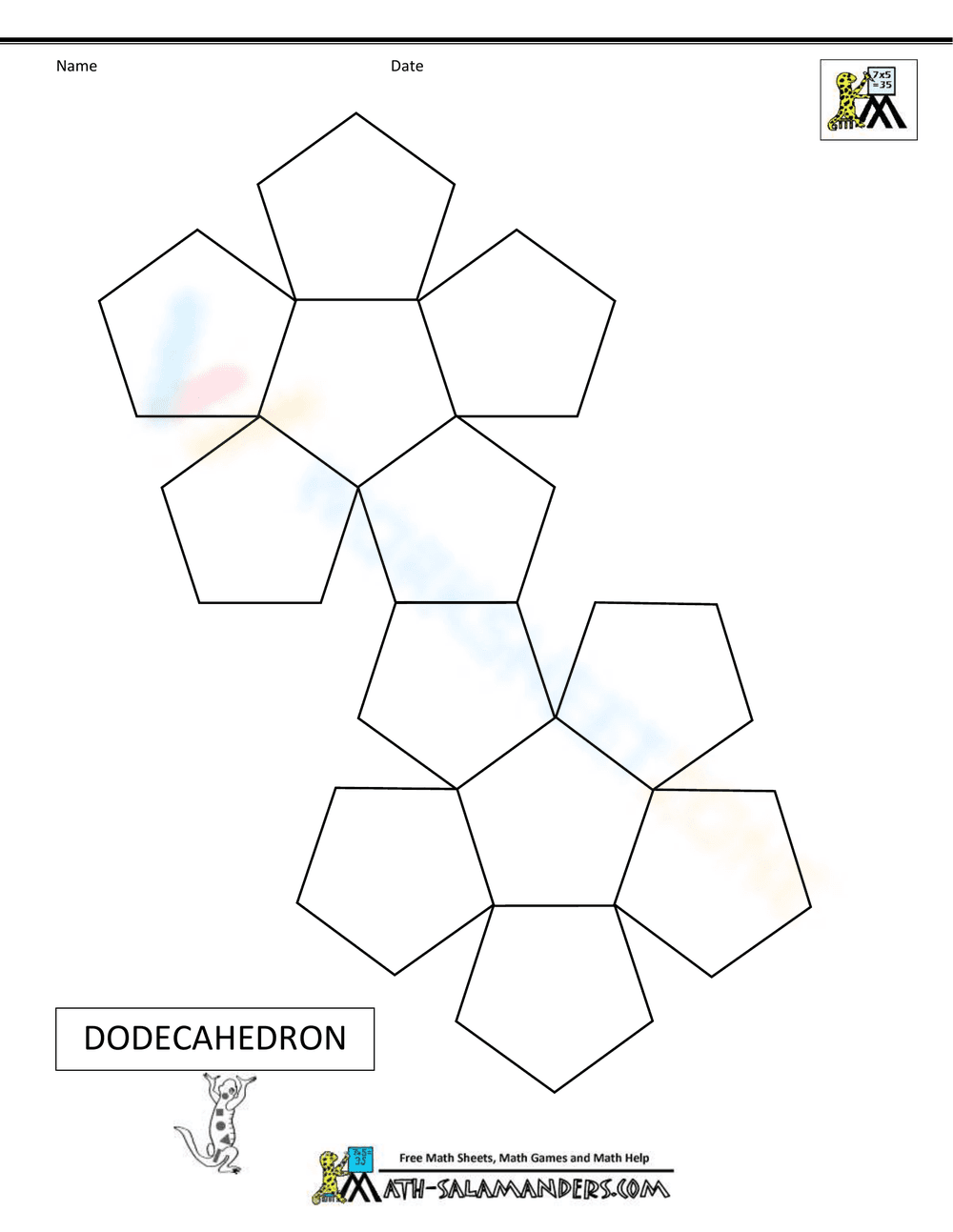


Dodecahedron Net Worksheet | Grade 6-9 Essential
Paste this activity's link or code into your existing LMS (Google Classroom, Canvas, Teams, Schoology, Moodle, etc.).
Students can open and work on the activity right away, with no student login required.
You'll still be able to track student progress and results from your teacher account.
This printable dodecahedron net worksheet provides a hands-on approach to three-dimensional geometry for students in grades 6 through 9. By physically constructing a 12-sided Platonic solid, learners bridge the gap between 2D representations and 3D spatial reasoning. This activity facilitates a deeper understanding of vertices, edges, and face properties in complex polyhedra.
At a Glance
- Grade: 6-9 · Subject: Geometry
- Standard:
CCSS.MATH.CONTENT.6.G.A.4— Represent three-dimensional figures using nets and use them to find surface area- Skill Focus: 3D Spatial Visualization
- Format: 2 pages · 1 construction task · No-prep · PDF
- Best For: Hands-on geometry stations and sub plans
- Time: 20–30 minutes
What's Inside: This resource includes 2 distinct pages featuring the net of a regular dodecahedron. The first page offers a clean, tab-less net ideal for tracing or mathematical analysis of surface area. The second page includes precise folding tabs, making it a ready-to-use template for physical assembly. Both pages are formatted as high-quality PDFs for clear printing and easy cutting.
Zero-Prep Workflow: Teachers can implement this activity in three simple steps. First, print the desired version (with or without tabs) in less than 1 minute. Second, distribute the sheets to students along with scissors and glue. Third, allow 15 to 20 minutes for students to cut, fold, and assemble their models. This resource is an ideal sub-plan or Friday enrichment activity that requires no prior teacher setup.
Standards Alignment: The primary standard addressed is `CCSS.MATH.CONTENT.6.G.A.4`, which requires students to represent three-dimensional figures using nets and use those nets to find surface area. While the standard specifically mentions rectangles and triangles, the dodecahedron extends this logic to regular pentagons. Both standard codes can be copied directly into lesson plans, IEP goals, or district curriculum mapping tools.
How to Use It: Use this worksheet during a unit on surface area to help students visualize how 2D shapes transform into 3D solids. As a formative assessment, observe students during the folding process to identify those struggling with spatial orientation. The expected completion time for a finished, glued model is approximately 25 minutes, making it a perfect mid-lesson transition or a collaborative group project.
Who It's For: This activity is designed for middle and high school geometry students, including those requiring tactile learning opportunities. It pairs naturally with a lesson on Platonic solids or an anchor chart detailing the properties of regular polyhedra. It is also suitable for advanced elementary students exploring complex shapes beyond basic cubes and pyramids.
According to the RAND AIRS 2024 report, hands-on manipulatives in mathematics significantly improve long-term retention of spatial concepts compared to purely digital instruction. This worksheet focuses on the CCSS.MATH.CONTENT.6.G.A.4 standard, enabling students to master the plain-English skill of constructing 3D models from 2D nets. By engaging in the physical assembly of a dodecahedron, students develop the fine motor skills and geometric intuition necessary for higher-level trigonometry and calculus. Research from Fisher & Frey (2014) supports the use of such productive struggle in geometry to build cognitive endurance. This resource provides a structured pathway for students to move from abstract theory to concrete application. Educators can rely on this tool to meet rigorous curriculum demands while maintaining high student engagement through kinesthetic learning.


