


























Views
Downloads


4.OA.B.4 Worksheet: Divisibility Rules — Essential Grade 5
Paste this activity's link or code into your existing LMS (Google Classroom, Canvas, Teams, Schoology, Moodle, etc.).
Students can open and work on the activity right away, with no student login required.
You'll still be able to track student progress and results from your teacher account.
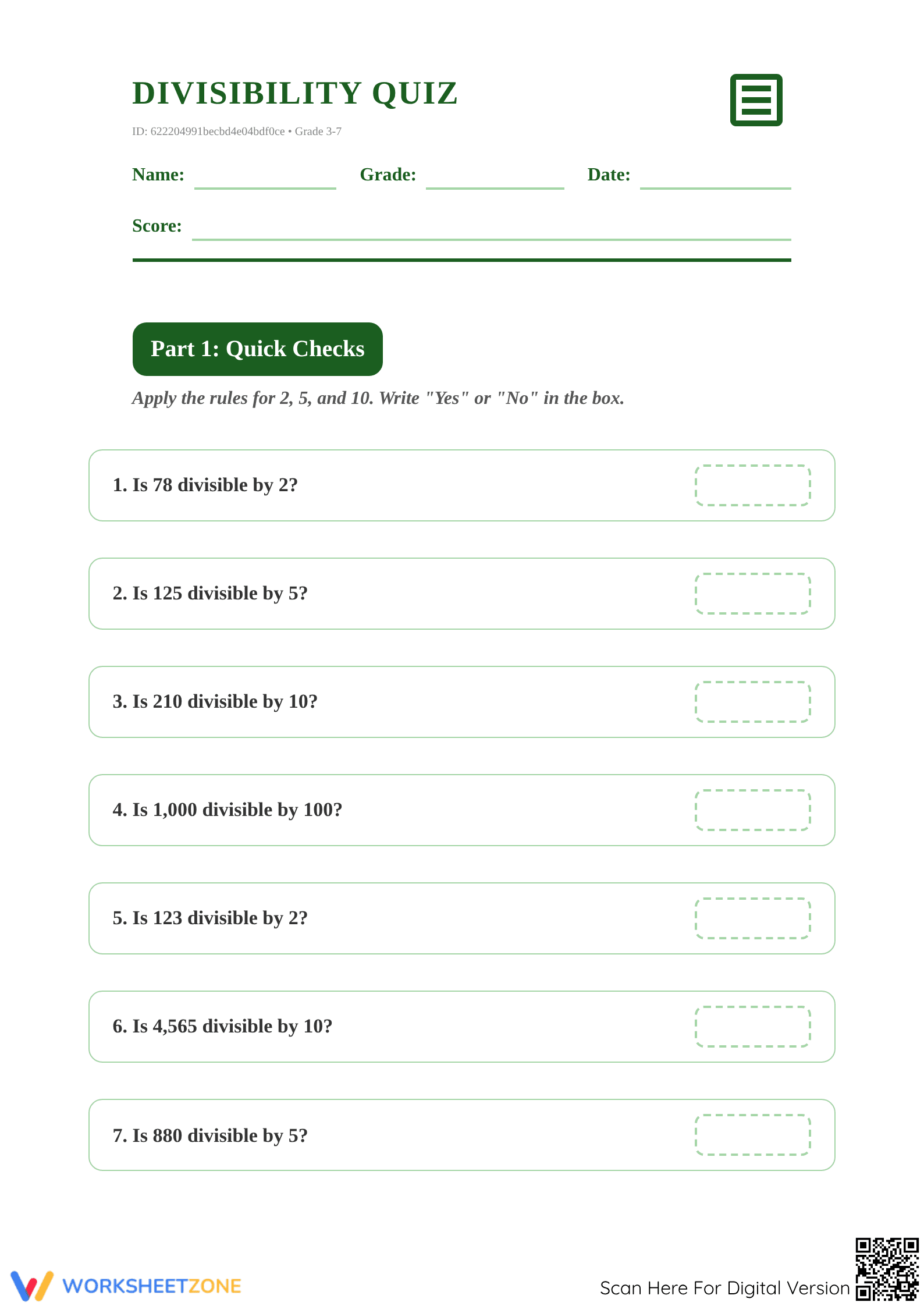
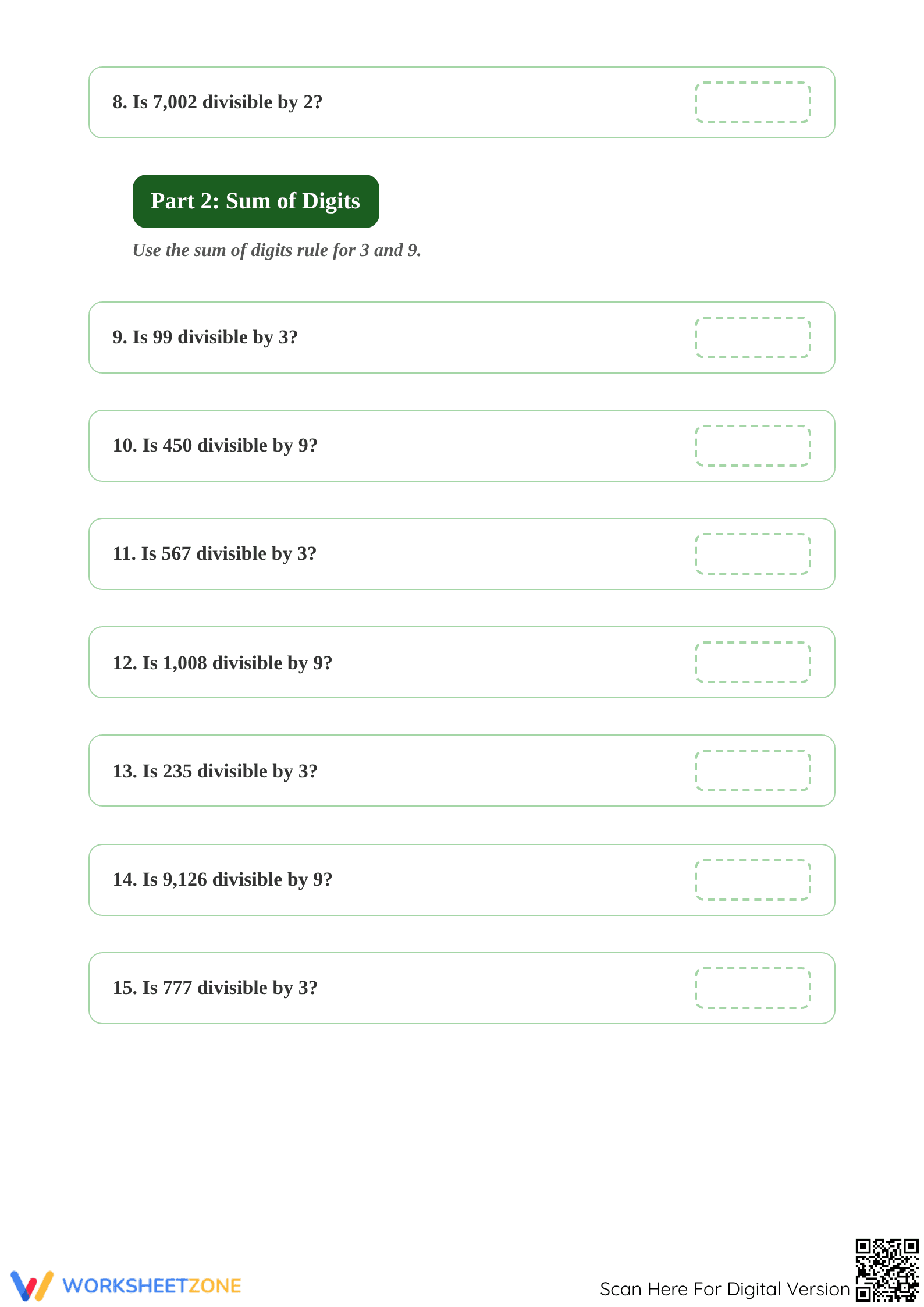
This comprehensive divisibility rules and prime factorization quiz provides Grade 5 students with targeted practice to master fundamental number theory concepts. By identifying factors and constructing factor trees, learners develop the essential fluency required for simplifying fractions and understanding complex operations. This resource ensures students can confidently apply mathematical rules to determine number relationships.
At a Glance
- Grade: Grade 5 · Subject: Math
- Standard:
4.OA.B.4— Find all factor pairs for a whole number in the range 1-100- Skill Focus: Divisibility Rules and Prime Factorization
- Format: 4 pages · 24 problems · Answer key included · PDF
- Best For: Formative assessment and unit quiz
- Time: 25–35 minutes
This printable math packet includes four dedicated pages designed to assess a student's grasp of numerical factors. The first page features a rule-based identification task followed by the introduction of factor trees. Subsequent pages provide extensive practice with prime factorization for various whole numbers, supported by a structured visual layout. A complete answer key is provided for immediate feedback.
The quiz is structured to provide clear evidence of mastery across multiple cognitive levels. Tasks 1 through 10 focus on the Approaching tier, requiring simple application of divisibility rules. The factor tree sections represent the Meeting and Exceeding tiers, challenging students to decompose numbers into their prime components. Results from these exercises can be entered directly into gradebooks or IEP progress monitoring tools.
Aligned primarily to `CCSS.MATH.CONTENT.4.OA.B.4`, this worksheet requires students to recognize that a whole number is a multiple of each of its factors. It also supports 6.NS.B.4 by laying the groundwork for finding the greatest common factor and least common multiple. Both standard codes can be copied directly into lesson plans, IEP goals, or district curriculum mapping tools.
Use this resource as a formal end-of-unit quiz or a comprehensive formative assessment after initial instruction on divisibility rules. Teachers should observe students during the factor tree construction to identify if they are struggling with basic multiplication facts or the recursive nature of factorization. Expect completion within a single class period, ranging from 25 to 35 minutes.
This quiz is intended for upper elementary and middle school students working on core multiplication and division standards. It is particularly effective for learners who require visual structures, like factor trees, to organize their mathematical thinking. The packet pairs naturally with number line activities, multiplication charts, or direct instruction on the Sieve of Eratosthenes.
Research from the RAND AIRS 2024 study emphasizes that frequent low-stakes assessment of foundational number theory, such as divisibility rules and prime factorization, significantly improves long-term retention of algebraic concepts. By identifying 4.OA.B.4 as a critical gateway standard, this quiz provides the structured evidence necessary to confirm student readiness for advanced middle school mathematics. Mastery of factorization allows students to move beyond rote memorization of multiplication tables into a deeper understanding of the multiplicative structure of whole numbers. This specific worksheet addresses the need for clear visual scaffolds in mathematical problem-solving, which has been shown to reduce cognitive load during multi-step procedures. Educators using this resource can ensure their instructional path remains aligned with national benchmarks while providing students with the repetitive practice required for fluency. The inclusion of a dedicated answer key facilitates self-grading, further supporting the development of metacognitive skills and student agency in the learning process.


