




























Views
Downloads


Essential Divisibility by 3 Worksheet | Grade 4-7 Math

Paste this activity's link or code into your existing LMS (Google Classroom, Canvas, Teams, Schoology, Moodle, etc.).
Students can open and work on the activity right away, with no student login required.
You'll still be able to track student progress and results from your teacher account.
This comprehensive divisibility by 3 worksheet helps students master the core mathematical rule of summing digits to determine factors. Students build fluency through repetitive identification, multiple-choice reasoning, and real-world word problems. Learners will confidently apply the rule to multi-digit numbers across various mathematical contexts and magnitudes without requiring full long division.
At a Glance
- Grade: 4-7 · Subject: Math
- Standard:
CCSS.MATH.CONTENT.4.OA.B.4— Identify factors and multiples by applying divisibility rules to whole numbers including multi-digit integers- Skill Focus: Divisibility rules for the number 3
- Format: 3 pages · 29 high-quality problems · Answer key included · PDF
- Best For: Small group practice, independent desk work, and formative assessment
- Time: 25–35 minutes of focused practice
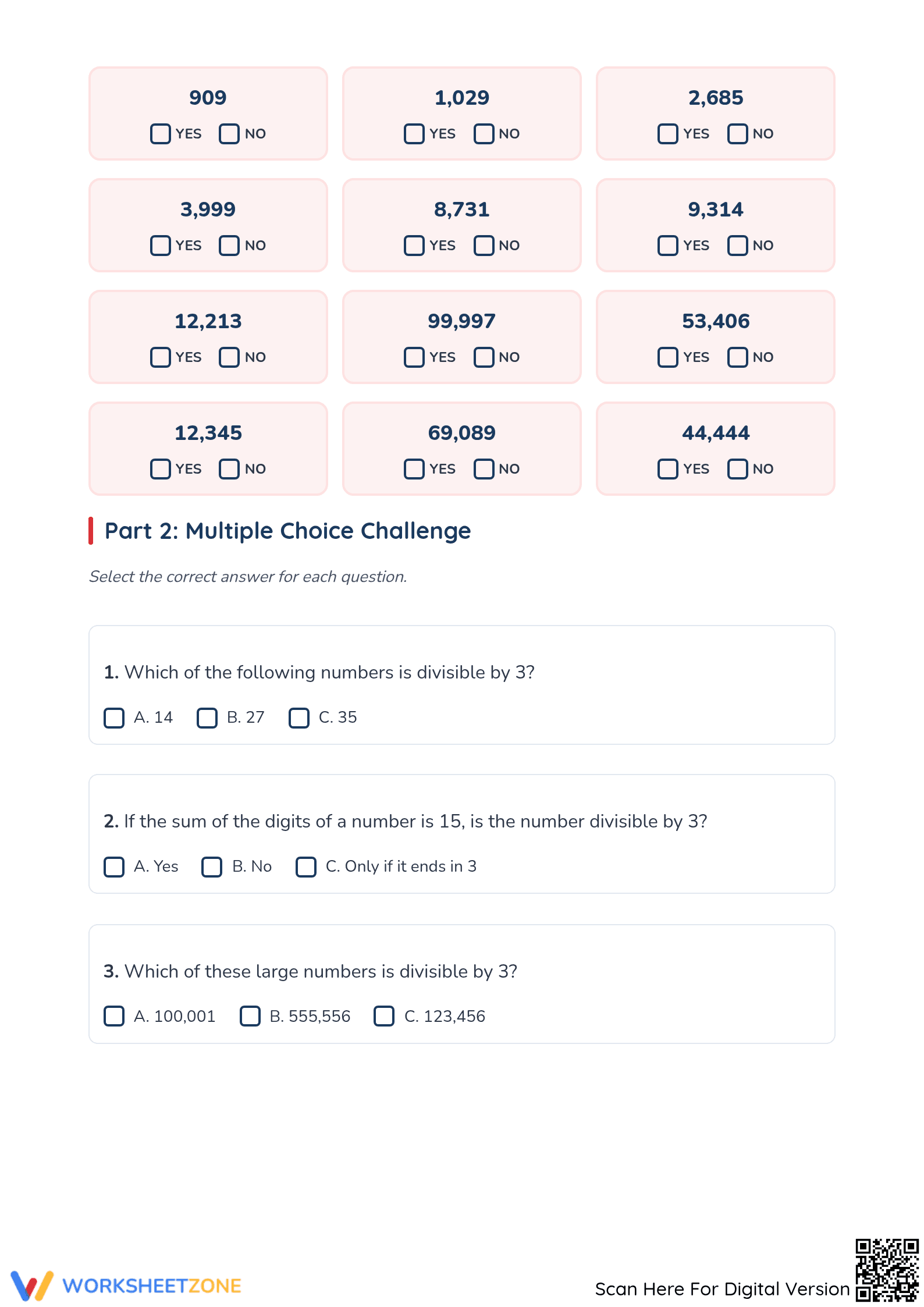
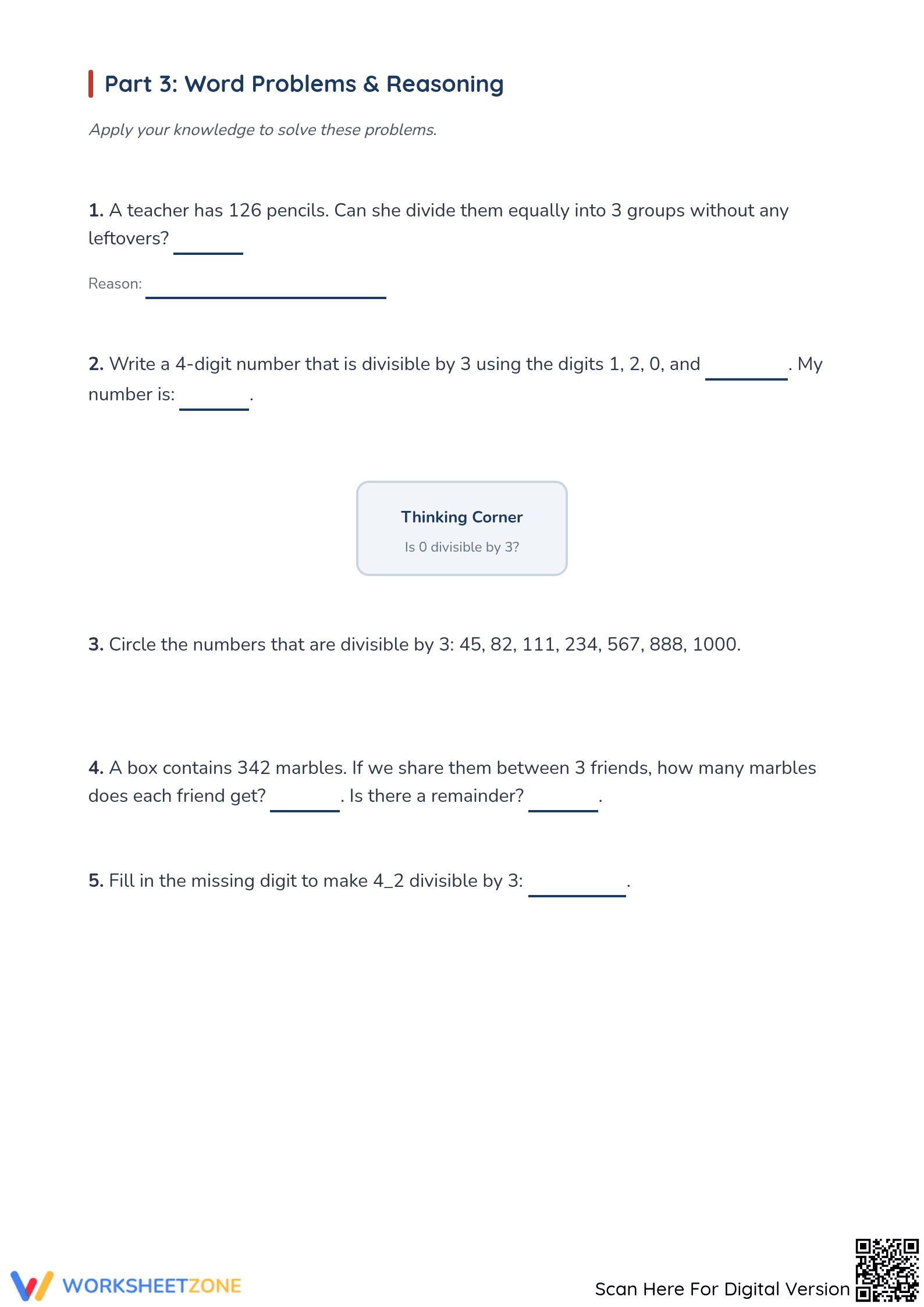
This packet contains three distinct parts designed to move students from recognition to application. Page one and two feature 21 quick-test boxes for yes/no identification of divisibility across various number magnitudes. Page two adds a multiple-choice challenge to test conceptual understanding. The final page includes five high-interest word problems and a reasoning corner. A complete answer key is included.
- Guided practice: Students begin with Part 1, using a "Quick Review" table that provides the divisibility rule for reference while testing 9 single- and double-digit numbers.
- Supported practice: The challenge scales in Part 2, where students apply the rule to 12 multi-digit numbers and solve 3 multiple-choice conceptual questions.
- Independent practice: Part 3 requires students to solve 5 complex word problems and reasoning tasks without direct cues, demonstrating mastery.
This follows a gradual-release model.
Standards Alignment
Primary standard: CCSS.MATH.CONTENT.4.OA.B.4 — "Find all factor pairs for a whole number in the range 1-100. Recognize that a whole number is a multiple of each of its factors. Determine whether a given whole number in the range 1-100 is a multiple of a given one-digit number." While this worksheet extends into larger multi-digit numbers to challenge Grade 6 and 7 students, it remains grounded in foundational algebraic thinking. Both standard codes can be copied directly into lesson plans.
How to Use It
Use this worksheet as a formative assessment during a unit on factors and multiples. Assign the first page immediately after direct instruction to check for initial understanding of the "sum of digits" rule. For Grade 6 and 7 students, the word problems on page three serve as an excellent warm-up or challenge task to reinforce long division concepts. Monitor students in Part 1 to ensure they add digits. Expect completion within 30 minutes.
Who It's For
This resource is designed for Grade 4 through Grade 7 students practicing division concepts. It is particularly effective for students requiring extra support with mental math or those preparing for standardized tests that require quick identification of factors. The tiered complexity makes it a natural pairing for instructional videos on divisibility or classroom anchor charts, supporting diverse learners in general education settings.
Mastering divisibility rules as shortcuts for factor identification is crucial for algebraic fluency. Research, such as the RAND AIRS 2024 report, shows students who use conceptual shortcuts like divisibility rules for 3 and 9 achieve higher accuracy in mental computation and multi-digit division. By reducing cognitive load from trial-and-error, this worksheet helps students focus on higher-level number relationships. The CCSS.MATH.CONTENT.4.OA.B.4 standard targets recognizing multiples via pattern identification. This resource's 29 repetitions across three pages foster long-term procedural fluency, aligning with research-validated methods for building number sense for middle school mathematics and cognitive load management.


