




























Views
Downloads

Printable Divisibility Rules Worksheet | Grade 6 Math

Paste this activity's link or code into your existing LMS (Google Classroom, Canvas, Teams, Schoology, Moodle, etc.).
Students can open and work on the activity right away, with no student login required.
You'll still be able to track student progress and results from your teacher account.
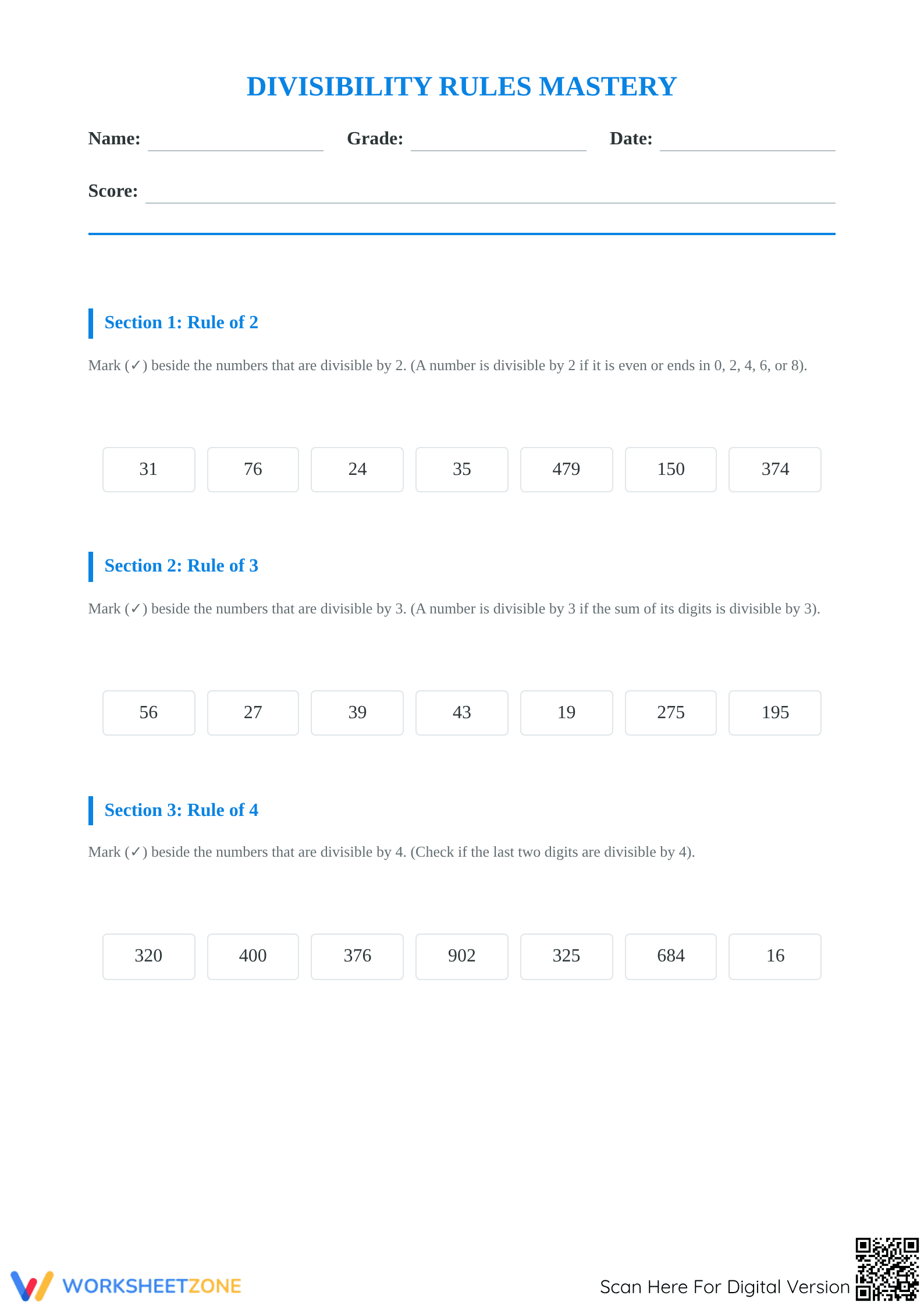
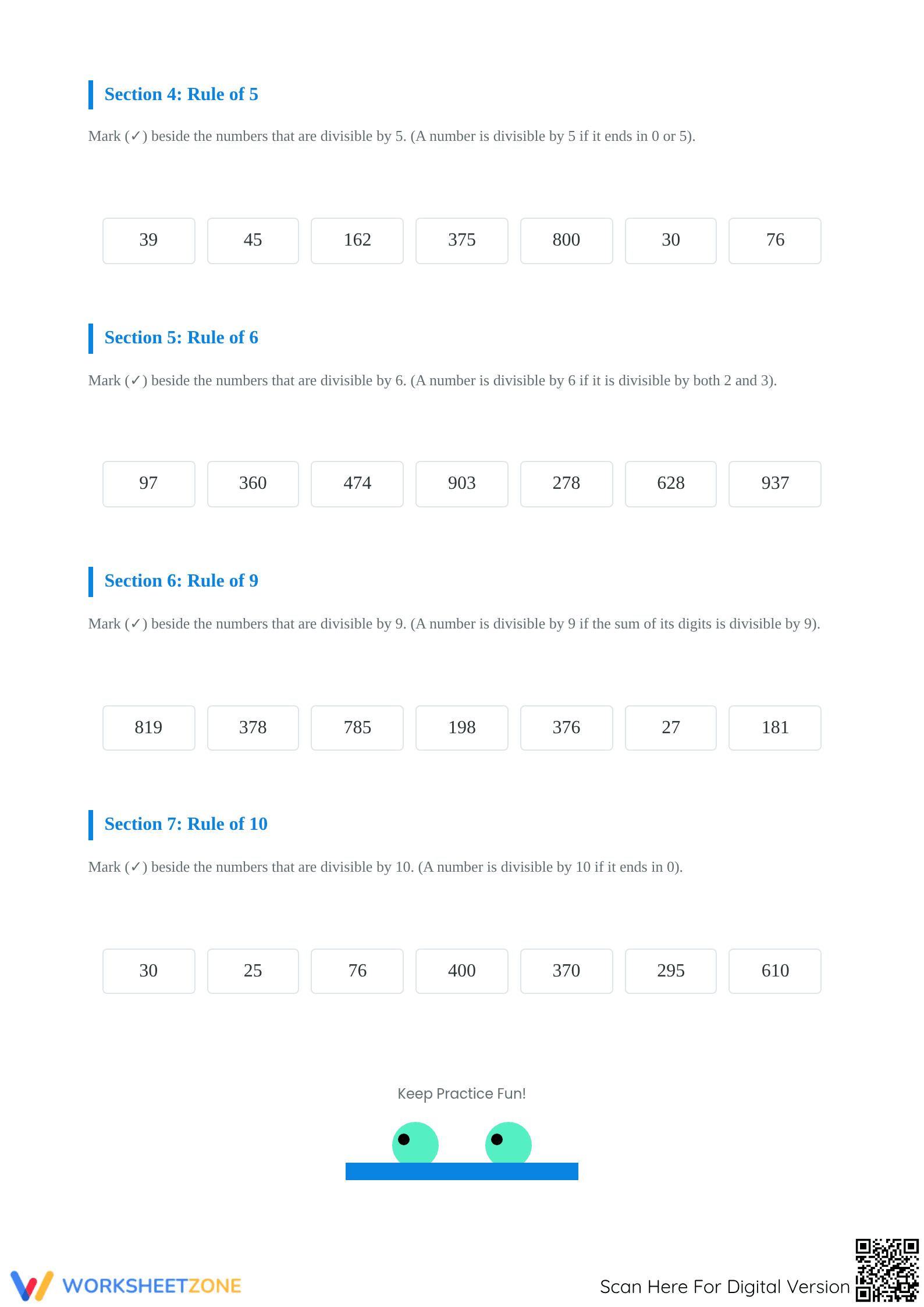
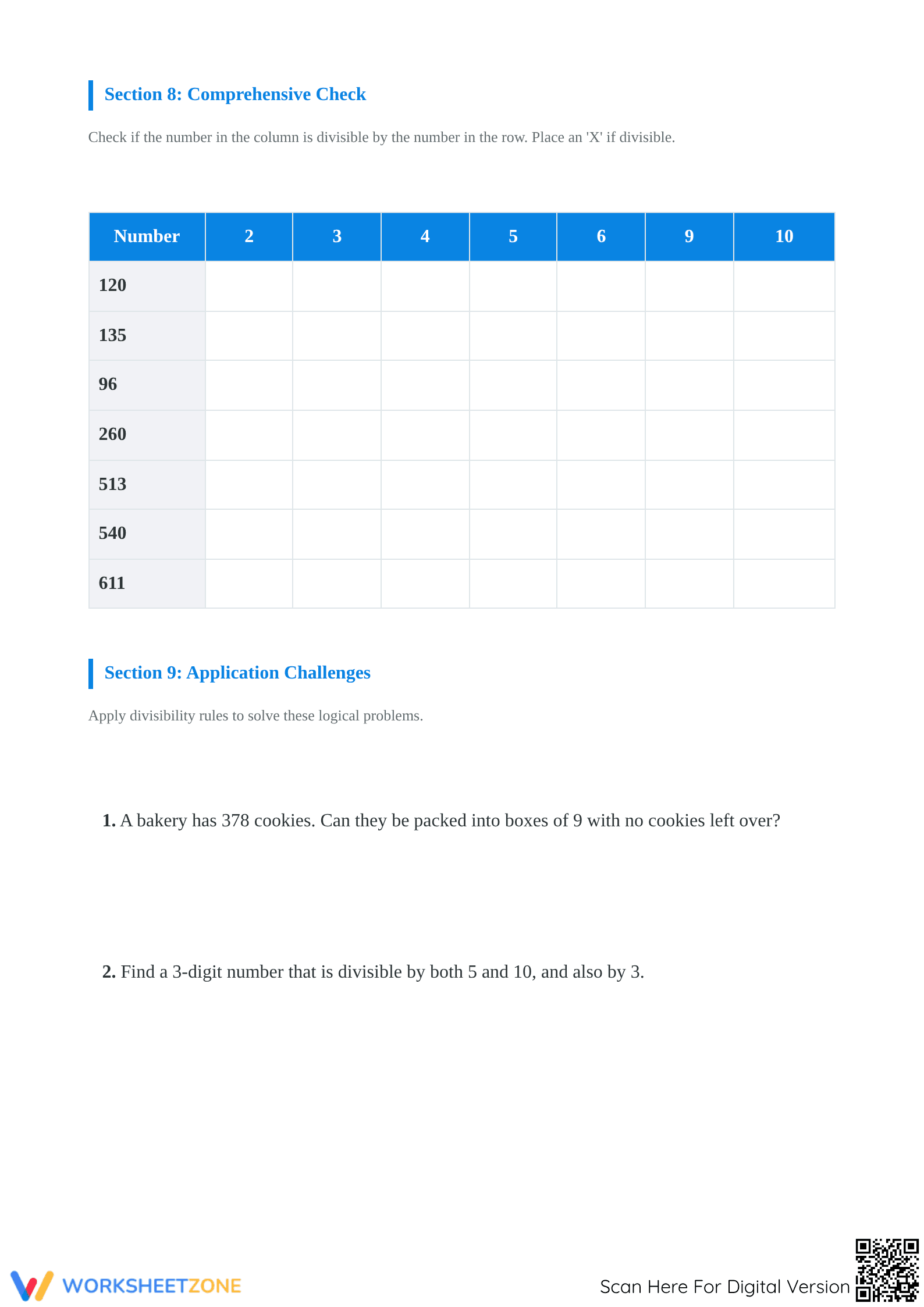
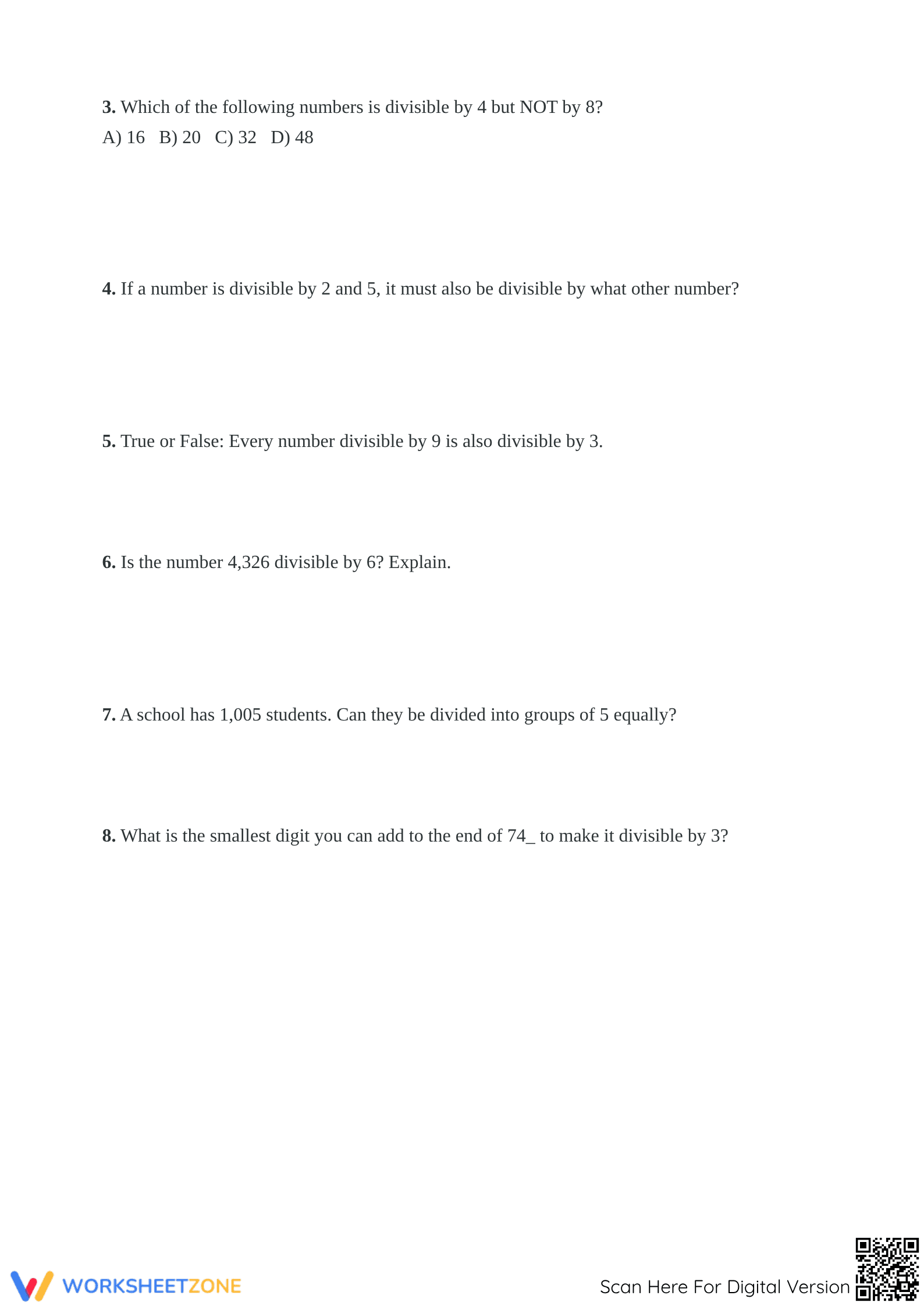
This printable Grade 6 Math worksheet provides comprehensive practice with divisibility rules for 2, 3, 4, 5, 6, 9, and 10. Students learn to determine if a number is divisible by another without long division, improving mental math speed. This resource is essential for mastering factors, multiples, and simplifying fractions effectively during middle school math units.
At a Glance
- Grade: 6 & 7 · Subject: Math
- Standard:
CCSS.MATH.CONTENT.6.NS.B.2— Fluently divide multi-digit numbers using the standard algorithm- Skill Focus: Divisibility rules (2-10)
- Format: 4 pages · 28 problems · Answer key included · PDF
- Best For: Reinforcing number sense and mental math
- Time: 15–25 minutes
This four-page PDF includes a clear reference chart followed by multiple practice tables. Students analyze 28 unique multi-digit numbers, applying seven different divisibility tests to each. The structured layout facilitates easy tracking of student progress. A complete answer key is provided to allow for quick grading or student self-correction during independent practice or as a homework assignment.
Skill Progression
- Guided practice: The initial rules reference chart serves as a visual scaffold, allowing students to verify their logic as they begin the first set of 7 problems on page one.
- Supported practice: Students transition to the middle pages, where they apply the rules to larger, more complex numbers like 1,000,000 and 10,230 with decreasing reliance on the chart.
- Independent practice: The final page challenges students to complete the checks with minimal assistance, ensuring mastery of core rules.
This gradual-release approach ensures students move from recognition to automaticity in their numerical analysis and calculation efficiency.
Standards Alignment
The primary standard is CCSS.MATH.CONTENT.6.NS.B.2: "Fluently divide multi-digit numbers using the standard algorithm." While divisibility rules are a prerequisite for CCSS.MATH.CONTENT.6.NS.B.4 (finding common factors), they directly support efficiency in all multi-digit division tasks. Both standard codes can be copied directly into lesson plans, IEP goals, or district curriculum mapping tools to ensure instructional alignment across the grade level.
How to Use It
Use this worksheet as a warm-up during a unit on prime factorization or fraction simplification. Assign one page per day as a bell ringer to reinforce number sense. During instruction, observe if students correctly sum digits for the rules of 3 and 9, as this is a common hurdle. Expected completion time is roughly 20 minutes for the full set of exercises provided.
Who It's For
Designed for Grade 6 and Grade 7 students requiring targeted practice in division fluency. It is particularly effective for students struggling with mental math or those preparing for advanced topics like the Greatest Common Factor. Pair this with a divisibility rules anchor chart or a short video lesson on the sum of digits trick to support diverse learning styles in the classroom.
The CCSS.MATH.CONTENT.6.NS.B.2 standard emphasizes the importance of procedural fluency in multi-digit division, a skill that serves as the foundation for higher-level algebra and number theory. Divisibility rules provide students with a cognitive shortcut, reducing the working memory load required for complex calculations. According to the RAND AIRS 2024 report on mathematics education, mastering these mental math strategies significantly improves overall arithmetic performance and confidence in middle school learners. This worksheet bridges the gap between basic division and strategic number analysis by requiring students to repeatedly apply logical tests to various numerical contexts. By automating the identification of factors, students are better prepared for the rigorous demands of 7th-grade proportional reasoning and rational number operations. This resource is a proven tool for building the mental infrastructure necessary for mathematical success in a classroom or home-school setting.


