


























Views
Downloads

Divisible by 4 Worksheet | Grade 4-7 Essential Printable
Paste this activity's link or code into your existing LMS (Google Classroom, Canvas, Teams, Schoology, Moodle, etc.).
Students can open and work on the activity right away, with no student login required.
You'll still be able to track student progress and results from your teacher account.
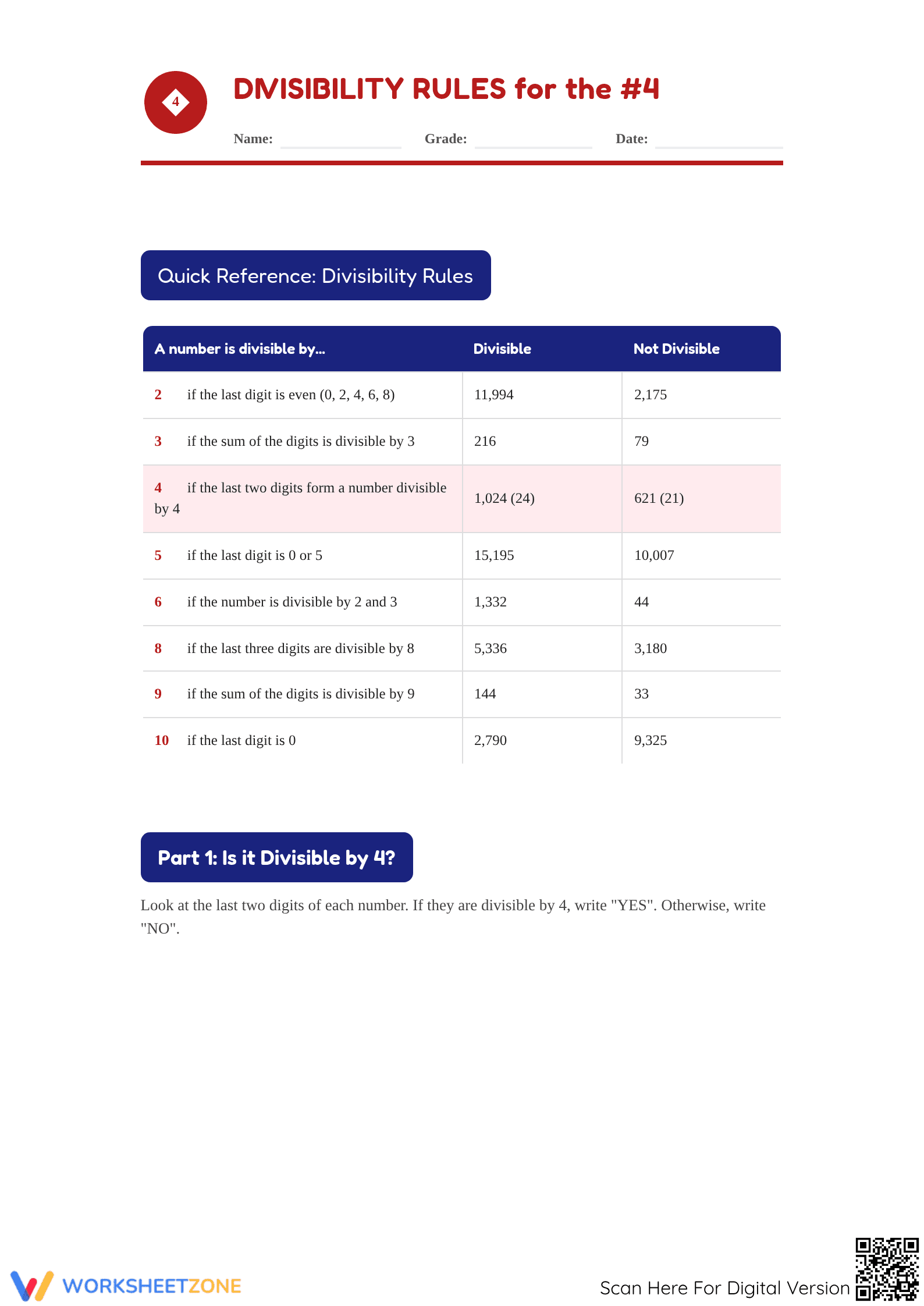
This comprehensive divisibility by 4 worksheet provides students in Grades 4 through 7 with targeted practice to master the specific rules of division. By identifying multiples and applying the rule that a number is divisible by 4 if its last two digits are divisible by 4, learners develop greater numerical fluency and mental math speed.
At a Glance
- Grade: 4-7 · Subject: Math
- Standard:
CCSS.MATH.CONTENT.4.OA.B.4— Determine whether a given whole number is a multiple of a one-digit number- Skill Focus: Divisibility rules for 4
- Format: 3 pages · 84 problems · Answer key included · PDF
- Best For: Independent practice and division mastery
- Time: 20–30 minutes
What's Inside
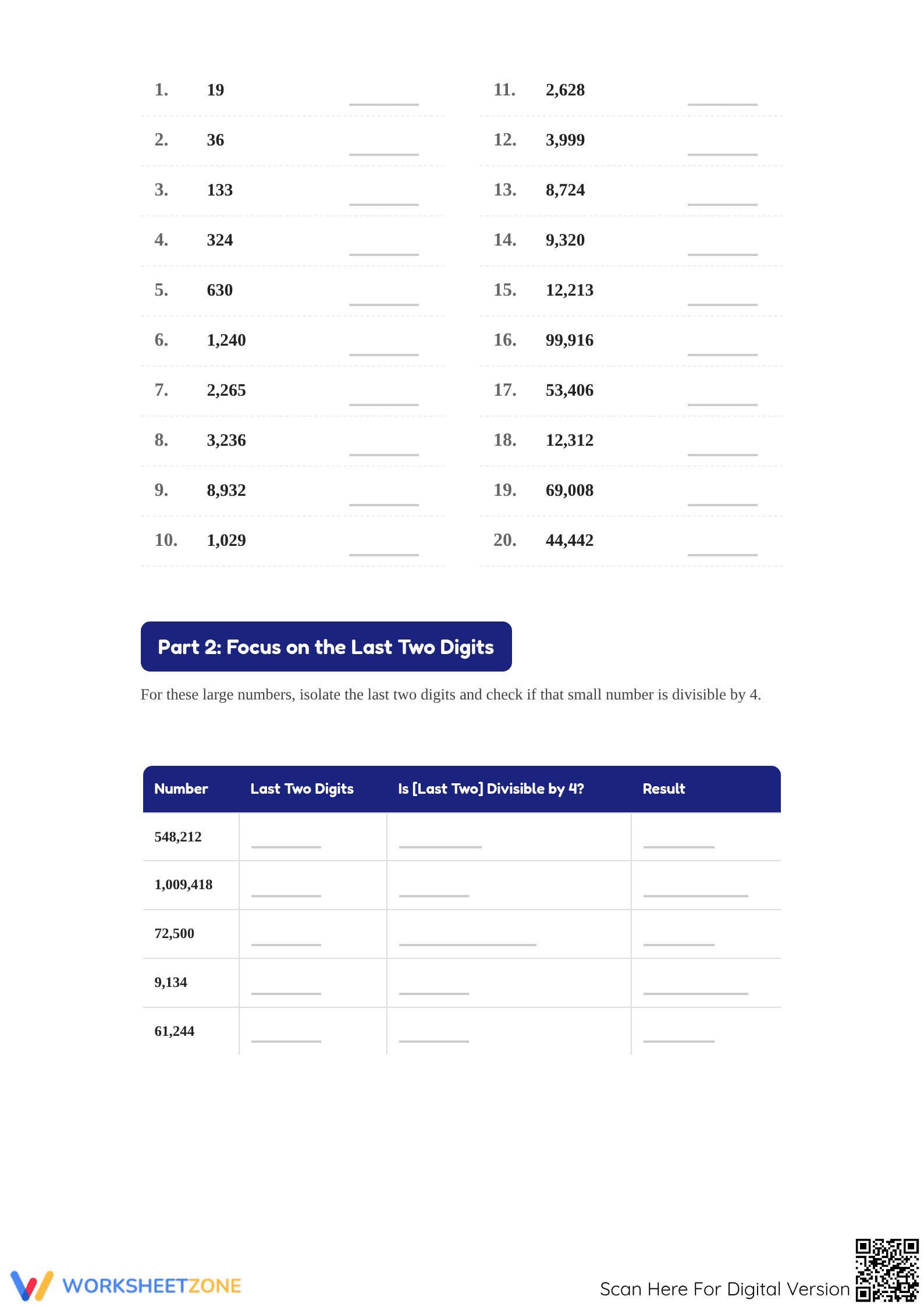
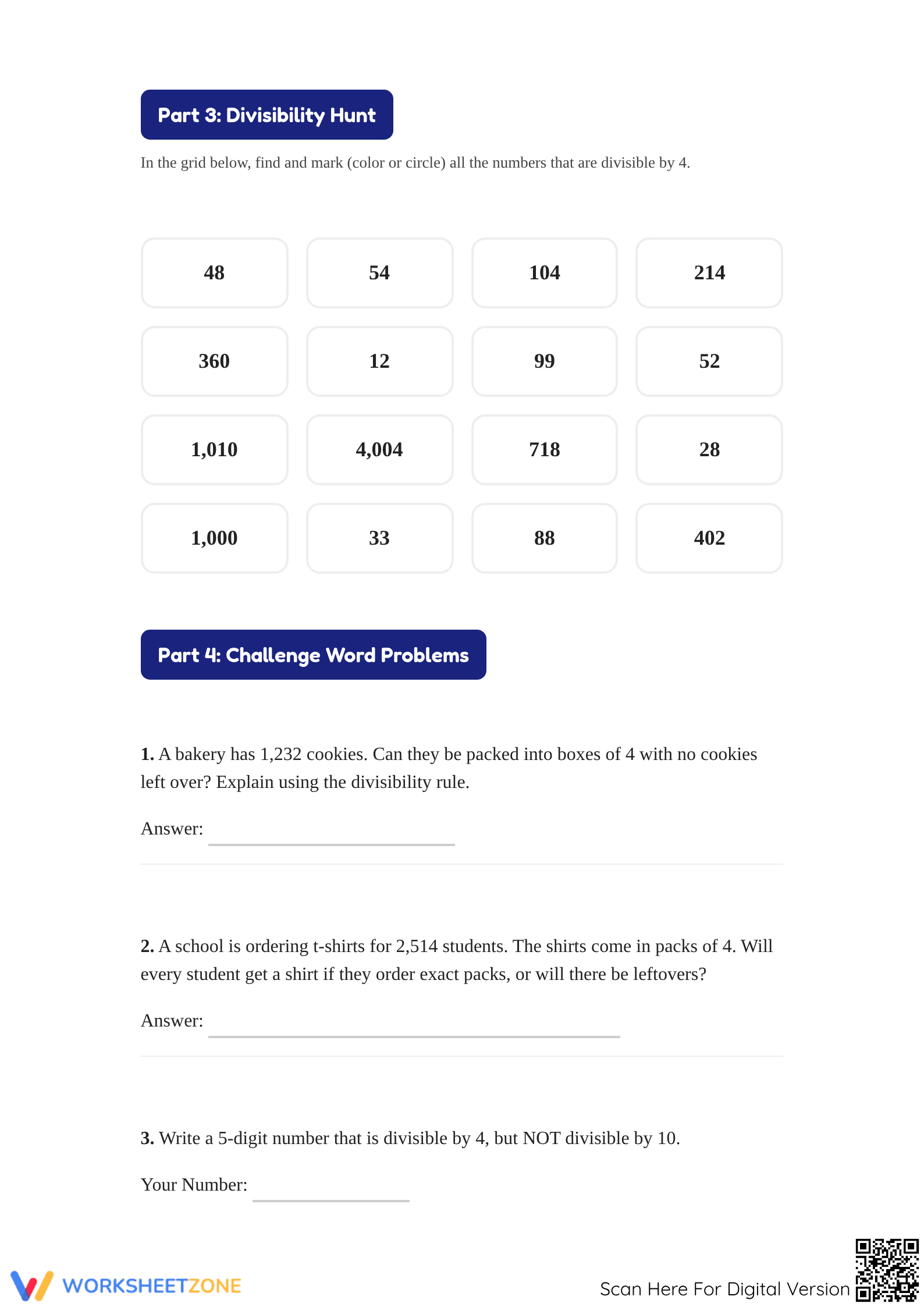
This resource consists of three full pages of practice, featuring a total of 84 distinct division challenges. Each page is structured to allow for clear scanning and quick identification. A complete answer key is included in the download, providing immediate feedback for students or rapid grading for teachers. The PDF format ensures high-quality printing for classroom distribution or digital assignment.
Skill Progression
- Guided Practice: Students begin with two-digit numbers to reinforce the foundational multiples of 4 and build initial confidence.
- Supported Practice: Learners progress to three-digit integers, focusing specifically on isolating the tens and ones place to apply the divisibility rule.
- Independent Practice: The final sets involve larger numbers and varied contexts, solidifying the mental shortcut without the need for long division.
This gradual-release model ensures that students move from basic recognition to conceptual mastery, effectively implementing an I Do, We Do, You Do instructional sequence.
Standards Alignment
This resource is directly aligned with `CCSS.MATH.CONTENT.4.OA.B.4`, which requires students to "Find all factor pairs for a whole number in the range 1-100. Recognize that a whole number is a multiple of each of its factors. Determine whether a given whole number in the range 1-100 is a multiple of a given one-digit number." This standard code can be copied directly into lesson plans, IEP goals, or district curriculum mapping tools.
How to Use It
Use this worksheet as a formative assessment after introducing the divisibility rule for 4. It works exceptionally well during the independent practice phase of a lesson or as a station activity during math rotations. For a quick check, observe students to see if they are performing the full long division or if they have successfully adopted the "last two digits" shortcut. Expect most students to complete the three-page set in approximately 25 minutes.
Who It's For
This practice set is designed for upper elementary and middle school students who are building their division skills or preparing for more complex fractions and factoring. It is particularly helpful for students who struggle with long division and need alternative strategies for numerical analysis. Pair this with a divisibility rules anchor chart or a multiplication table for scaffolded support.
According to the ScienceDirect TpT Analysis (2024), targeted divisibility practice is a critical component in developing mathematical automaticity, which directly correlates with success in higher-level algebra. This Grade 4-7 worksheet focuses on the standard CCSS.MATH.CONTENT.4.OA.B.4, providing the necessary repetition for students to internalize the rule that a whole number is a multiple of 4 based on its terminal digits. By removing the cognitive load of full calculation, this resource allows learners to focus on pattern recognition and number properties. The inclusion of 84 problems across 3 pages provides sufficient data points for teachers to identify specific misconceptions in place value or multiplication facts. Such structured practice ensures that the plain-English skill of determining multiples becomes a permanent part of the student's mathematical toolkit, bridging the gap between basic arithmetic and algebraic reasoning.


