


























Views
Downloads

Essential Divisibility Rules Worksheet | Grade 4-6 Math
Paste this activity's link or code into your existing LMS (Google Classroom, Canvas, Teams, Schoology, Moodle, etc.).
Students can open and work on the activity right away, with no student login required.
You'll still be able to track student progress and results from your teacher account.
This 4-page worksheet provides comprehensive practice on divisibility rules for numbers 2 through 10. Students move from basic identification to complex digit manipulation, ensuring a deep understanding of factors and multiples. By mastering these mental math shortcuts, learners significantly improve their long division efficiency, number sense, and ability to simplify fractions with ease.
At a Glance
- Grade: 4–6 · Subject: Math
- Standard:
CCSS.MATH.CONTENT.4.OA.B.4— Identify factors and determine if a number is a multiple of another- Skill Focus: Divisibility Rules (2, 3, 4, 5, 6, 8, 9, 10)
- Format: 4 pages · 60+ problems · Answer key included · PDF
- Best For: Mental math practice and factor identification
- Time: 30–45 minutes
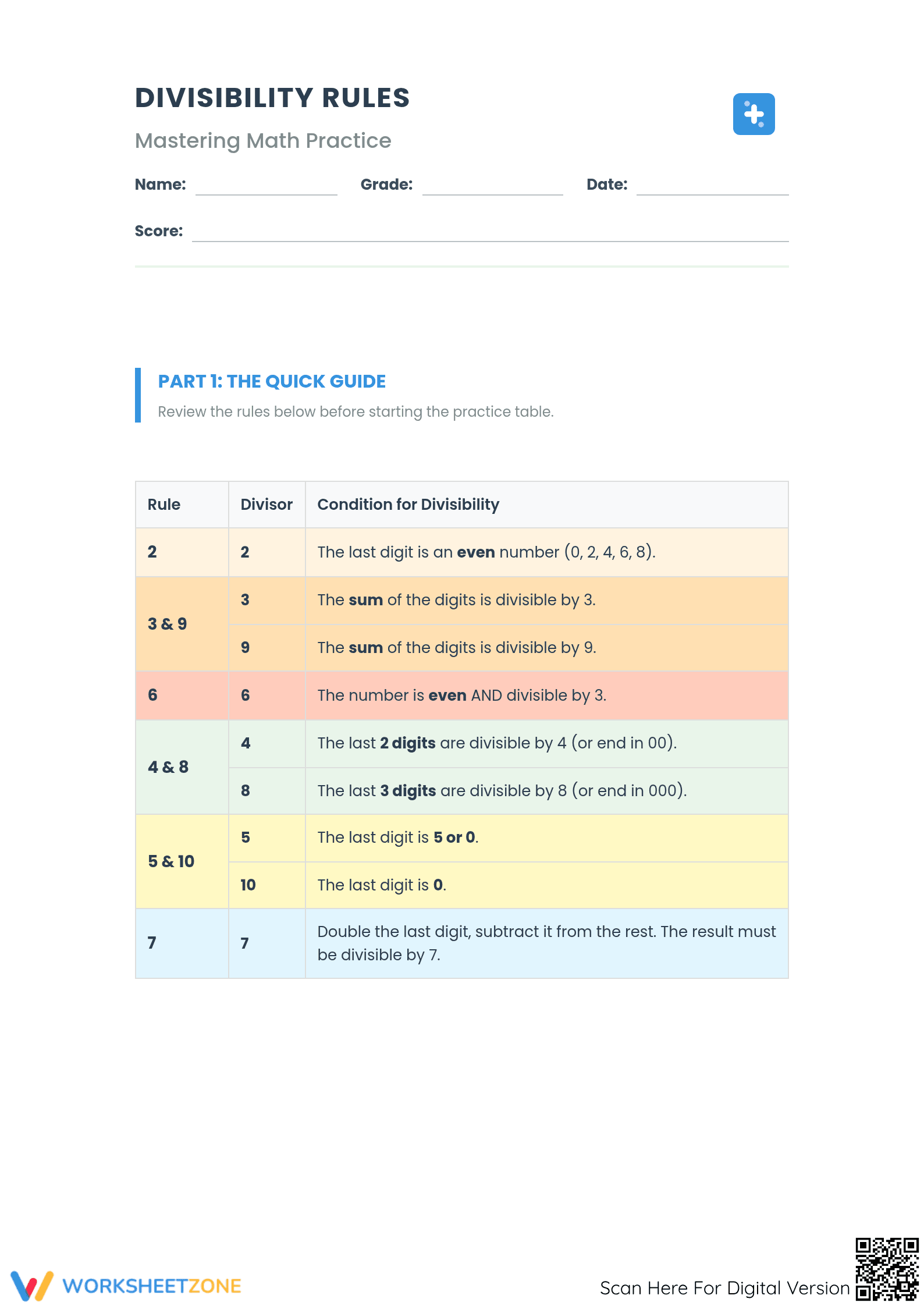
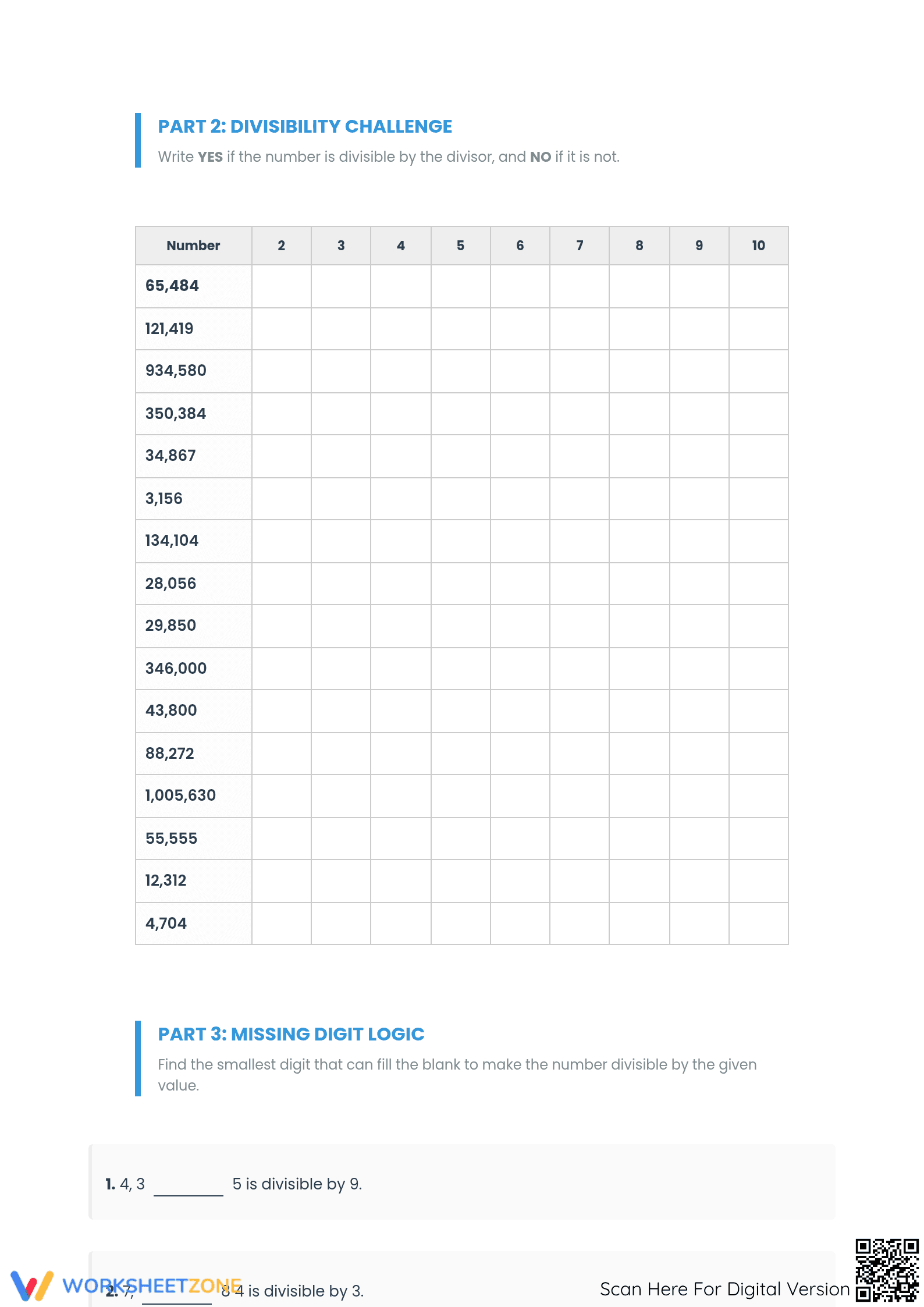
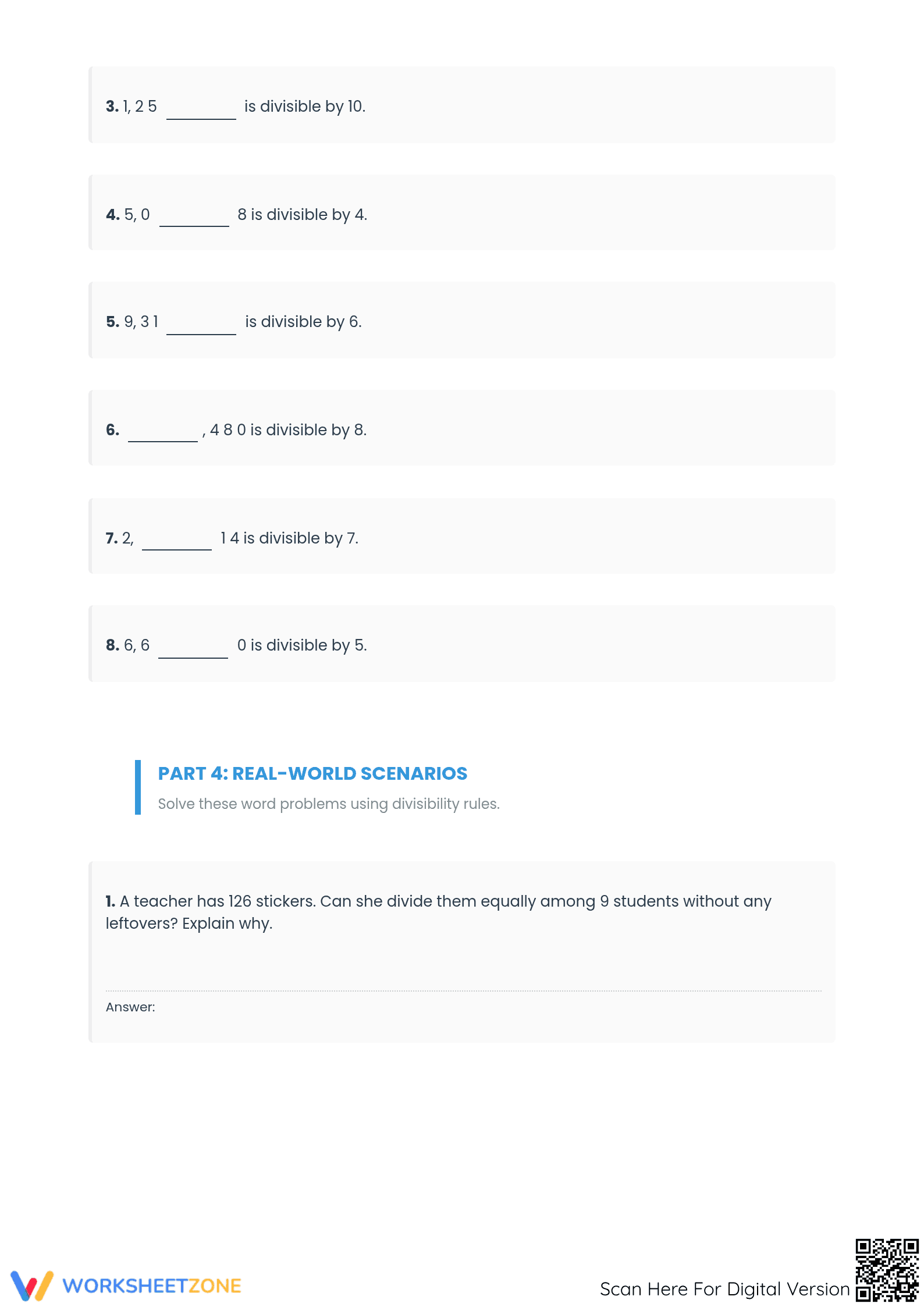
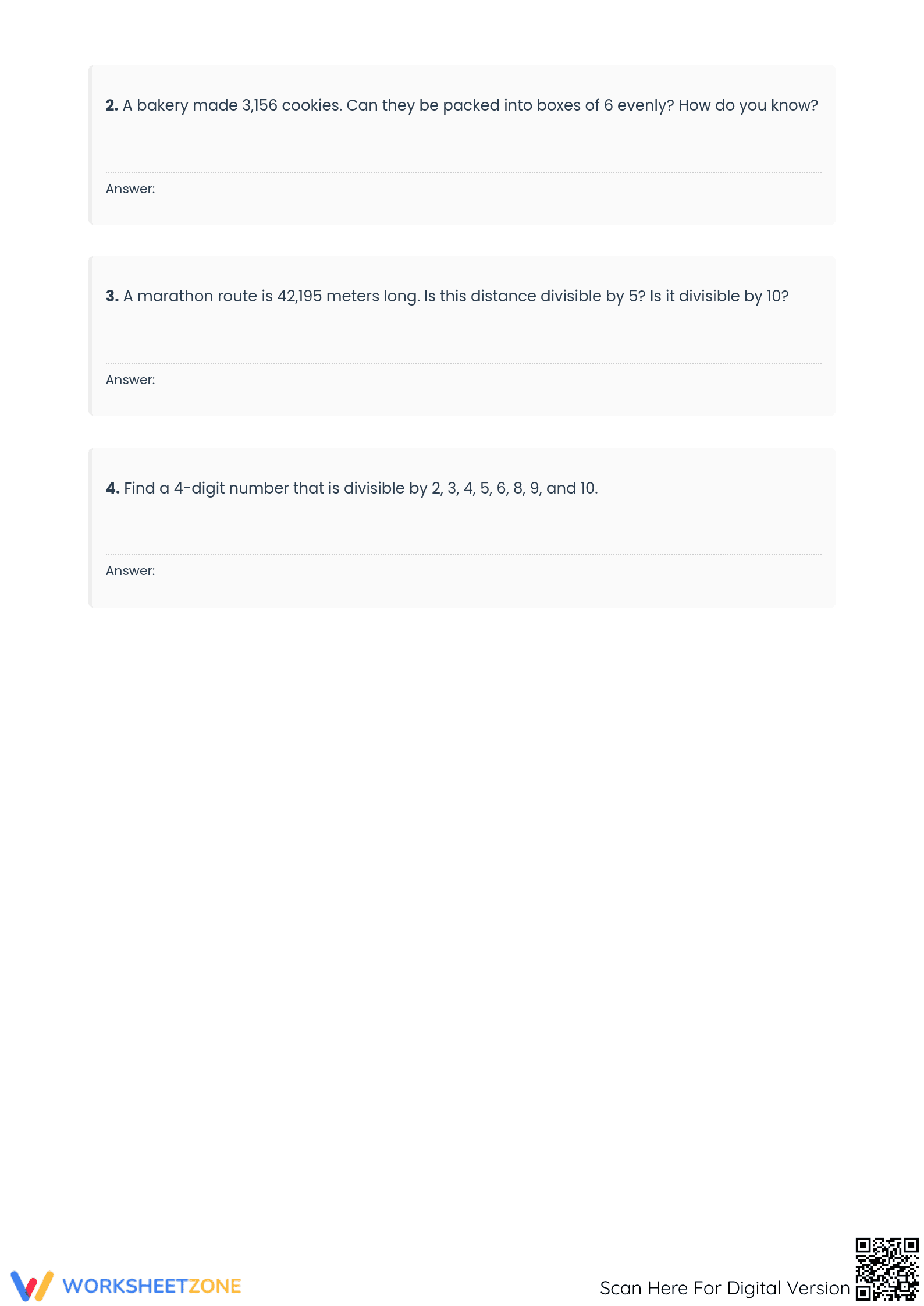
What's Inside: This resource consists of four pages of targeted content. It begins with a comprehensive reference table outlining the rules for divisors 2 through 10. Part A utilizes a large checkbox grid for multi-rule identification. Part B features True/False reasoning tasks for specific divisors. Part C challenges students to find the missing digit to satisfy a divisibility rule, while Part D provides categorization tasks. A full answer key is included for rapid grading and student self-correction.
Skill Progression
- Guided practice: The initial checkbox grid in Part A provides a highly structured environment for applying multiple rules to 20 multi-digit numbers, scaffolding the identification process through clear visual organization.
- Supported practice: True/False questions and missing digit tasks in Parts B and C require students to justify their understanding of specific, trickier rules like those for 3, 6, 9, and 4.
- Independent practice: The final sorting tasks in Part D demand fluid recall of all rules as students independently categorize numbers into divisibility groups without prompts.
This follows a gradual-release model to ensure total conceptual mastery of divisibility properties.
Standards Alignment: The primary standard addressed is CCSS.MATH.CONTENT.4.OA.B.4, requiring students to find factor pairs and recognize multiples. This resource extends this foundational skill to larger numbers and complex divisors, supporting the Grade 6 transition to finding Greatest Common Factors. Standard codes can be copied directly into lesson plans or curriculum mapping tools.
How to Use It: Use this as a mid-unit assessment or reinforcement activity after introducing division properties. A formative assessment tip: observe student performance on Part C to gauge their understanding of the "sum-of-digits" rule for 3 and 9, revealing insights into place value understanding. Expected completion time is 30 to 45 minutes.
Who It's For: Designed for Grade 4 through 6 students developing mental math fluency and number sense. It's effective for learners struggling with long division who need strategies to quickly identify factor pairs. For additional scaffolding, pair this resource with a divisibility anchor chart or a multiplication table.
Mental math fluency, particularly applying divisibility rules, is critical in intermediate mathematics. This Grade 4-6 resource aligns with CCSS.MATH.CONTENT.4.OA.B.4 by offering over 60 targeted problems that require students to identify factors and multiples through systematic rule application. Engaging with diverse task types—from grid identification to missing digit analysis—students build cognitive pathways necessary for complex operations like fraction simplification and prime factorization. This worksheet is a robust tool for educators reinforcing fundamental skills within a structured, multi-page format. An answer key facilitates immediate feedback, improving long-term retention of mathematical properties.


