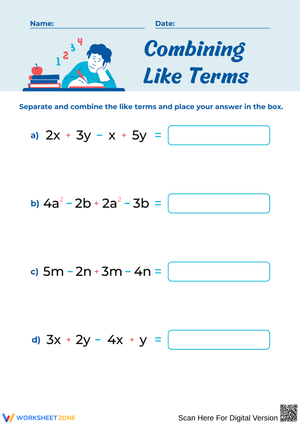
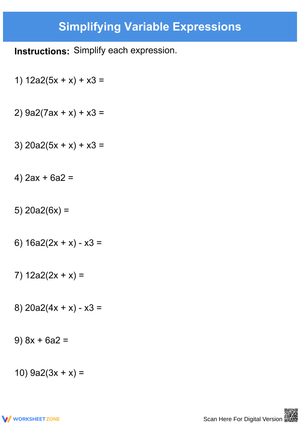
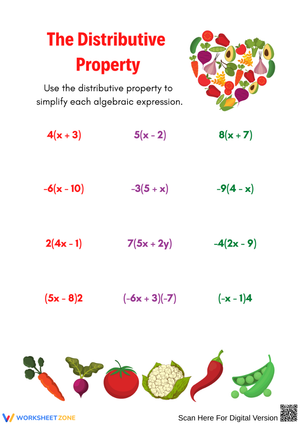
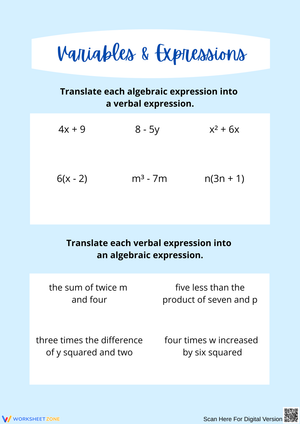
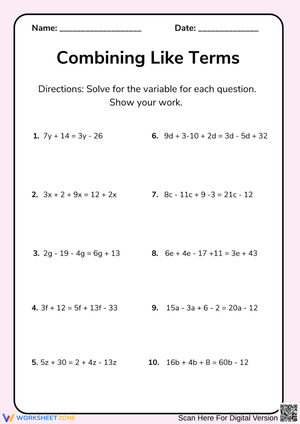
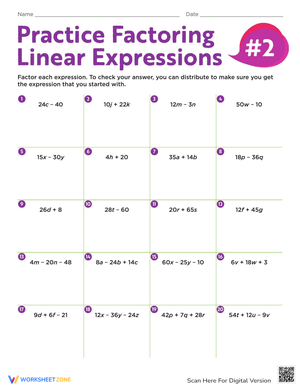
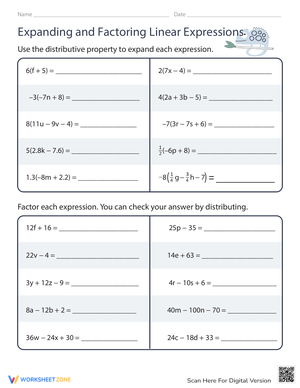
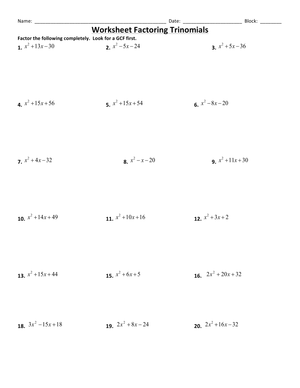
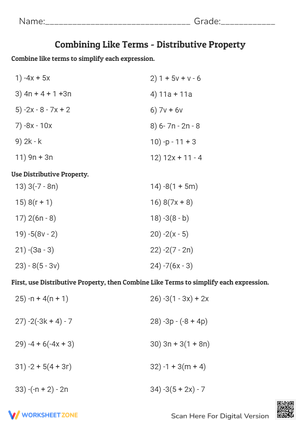
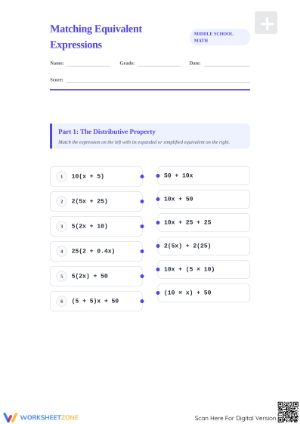
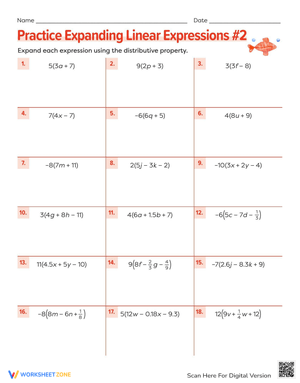
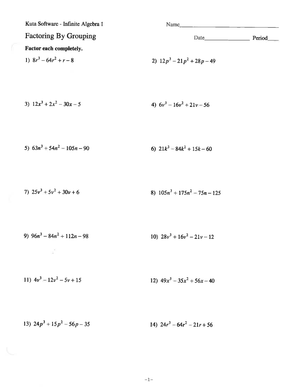
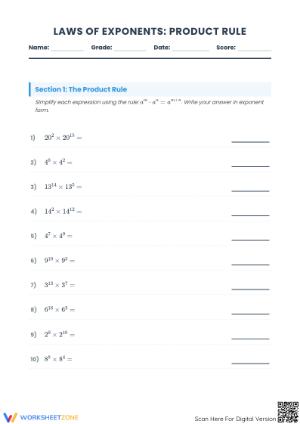
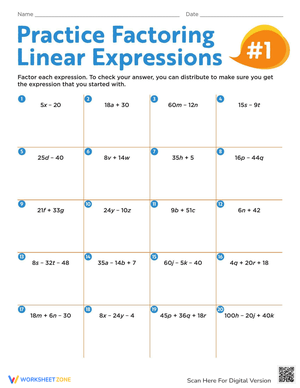
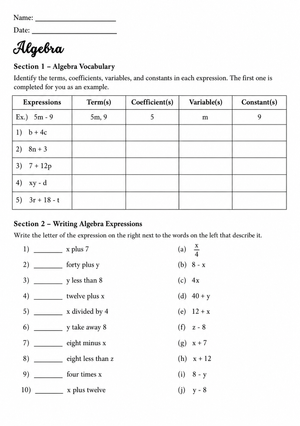
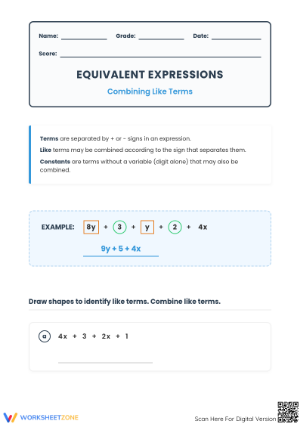
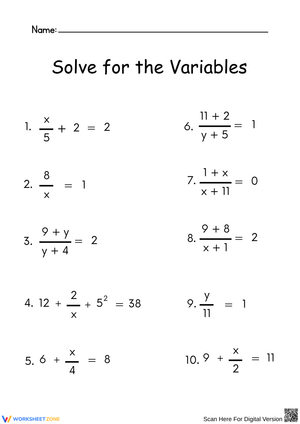
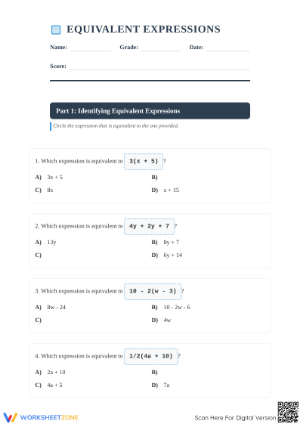
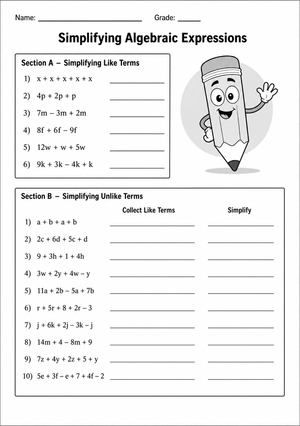
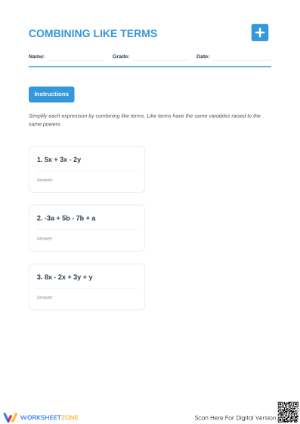
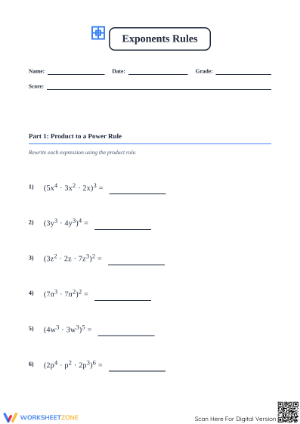
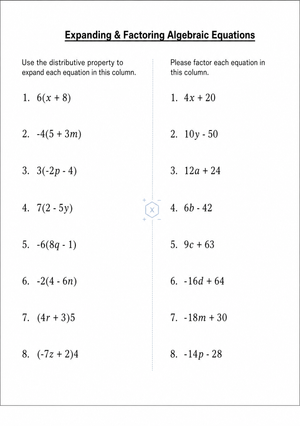
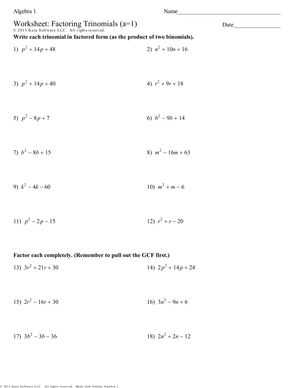
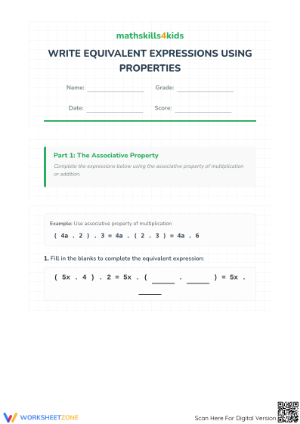
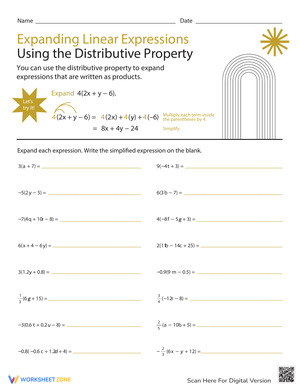
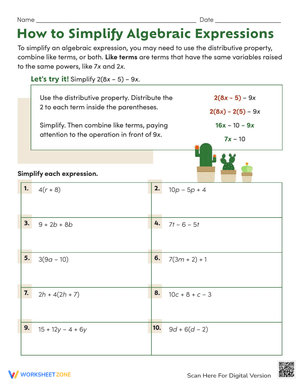
These 7th grade expressions pdf worksheets address the moment in middle school math that most teachers find genuinely tricky to navigate — the point where students stop calculating with known numbers and start reasoning about unknowns. That shift demands more than practice; it demands the right kind of practice, structured around the specific skills and misconceptions that show up consistently in Grade 7 classrooms. What this set gives teachers is focused, printable expression work that fits into instruction rather than sitting alongside it.
The Specific Skills These Worksheets Target
Expression work in Grade 7 covers more ground than most single-skill practice acknowledges. Four distinct tasks — evaluating, writing, simplifying, and applying — require different kinds of thinking, and students who handle one well sometimes fail on another entirely.
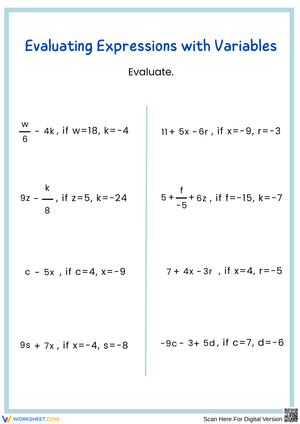
- Evaluating expressions: Students substitute integer values for variables and carry out multi-step calculations, attending carefully to order of operations and sign rules.
- Writing expressions from words: Students translate verbal descriptions — phrases like four less than twice a number or the sum of x and seven, divided by three — into proper algebraic notation.
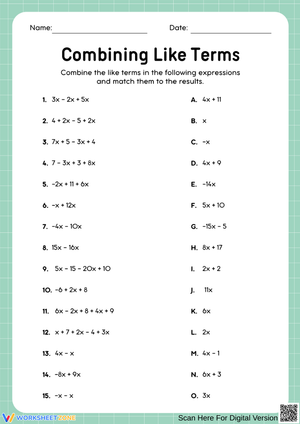
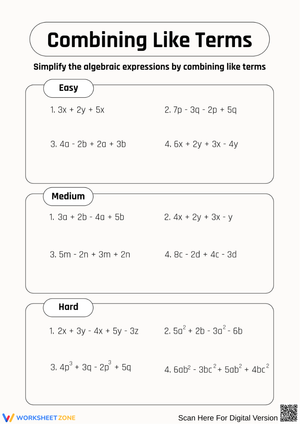
- Simplifying by combining like terms: Students rewrite expressions in equivalent form by grouping terms with matching variable parts, which requires both conceptual clarity and close attention to coefficients.
- Short application tasks: Students model simple real-world situations — cost problems, pattern rules, measurement relationships — using algebraic expressions, then interpret what each part of the expression represents.
A well-built set of worksheets moves students through all four of these. That matters because a student who evaluates accurately may still write n + 4 when a problem calls for 4n. Mixed practice surfaces those gaps before the unit assessment does.
Frequent Mistakes to Watch For in Student Work
The errors that appear in Grade 7 expression work follow predictable patterns, and knowing them in advance changes what teachers look for when circulating during practice.
The most persistent error is combining unlike terms. A student who correctly simplifies 3x + 5x to 8x will often also combine 3x + 5 into 8x, treating the constant as though it carries the same variable part. That error doesn't always surface on a page of pure like-terms problems — it shows up when problem types are mixed and students aren't pausing to identify the task.
Substitution with negative values produces its own consistent failure mode. When students substitute x = -3 into 2x + 7, many write 2 + (-3) + 7 instead of 2(-3) + 7, reading the coefficient as an addend rather than a factor. The wrong answer looks plausible, so students rarely catch it without an answer key that shows the correct substitution step, not just the final result.
Translation problems carry a third common error. "Five less than a number" reliably produces 5 - n rather than n - 5 among students who map word order directly into symbols. That reversal is worth naming explicitly before students practice translation independently — once the error is established, it takes more repetition to correct than it would have taken to prevent.
How These Worksheets Fit Into the Week
Expression practice works best in short, purposeful segments rather than extended silent-work blocks. In a 50-minute period, six to eight problems assigned right after direct instruction — not a full worksheet — gives teachers time to circulate and catch errors while the lesson is still fresh. Walking the room after students have done three or four problems, rather than waiting until everyone finishes, lets teachers pause for a quick correction before confusion hardens into a habit.
Bell ringers are another strong use. Three or four expression problems at the start of class — evaluate this, translate that, simplify this one — take about five minutes and serve as spaced retrieval of the previous lesson. Students who understood the concept stay sharp; students who didn't reveal exactly where they stalled. That information is more useful than waiting for the unit quiz to surface it.
For teachers running stations or rotations, each worksheet can anchor one stop. One station handles evaluation with integers, another covers writing expressions from verbal cues, a third focuses on combining like terms, and a fourth uses short application tasks. That format keeps groups focused and makes it easy to debrief each rotation in under two minutes.
These 7th grade expressions pdf worksheets also function cleanly as substitute-day materials — problems don't require setup beyond reading them, and an included answer key lets a non-math sub manage basic self-checking without running into trouble.
Adjusting the Work for a Range of Learners
The same expression task can run at very different difficulty levels depending on the numbers involved, the language load, and the structure given to the student. That makes this topic more adaptable than it first appears.
Students who need additional support do better with a reduced variable set and positive numbers only. Keep coefficients as whole numbers, use single-step evaluation before introducing multi-step, and leave generous blank space for showing substitution work line by line. A worksheet with eight well-chosen problems at this level produces more useful evidence of understanding than a crowded 25-item worksheet where the student rushes through and the errors pile up.
On-level practice should mix problem types so students practice identifying the task before solving it. That recognition step — this is evaluating, this is simplifying, this one is translating — mirrors what happens on an assessment and builds flexibility that single-skill drills alone don't develop.
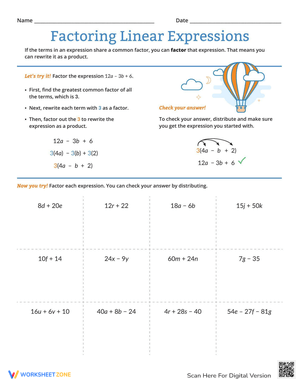
For students ready for greater challenge, add distributive property items alongside like-terms work, introduce rational coefficients, and include comparison tasks that ask whether two expressions are equivalent and why. Application problems where students write an expression, evaluate it for a given value, and explain what each term represents push both algebraic reasoning and mathematical communication simultaneously.
Answer keys support all of this. When students can check work independently, teachers stay available for small-group reteaching instead of fielding individual answer questions across the room. For 7th grade expressions pdf worksheets to function well in a mixed-ability setting, a clean, readable answer key isn't optional — it's part of how the resource does its job.
Standard Alignment
The expression work in these worksheets maps directly to two Grade 7 Common Core standards. CCSS.MATH.CONTENT.7.EE.A.1 calls for students to apply properties of operations to add, subtract, factor, and expand linear expressions with rational coefficients — which is exactly what combining like terms and rewriting equivalent expressions require. CCSS.MATH.CONTENT.7.EE.A.2 asks students to rewrite expressions in different forms within a problem context, which is where application tasks and translation problems earn their place in the unit.
In practice, both standards appear in the first quarter of most Grade 7 math sequences, before students move into solving equations and inequalities. Expression fluency at this stage functions as a direct prerequisite: students who can't reliably simplify or translate expressions will run into difficulty setting up and rearranging equations later in the year. Treating expression work as foundational — rather than a brief introductory unit — reflects what the standards progression actually requires.
Frequently Asked Questions
What is the difference between simplifying and evaluating an expression?
Evaluating means substituting a specific value for each variable and calculating a numerical result. Simplifying means rewriting an expression in an equivalent, cleaner form — usually by combining like terms — without assigning values to the variables. Both skills appear in Grade 7 expression work, and students often conflate them until they've practiced both enough to recognize the difference at the start of a problem.
Do these worksheets come with answer keys?
Yes. Answer keys are included with these resources. For expression practice, a clear key matters more than it might for other topics — negative signs, parentheses placement, and the correct simplified form of a combined expression all need to be readable at a glance, especially when students are self-checking or when a teacher is working with a pull-out group and can't monitor the room simultaneously.
How do these worksheets fit into a unit sequence?
Most teachers introduce expressions early in the school year, before equations and inequalities. Within an expressions unit, a logical order moves from vocabulary and basic evaluation to writing from verbal cues, then simplifying by combining like terms, and finally short application tasks. The 7th grade expressions pdf worksheets in this set support that sequence — each worksheet targets one primary skill, which makes it straightforward to pull exactly what a lesson calls for rather than sorting through a general review packet for the relevant problems.
Can these be used for reteaching or intervention?
They work well for that purpose. Because each worksheet targets a distinct skill, a teacher can identify exactly where a student broke down — substitution errors, sign errors in simplification, translation reversals — and assign the relevant practice without re-exposing the student to skills already mastered. That specificity makes reteaching more efficient than handing a student a general review worksheet and hoping the right problems happen to appear.













 Interactive Worksheet Maker
 Quiz Maker
 Word Search Maker
 Crossword Puzzle Maker
 Word Scramble Generator
 Sentence Scramble Generator
 Handwriting Worksheet Generator
 Name Tracing Generator
 Fill In The Blank Generator