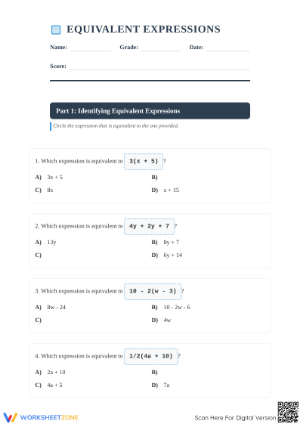
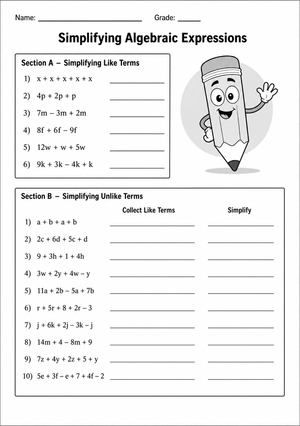
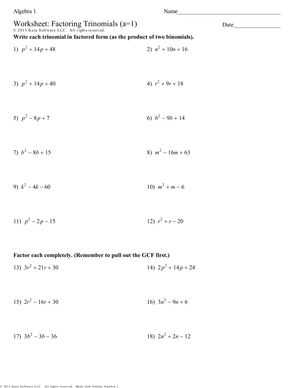
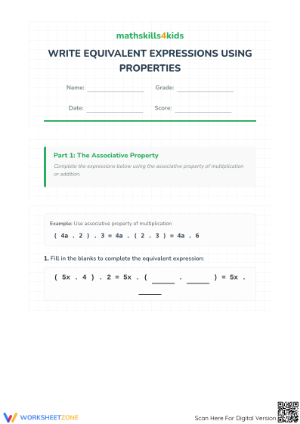
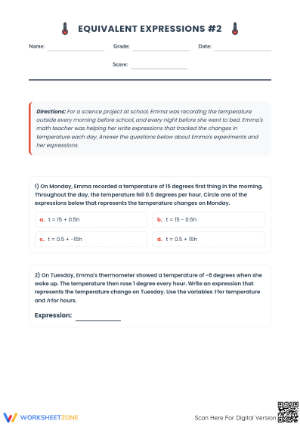
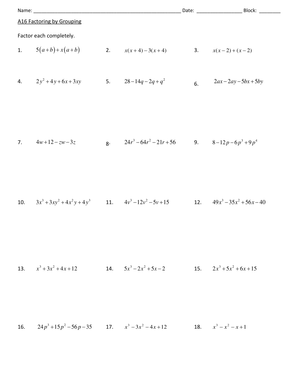
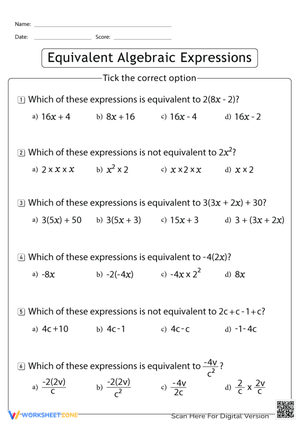
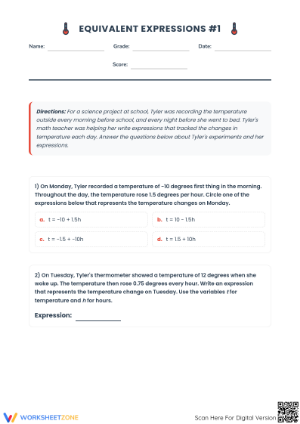
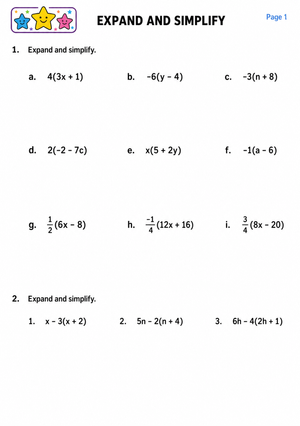
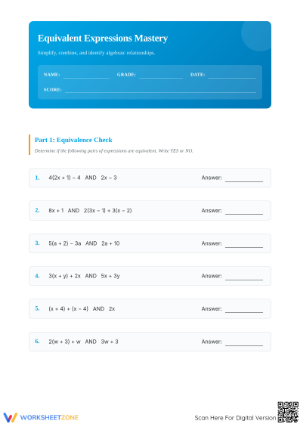
Equivalent expressions printable worksheets for 7th grade target a skill that sits at the heart of early algebra: recognizing that two expressions can look completely different and still describe the same quantity for every value of the variable. This set gives teachers immediate access to targeted practice — across the distributive property, combining like terms, and equivalence reasoning — and makes visible whether students understand the concept or are only following a memorized procedure.
Mistakes Students Make That These Worksheets Surface
The most persistent error in this domain isn't a computation slip — it's categorical. Students who add integers correctly will still write 3x + 4 = 7x, treating the constant as a like term simply because both terms appear in the same expression. The problem isn't carelessness; it's that students haven't yet internalized what distinguishes a variable term from a constant. A second error appears the moment negative signs enter the work: expanding 2(x − 5) as 2x − 5 instead of 2x − 10 is predictable enough that it's worth building an entire worksheet around that single distribution move before stacking in further complexity.
Two more patterns show up in 7th grade student work with some regularity. Some students who have just learned the distributive property try to apply it where it doesn't belong — treating the addition sign in 3x + 4 as a cue to distribute. And many students resist accepting that 4(y − 2) and 4y − 8 are equivalent because "they look different." That resistance isn't stubbornness; it flags a genuine gap in what the student understands equivalence to mean, not just how to produce it.
What Each Worksheet Builds
Each worksheet in the set targets specific moves within the broader skill of rewriting expressions. The core item types across the collection include:
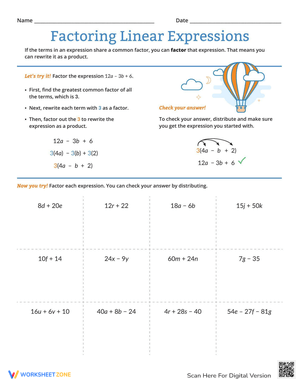
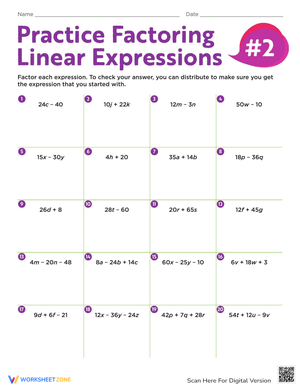
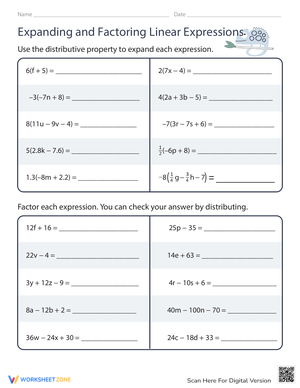
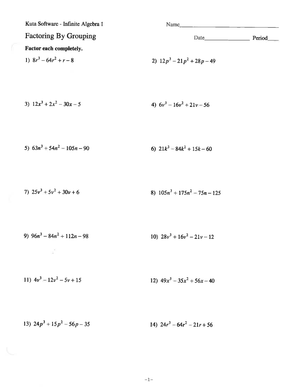
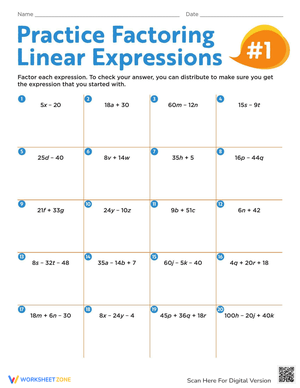
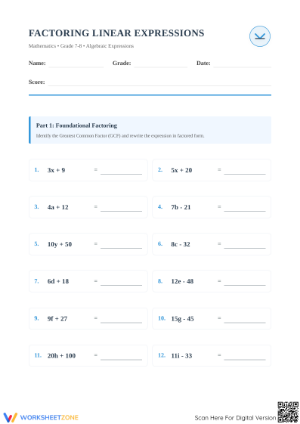
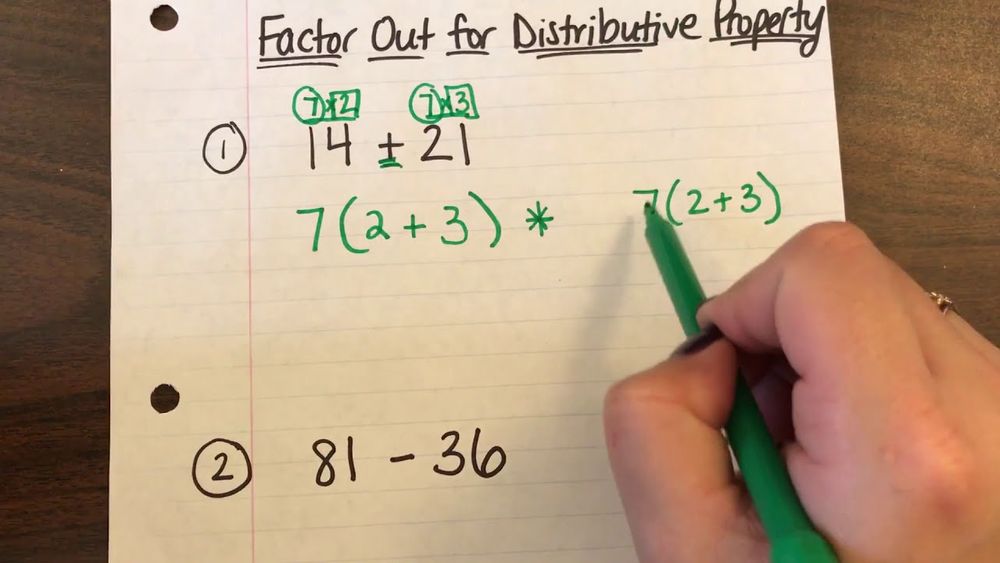
- Distributive property — both directions: Students expand 3(x + 4) into 3x + 12 and also move from 6n + 18 back to 6(n + 3). Working in both directions matters because most students learn expansion first and need deliberate practice reversing the process.
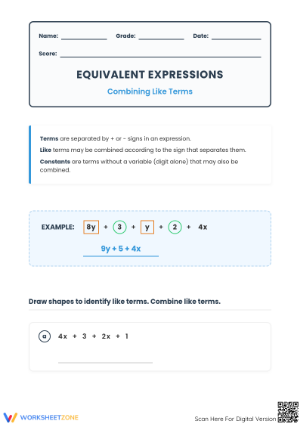
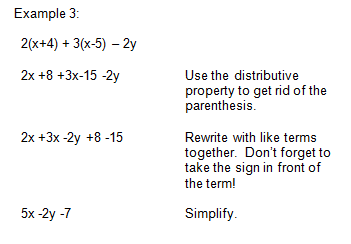
- Combining like terms: Problems include positive and negative coefficients, constants mixed with variable terms, and expressions with more than one variable — not just simple two-term setups.
- Equivalence verification: Students determine whether a given pair of expressions is equivalent and write a brief justification. This is where conceptual understanding shows up distinctly from procedural fluency.
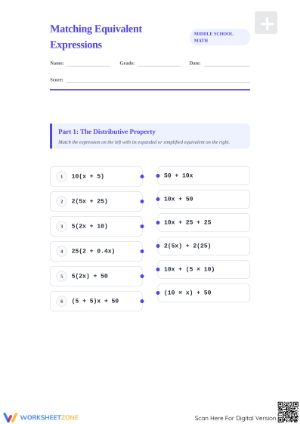
- Matching tasks: Students pair expressions that represent the same quantity, which reduces writing load while keeping the reasoning central.
- Error analysis: Students examine incorrect student work — for instance, a solution that simplifies 5a + 2a − 3 as 4a — and identify exactly where the error occurred and why it is wrong.
- Open generation: Students write a new expression equivalent to a given one and name the property or operation used. This task separates students who have internalized the concept from those still dependent on a fixed set of steps.
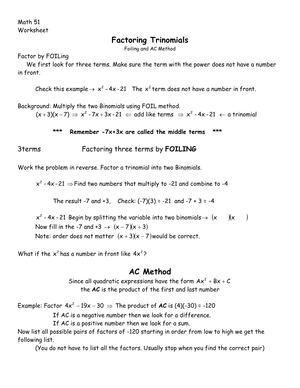
Teachers consistently observe that students handle expansion more comfortably than factoring or independent generation. A set that moves in both directions — and asks students to produce, not just recognize — makes that distinction visible early enough to address it during the unit rather than at the assessment.
Working These Worksheets Into Your Daily Math Block
A short three- to four-problem worksheet makes a strong bell ringer at the start of class, especially early in the unit when students need daily contact with the vocabulary and notation. The matching worksheets are well suited to partner work — students tend to talk through their reasoning when comparing columns, and that conversation is often more instructive than silent solo practice. Error analysis worksheets fit the ten minutes before the end of a block when students are tiring but can still engage critically with a concrete worked example rather than generating from scratch.
Equivalent expressions printable worksheets for 7th grade also fit naturally into small-group reteaching. A focused worksheet on distributing a negative — six to eight items built around that single operation — lets an intervention group work through the most common stumbling block without navigating a full mixed-review worksheet. Across a unit, teachers generally find a repeatable rotation that works: direct instruction, short practice worksheet, partner check, then a brief exit item from the same set to close the lesson and inform the next day's groupings.
Standard Alignment
These worksheets address CCSS 7.EE.A.1, which asks students to apply properties of operations to add, subtract, factor, and expand linear expressions with rational coefficients. In classroom terms, this standard appears early in the Grade 7 expressions and equations unit and carries forward into solving equations and understanding proportional relationships. Students who develop fluency here — particularly in moving between factored and expanded forms — enter the equation-solving strand with a stronger intuition about expression structure. The worksheets also support 7.EE.A.2, which adds the expectation that students rewrite expressions in different forms to shed light on the meaning of a quantity, not only to complete a procedure.
Adjusting the Set for a Range of Learners
Start students who are still building number sense with expressions that use only positive integer coefficients and a single variable. Once those students can reliably combine like terms and expand correctly, introduce subtraction, then negative coefficients — not at the same time, since layering both challenges into one problem produces errors that are harder to diagnose cleanly. Equivalent expressions printable worksheets for 7th grade organized by task type let teachers pull specific items for specific groups rather than assigning an entire worksheet uniformly.
For students who are ready for more, open-generation tasks carry the most weight: ask them to write three different expressions equivalent to 12x − 4 using three different strategies, then justify each. Matching worksheets serve as a strong entry point for students who struggle with extended writing — they work through the same conceptual reasoning without the barrier of generating expressions from scratch. Students who are strong procedurally but weak on justification benefit most from equivalence-verification items paired with a sentence frame to structure their explanation, such as "These expressions are equivalent because ___."
Frequently Asked Questions
How do students check whether two expressions are equivalent without relying on teacher confirmation?
The most practical method at this grade level is substitution: plug in a value for the variable and check whether both expressions produce the same result. This builds the correct intuition — equivalence means the same output for every value of the variable. It's worth pairing this strategy with a brief discussion of why a single substitution doesn't confirm equivalence in every case, which opens a useful conversation about what would actually constitute proof at this level.
What separates simplifying an expression from finding an equivalent one?
Simplifying is one path to an equivalent expression, but equivalence is broader. When students simplify 2x + 5 + 3x − 1 to 5x + 4, they've produced an equivalent form. But 5(x + 4) − 16 is also equivalent to the original, and no standard simplification step leads there directly. Pointing this out shifts students away from thinking there is one correct equivalent expression and toward understanding that the full set of equivalent expressions is infinite — a conceptual shift that matters for the rest of algebra.
Can these worksheets support students who haven't fully consolidated integer operations?
The sign-error pattern that shows up in equivalent expressions work is almost always rooted in shaky integer arithmetic — particularly adding and subtracting negatives. If students are consistently losing signs when combining terms or distributing, a short integer operations review running alongside equivalent expressions practice usually resolves the pattern faster than reteaching distribution rules in isolation. The equivalent expressions printable worksheets for 7th grade that center on error analysis are especially useful here because they ask students to slow down and locate the specific step where a sign change went wrong, which often reveals whether the issue is operational or conceptual.
How much practice do students typically need before a unit assessment?
The structure of practice matters more than the volume. Students who work through a deliberate mix of item types — at least one equivalence-verification task and one error analysis task alongside standard simplification — tend to perform better on assessments that require explanation than students who completed more problems of a single format. A compact mixed-review worksheet used as a self-check two days before the assessment, rather than as new instruction, is more effective than a long drill the night before.













 Interactive Worksheet Maker
 Quiz Maker
 Word Search Maker
 Crossword Puzzle Maker
 Word Scramble Generator
 Sentence Scramble Generator
 Handwriting Worksheet Generator
 Name Tracing Generator
 Fill In The Blank Generator