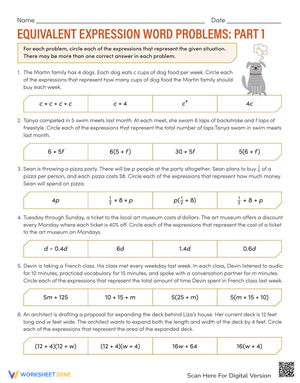
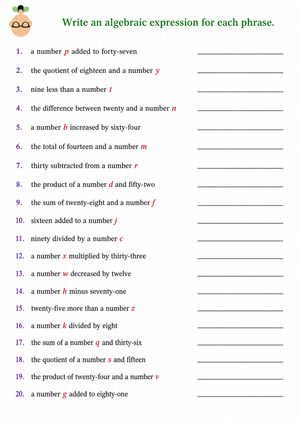
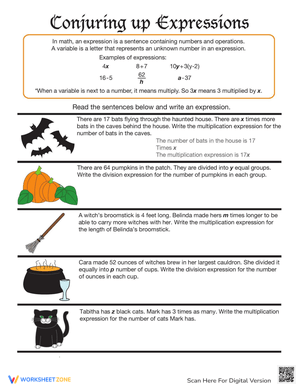
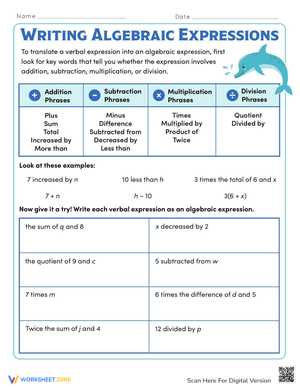
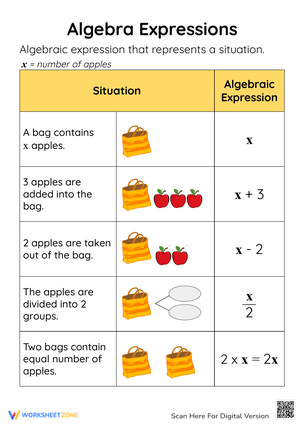
These writing expressions printable worksheets for 7th grade give teachers a targeted bridge into algebra—the moment when students move from arithmetic fluency to representing unknown quantities in variable form. The practice centers on translation: students read a word phrase, parse its structure, and write the corresponding expression without solving for a value. That distinction between representing and solving is exactly what this skill set builds.
The Specific Skills These Worksheets Build
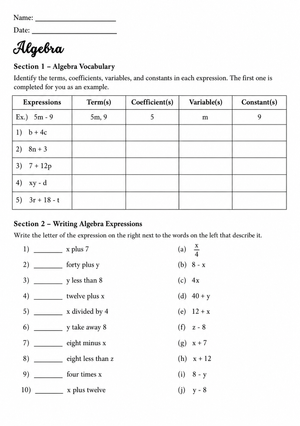
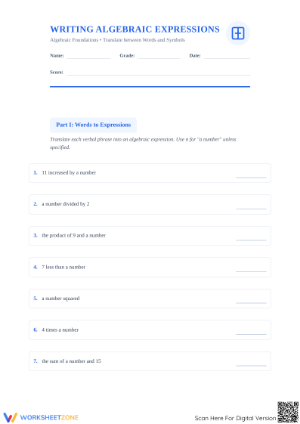
The set moves from single-operation phrases to layered, multi-step verbal expressions. Early items are clear entry points—8 more than n, the product of 4 and x—where one operation and one variable form the complete task. Later items introduce real complexity: 3 less than twice a number, or the quantity of p plus 7, divided by 2. That second type requires students to hold the full phrase in mind before writing, because word order in English does not always match operation order in algebra.
Across the worksheets, students work through:
- Phrase-to-expression translation: converting word phrases into variable expressions with the correct operation and order
- Operation vocabulary: treating terms like sum, quotient, increased by, and decreased by as precise mathematical signals rather than casual synonyms
- Order sensitivity: recognizing that 5 less than x and x minus 5 are not equivalent and do not share the same written form
- Grouping with parentheses: identifying when phrases like the quantity of change an expression's structure entirely
- Expression versus equation awareness: practicing representation without defaulting to an equals sign
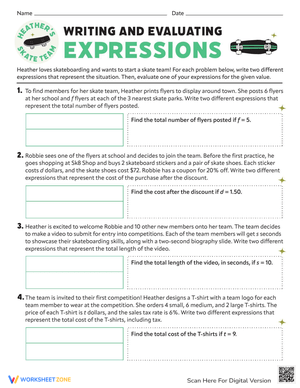
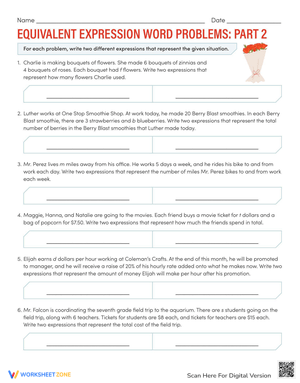
- Context problems: pulling variable relationships from shopping totals, perimeter descriptions, age comparisons, and similar short scenarios
Context problems matter specifically at this level. Students who handle isolated vocabulary items fluently often pause when the same operation appears inside a three-sentence scenario. Including both item types on the same worksheet surfaces that gap while the skill is still new enough to correct.
Student Errors This Work Surfaces Early
Reversal is the most consistent mistake at this level, and it has a specific shape: students read 5 less than x and write 5 - x. They are transcribing left to right as they read rather than holding the full phrase before writing, so the first quantity they encounter becomes the first quantity they record. This is not a sign that students misunderstand subtraction—it is a sign that they have not yet separated algebraic phrase structure from English sentence order.
Division language produces the same pattern. The quotient of a number and 4 becomes 4 ÷ n because students are still reading and writing simultaneously when 4 appears in the phrase. Placing a correct expression next to an incorrect one and asking students to explain the difference in words does more to fix this than additional drill on the same phrase type.
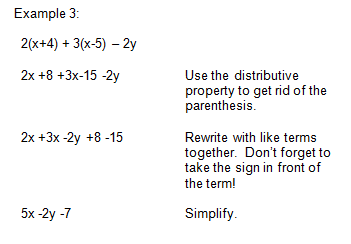
Missing parentheses are the second predictable error. Students who correctly write 2n + 6 for twice a number plus 6 often produce the same expression for the quantity of a number plus 6, times 2—same numbers, same operations, so they assume the same notation. Grouping language reads to them as emphasis rather than structure. A third, subtler problem: students write equations when the prompt asks only for an expression. A sentence-style prompt primes them for a complete statement, so they add an equals sign automatically. Task formatting that keeps translation, evaluation, and solving on clearly labeled separate worksheets addresses this more reliably than any verbal reminder during class.
Where These Worksheets Fit Into Your Lesson Week
Front-loading practice as a warm-up—4 to 6 phrase-translation items before instruction opens—is one of the most effective classroom uses for writing expressions printable worksheets for 7th grade. When students attempt phrases cold, the errors they produce become the teaching material. If three students wrote 5 - x for a "less than" phrase, there is a visible, immediate reason to model the correct reading strategy during the opening minutes of class—not after the lesson, when the moment has passed.
During the main lesson block, a full worksheet moves students through multiple formats in one sitting: phrase-only items, two-step items, and short context scenarios. Translation fluency on isolated phrases does not automatically transfer to scenario-based problems, and varied formats on the same worksheet make that gap visible in real time. Students see where their understanding holds and where it does not, which gives peer conferencing and teacher check-ins a concrete focus.
Intervention groups benefit from more targeted use. Rather than reteaching the full unit, pull a small group and work through only the subtraction-language or division-language items during a flex block or the last 10 minutes of class while others work independently. That focused session addresses the specific error pattern without requiring the group to start over from the beginning of the skill.
Standard Alignment
The organizing standard here is CCSS 6.EE.A.2, which asks students to write, read, and evaluate expressions in which letters stand for numbers. That standard is formally coded at grade 6, but writing expressions printable worksheets for 7th grade serve a genuine instructional purpose at this level because many students arrive without fluent command of multi-step phrase translation or grouping notation. Placing this practice early in the year gives teachers a diagnostic read on which students have consolidated that 6th grade work before the class moves into 7.EE.A—adding, subtracting, and factoring linear expressions—where translation is assumed rather than explicitly taught.
Adjusting the Worksheets for Students at Different Levels
Students who are still building operation vocabulary benefit from sorted practice before mixed review. When each worksheet focuses on one operation type—all subtraction phrases, then all division phrases—students develop pattern recognition without having to context-switch between vocabularies on every item. Adding a sentence frame ("The variable represents ___, the operation is ___, so I write ___") reduces the number of decisions a student manages at once, which means errors are more likely to reflect actual confusion than cognitive overload.
For students who move through phrase translation without difficulty, the same worksheets support extension through a shift in task demand rather than a change in content. Ask them to examine a peer's incorrect expression and write a precise explanation of what went wrong. Or ask them to produce two non-equivalent expressions that both describe a given scenario and explain what makes them different. Those tasks stay anchored to the translation skill while requiring the kind of written mathematical reasoning that later grades treat as routine.
Frequently Asked Questions
What prior knowledge should students have before starting this practice?
Students should be familiar with the four operations in word form, understand that a variable represents an unknown quantity, and recognize basic vocabulary like sum, difference, product, and quotient. Students who are still unclear on what a variable represents need a brief conceptual grounding before phrase-to-expression translation makes sense to them.
How do I help students stop reversing phrases like "5 less than x"?
Slow the reading down before any writing begins. Teach students to underline the variable phrase, circle the operation word, and decide which quantity is being subtracted from which—all before writing anything. Placing a correct expression next to an incorrect one and asking students to describe the difference in words builds the habit of parsing structure rather than transcribing left to right.
Can these worksheets work as homework assignments?
Phrase-translation items with one or two operations and clear vocabulary work well as homework review. Longer context scenarios are better reserved for class, where students can raise questions when a scenario is unfamiliar or the phrasing is unclear. Using writing expressions printable worksheets for 7th grade as homework is most effective once students have worked through similar items in class at least once—otherwise reversal errors tend to calcify before a teacher can address them.
What should I do when students write an equation instead of an expression?
This is a task-type confusion rather than a conceptual error about what expressions are. Students who do this have internalized math tasks as "solve for the answer" and apply that habit automatically. Using worksheets that label task types clearly—"Write an expression" on its own, separated from any solving work—and a brief non-example at the start of the lesson ("Here is what this prompt is not asking you to do") usually stops the pattern before it appears across a full set of items.













 Interactive Worksheet Maker
 Quiz Maker
 Word Search Maker
 Crossword Puzzle Maker
 Word Scramble Generator
 Sentence Scramble Generator
 Handwriting Worksheet Generator
 Name Tracing Generator
 Fill In The Blank Generator