




























0
Views
0
Downloads

Save
0 Likes
Share
Good vs Bad Communication Analysis Worksheet
0 Views
0 Downloads

Paste this activity's link or code into your existing LMS (Google Classroom, Canvas, Teams, Schoology, Moodle, etc.).
Students can open and work on the activity right away, with no student login required.
You'll still be able to track student progress and results from your teacher account.
Information
Description
What It Is:
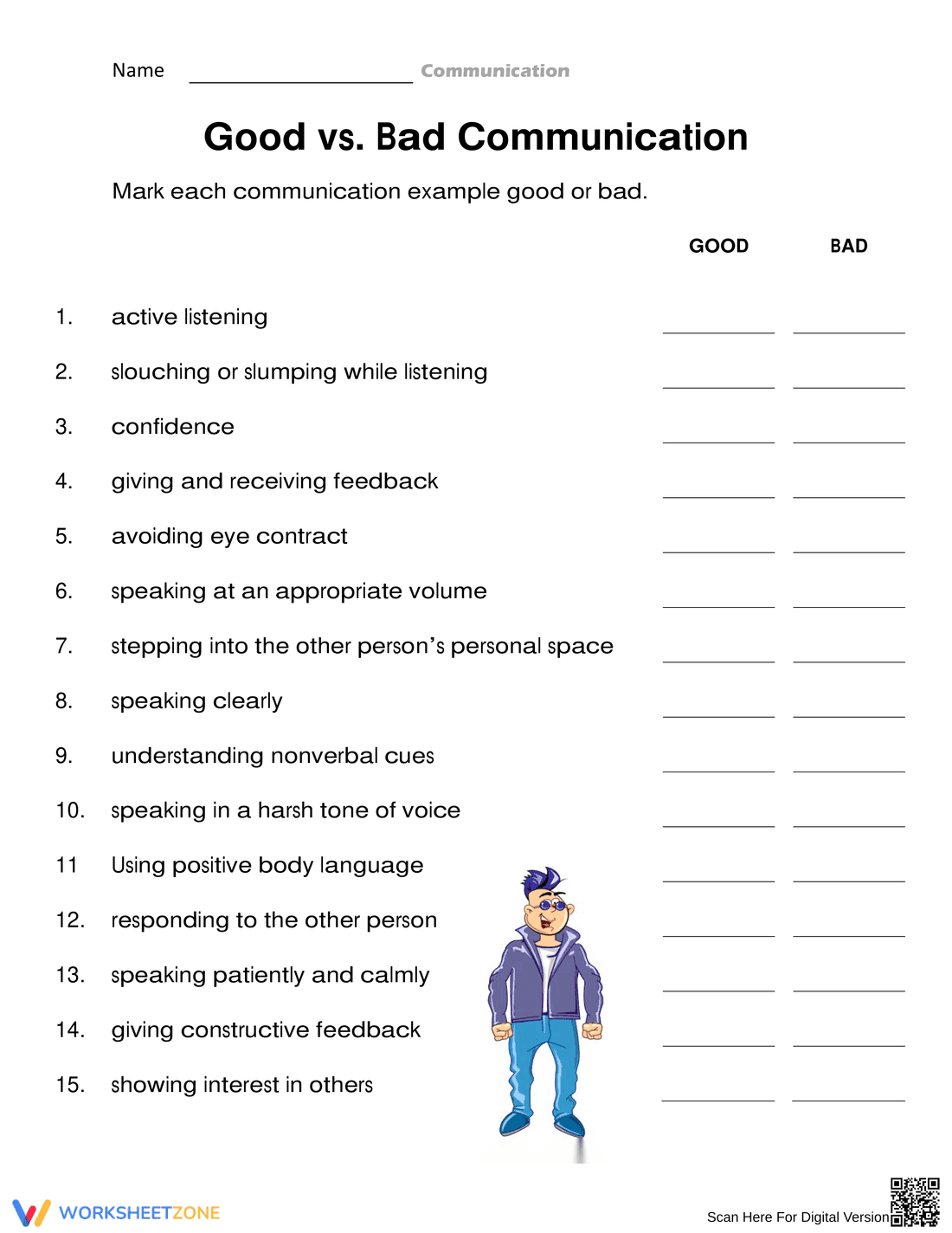
This is a worksheet titled 'Good vs. Bad Communication.' It presents a list of 15 different communication behaviors and asks the student to identify each one as either 'Good' or 'Bad' by marking the appropriate column. Examples include active listening, slouching, confidence, avoiding eye contact, and speaking in a harsh tone of voice. There is also a cartoon image of a person included on the page.
Grade Level Suitability:
This worksheet is suitable for grades 4-8. The concepts are relatively straightforward, but the vocabulary and critical thinking required to evaluate the communication examples are appropriate for upper elementary and middle school students.
Why Use It:
This worksheet helps students develop an understanding of effective communication skills and identify behaviors that hinder positive interactions. It promotes critical thinking and self-reflection on their own communication habits. It reinforces the importance of verbal and nonverbal cues in communication.
How to Use It:
Students should read each communication example carefully and determine whether it represents good or bad communication. They should then mark either the 'Good' or 'Bad' column next to each statement. The worksheet can be used as an individual activity, a group discussion starter, or as part of a larger lesson on communication skills.
Target Users:
This worksheet is ideal for teachers, counselors, and parents who want to teach children and adolescents about effective communication. It is also useful for students in social skills groups or character education programs.
This is a worksheet titled 'Good vs. Bad Communication.' It presents a list of 15 different communication behaviors and asks the student to identify each one as either 'Good' or 'Bad' by marking the appropriate column. Examples include active listening, slouching, confidence, avoiding eye contact, and speaking in a harsh tone of voice. There is also a cartoon image of a person included on the page.
Grade Level Suitability:
This worksheet is suitable for grades 4-8. The concepts are relatively straightforward, but the vocabulary and critical thinking required to evaluate the communication examples are appropriate for upper elementary and middle school students.
Why Use It:
This worksheet helps students develop an understanding of effective communication skills and identify behaviors that hinder positive interactions. It promotes critical thinking and self-reflection on their own communication habits. It reinforces the importance of verbal and nonverbal cues in communication.
How to Use It:
Students should read each communication example carefully and determine whether it represents good or bad communication. They should then mark either the 'Good' or 'Bad' column next to each statement. The worksheet can be used as an individual activity, a group discussion starter, or as part of a larger lesson on communication skills.
Target Users:
This worksheet is ideal for teachers, counselors, and parents who want to teach children and adolescents about effective communication. It is also useful for students in social skills groups or character education programs.


