


























0
Views
0
Downloads

0.0
0
Save
0 Likes
Share
Exploring Opposite Feelings Worksheet
0 Views
0 Downloads
Paste this activity's link or code into your existing LMS (Google Classroom, Canvas, Teams, Schoology, Moodle, etc.).
Students can open and work on the activity right away, with no student login required.
You'll still be able to track student progress and results from your teacher account.
Information
Description
What It Is:
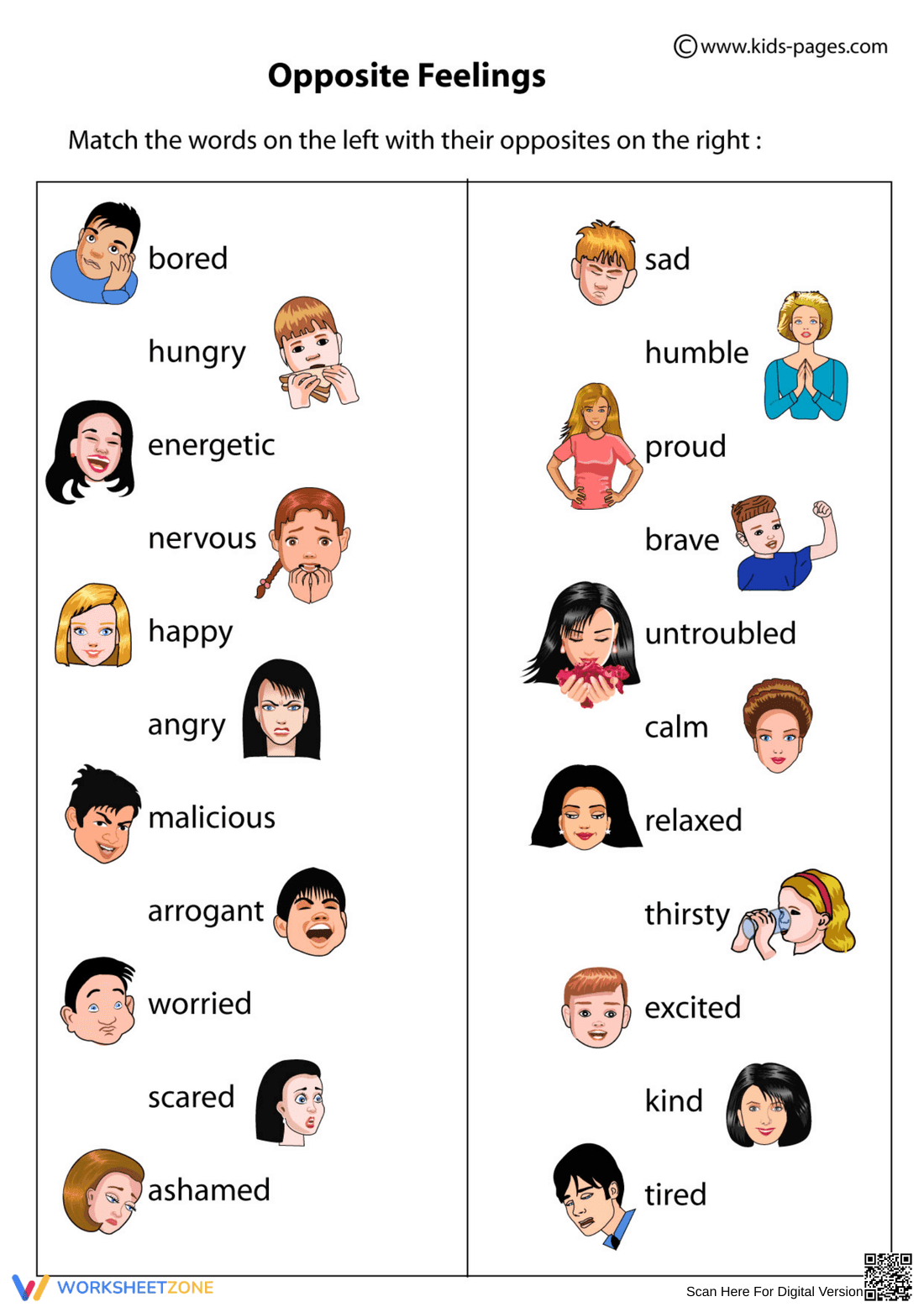
This is a worksheet titled 'Opposite Feelings.' It presents two columns of words describing feelings. The left column includes words like 'bored,' 'hungry,' 'energetic,' 'nervous,' 'happy,' 'angry,' 'malicious,' 'arrogant,' 'worried,' 'scared,' and 'ashamed.' The right column includes words like 'sad,' 'humble,' 'proud,' 'brave,' 'untroubled,' 'calm,' 'relaxed,' 'thirsty,' 'excited,' 'kind,' and 'tired.' Each word is accompanied by a cartoon illustration of a person displaying the corresponding emotion. The task is to match each word on the left with its opposite on the right.
Grade Level Suitability:
This worksheet is suitable for kindergarten to 2nd grade (K-2). The vocabulary is relatively simple and the illustrations provide visual cues, making it accessible to young learners. The matching activity is a common exercise for this age group.
Why Use It:
This worksheet helps children expand their vocabulary related to emotions and understand the concept of opposites. It encourages critical thinking as students must analyze the meaning of each word and identify its antonym. It also promotes emotional literacy by connecting words with visual representations of feelings.
How to Use It:
Students can draw lines connecting each word in the left column to its opposite in the right column. Alternatively, they can write the corresponding letter or number of the opposite word next to each word on the left. The teacher can then review the answers and discuss the different emotions with the students.
Target Users:
This worksheet is ideal for young children in elementary school (K-2), ESL students learning English vocabulary, and children with special needs who benefit from visual aids and simple instructions. It can also be used as a supplemental activity for social-emotional learning programs.
This is a worksheet titled 'Opposite Feelings.' It presents two columns of words describing feelings. The left column includes words like 'bored,' 'hungry,' 'energetic,' 'nervous,' 'happy,' 'angry,' 'malicious,' 'arrogant,' 'worried,' 'scared,' and 'ashamed.' The right column includes words like 'sad,' 'humble,' 'proud,' 'brave,' 'untroubled,' 'calm,' 'relaxed,' 'thirsty,' 'excited,' 'kind,' and 'tired.' Each word is accompanied by a cartoon illustration of a person displaying the corresponding emotion. The task is to match each word on the left with its opposite on the right.
Grade Level Suitability:
This worksheet is suitable for kindergarten to 2nd grade (K-2). The vocabulary is relatively simple and the illustrations provide visual cues, making it accessible to young learners. The matching activity is a common exercise for this age group.
Why Use It:
This worksheet helps children expand their vocabulary related to emotions and understand the concept of opposites. It encourages critical thinking as students must analyze the meaning of each word and identify its antonym. It also promotes emotional literacy by connecting words with visual representations of feelings.
How to Use It:
Students can draw lines connecting each word in the left column to its opposite in the right column. Alternatively, they can write the corresponding letter or number of the opposite word next to each word on the left. The teacher can then review the answers and discuss the different emotions with the students.
Target Users:
This worksheet is ideal for young children in elementary school (K-2), ESL students learning English vocabulary, and children with special needs who benefit from visual aids and simple instructions. It can also be used as a supplemental activity for social-emotional learning programs.


