These 6th grade heat transfer printable worksheets give science teachers a ready-to-use set of practice activities targeting conduction, convection, and radiation through classification tasks, diagram labeling, short scenarios, and written explanation prompts. The activities move students from recognizing familiar examples to explaining the mechanism behind each one — a shift that most sixth graders need explicit, repeated practice to make.
The Specific Skills Covered in Each Worksheet
Each worksheet in the set targets one or more of the core skills students need before a heat transfer unit assessment. The range of task types means teachers can pull the right worksheet for the lesson stage rather than forcing one format to do every job.
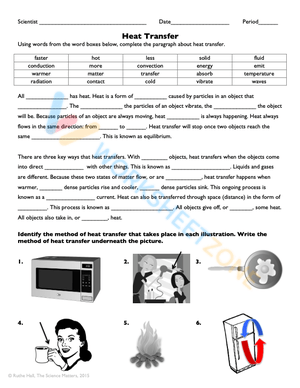
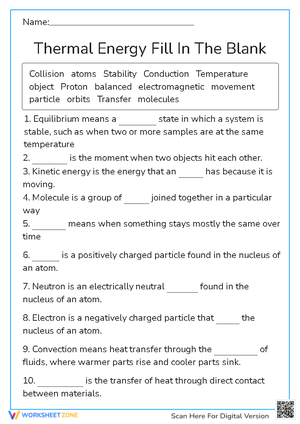
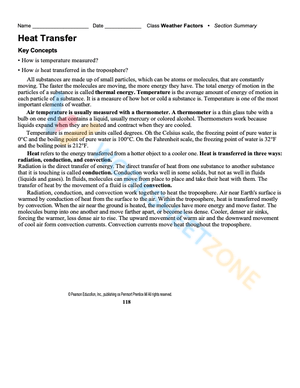
- Vocabulary work: Students match terms — heat, thermal energy, conduction, convection, radiation — to definitions and then use those terms in their own sentences to reinforce meaning in context.
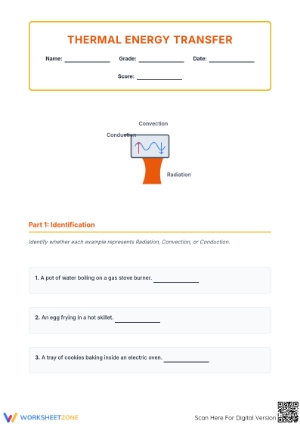
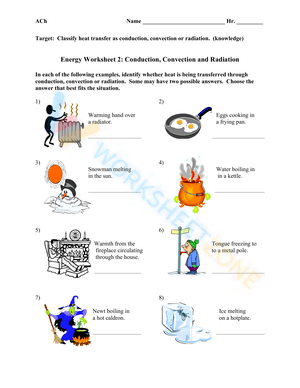
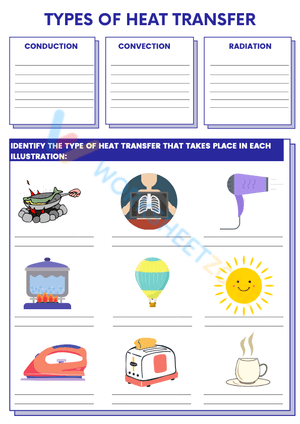
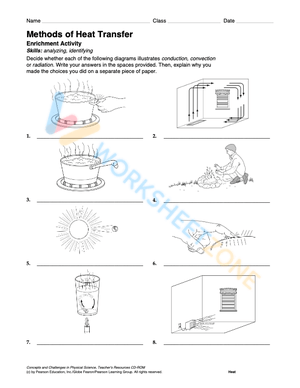
- Classification practice: Students read short, realistic scenarios and label each as conduction, convection, or radiation. A sample item: a metal bench left in the afternoon sun that feels hot even through your jeans.
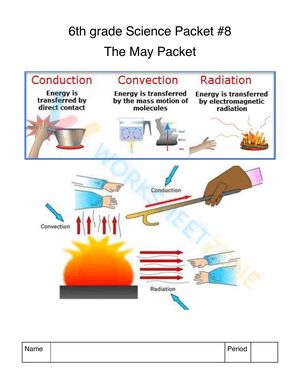
- Diagram labeling: Students mark the direction of heat movement on cross-section illustrations of a pot on a stove, a sunny window, and a campfire setup.
- Scenario-based explanation: Short written prompts ask students to identify the transfer type and explain why, using the principle that energy moves from warmer to cooler areas.
- Compare-and-contrast tasks: Students identify what conduction and radiation share and how they differ — a check on whether students genuinely understand the role of physical contact.
The set deliberately avoids advanced physics vocabulary beyond what sixth graders are expected to use. The goal is accurate application of the three mechanisms, not memorization of equations or particle-level math.
Student Errors Worth Anticipating Before You Teach This Unit
The most persistent error in sixth-grade heat transfer work is what you might call the contact problem with radiation. Students who have correctly learned that conduction requires touching will sometimes extend that logic to all heat transfer — so they classify sunlight warming a sidewalk as conduction because the light "hits" the surface. This error appears consistently in short-response questions and is worth naming explicitly during instruction before students attempt classification tasks independently.
A second error is treating convection as an air-only phenomenon. Ask students whether soup heating in a pot involves convection, and a notable portion will say no because there is no air involved. They have memorized "warm air rises" without internalizing that any fluid — liquid or gas — convects. Worksheets that place steam and boiling water as separate examples in the same activity help students catch this gap themselves.
There is also a persistent vocabulary confusion between heat and temperature. Students write that "temperature transfers" or that "cold moves into the room," which reverses the actual direction of energy flow. Short written explanations surface this problem in a way that multiple-choice questions rarely will, which is one reason the set weights explanation prompts heavily.
How to Work These Worksheets Into Your Instruction
The sequence that holds up best in a 50-minute class is a three-part structure: a 5-item classification bell ringer shown on the board, a brief teacher demonstration — a metal spoon lowered into hot water, a lamp held near the back of the hand — and then an independent or partnered worksheet asking students to explain what they observed using accurate vocabulary. That predict-observe-explain arc is a reliable middle school science structure, and these worksheets fit cleanly into the explanation stage without any additional setup.
These 6th grade heat transfer printable worksheets also work well in station rotations. One station can use the vocabulary matching worksheet, a second can run the diagram labeling activity, and a third can present scenario explanation prompts. Stations keep the cognitive demand focused at each stop and prevent students from skipping ahead to easier items before working through harder ones.
For days when a substitute is covering the class, the classification and diagram worksheets work without prior teacher explanation — students can read the brief directions independently and use an answer key left for self-checking. For end-of-unit review, the comparison and explanation worksheets give students practice with the question style that appears most often on middle school science assessments.
Adjusting the Work for a Range of Learners
For students who need more support, start with picture-based classification before moving to text. Showing a photograph of a candle flame, a heating vent, and a campfire and asking students to sort removes the reading barrier without reducing the science demand. Sentence frames help here too: "This is an example of ___ because the heat moves through ___ without / with direct contact." Students who struggle to generate language independently can still produce correct scientific reasoning when a language structure is provided.
On-level learners generally handle the scenario questions and diagram labeling without modification. The diagrams show heat flow direction with arrows, which gives students enough visual information to check their own thinking.
For advanced learners, the most useful extension is to remove the answer choices and ask students to write the classification and justification from scratch — then construct a fourth scenario of their own for each transfer type. Students who can write a conduction example involving two unlike materials, explain why it qualifies, and distinguish it from a similar-sounding radiation example have demonstrated understanding well beyond the standard. These 6th grade heat transfer printable worksheets adapt easily for this: cover the multiple-choice options before copying, and the activity becomes a generation task rather than a recognition task.
Standard Alignment
These worksheets align with NGSS MS-PS3-3, which asks students to apply scientific principles to explain how thermal energy transfer occurs across different materials and contexts. At the sixth-grade level, MS-PS3-3 typically appears after students have explored kinetic molecular theory and before they move into energy transformation in life or earth science units. The classification and explanation tasks in the set directly address Disciplinary Core Idea PS3.B: Conservation of Energy and Energy Transfer — specifically the expectation that students distinguish the mechanisms by which thermal energy moves between objects and systems, and that heat flows spontaneously from hotter regions toward cooler ones.
Frequently Asked Questions
Do these worksheets cover all three types of heat transfer together, or is each mechanism treated separately?
Each worksheet addresses conduction, convection, and radiation together. Some tasks ask students to work with all three in a single activity; others pair two mechanisms side by side — conduction and radiation, for example — to highlight the contrast. No worksheet treats any one mechanism in isolation, because the instructional value comes from comparing all three.
Are these worksheets suitable for students who have not yet had a formal lesson on heat transfer?
A few worksheets in the set work as pre-teaching activities because the vocabulary terms are defined within the task itself. These are useful on the first or second day of a unit when students are meeting the terms for the first time. Others assume students have already been introduced to all three mechanisms and are ready for application practice. The answer keys make it straightforward to determine which worksheets require prior knowledge before assigning.
What answer formats does the set include?
The set includes matching, labeling, multiple-choice, short-answer explanation, and comparison tasks. That variety means teachers can use these 6th grade heat transfer printable worksheets for purposes ranging from a 5-minute exit check to a full-period review session without students feeling like they are repeating the same activity format throughout the unit.












 Interactive Worksheet Maker
 Quiz Maker
 Word Search Maker
 Crossword Puzzle Maker
 Word Scramble Generator
 Sentence Scramble Generator
 Handwriting Worksheet Generator
 Name Tracing Generator
 Fill In The Blank Generator