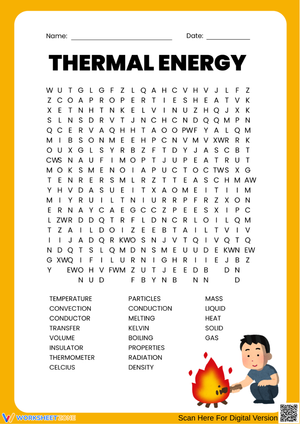
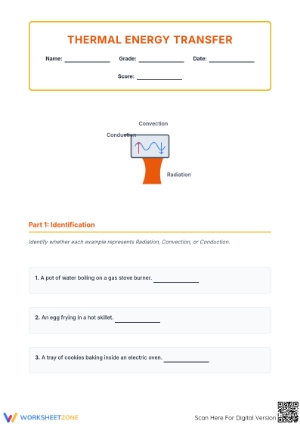
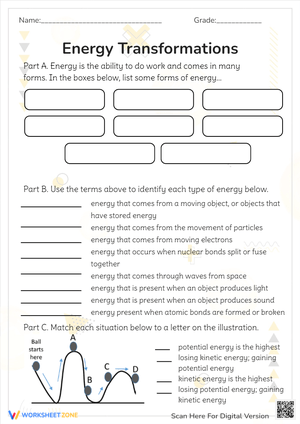
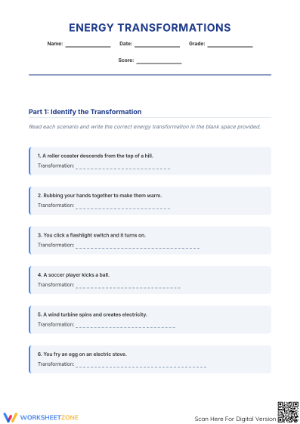
6th grade forms of energy worksheets help teachers catch the specific moment when students stall — when a student can recite "thermal energy comes from heat" but can't identify it in a campfire, or labels every battery-powered device as "electrical energy" without considering what the device actually outputs. Each worksheet in the set targets a distinct skill: labeling, sorting, matching, or tracing transformation sequences. Together they give teachers usable classroom evidence about where student thinking is solid and where it still needs direct correction.
The Science Concepts These Worksheets Target
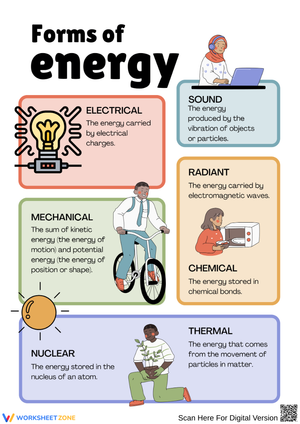
At this grade level, students are expected to recognize and distinguish six energy forms: light, sound, thermal, electrical, mechanical, and chemical. The vocabulary itself isn't the sticking point — students pick up terms quickly. The harder work is applying them consistently, especially when more than one form is present in the same object or event.
- Light energy: sunlight, flashlights, screens, and bioluminescent organisms
- Sound energy: speakers, vibrating strings, and slamming doors
- Thermal energy: friction between surfaces, heating elements, and body heat
- Electrical energy: charge moving through circuits, batteries, and power lines
- Mechanical energy: moving objects, compressed springs, and pendulums mid-swing
- Chemical energy: stored in food, fuel, and batteries before discharge
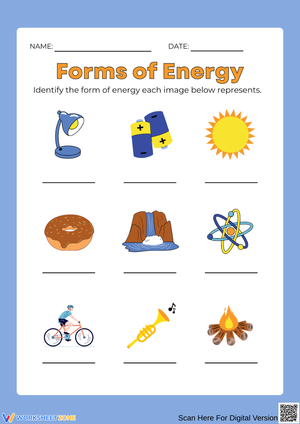
Each worksheet also addresses kinetic and potential energy as subdivisions of mechanical energy — the distinction that causes the most persistent confusion at this level. A worksheet that places a stretched rubber band, a ball sitting on a shelf, and a rolling skateboard side by side moves students from memorized definitions toward actual conceptual comparison. Well-designed 6th grade forms of energy worksheets make that contrast visible in a format students can work through independently.
Patterns of Error Worth Knowing Before You Assign These
The most predictable mistake in energy units: students associate "stored energy" exclusively with food and fuel, so they'll correctly label a battery as chemical energy but draw a blank when shown a compressed spring. They've built their mental model from familiar food examples, and it hasn't extended to mechanical potential energy yet.
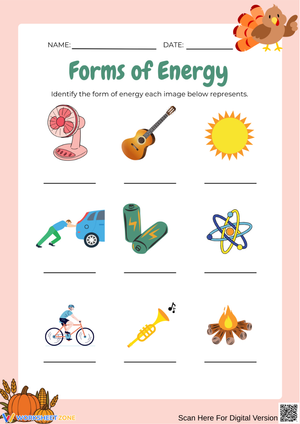
A second reliable error — students label a fan as "electrical energy" and stop there. It plugs into a wall, so they record the input and ignore what the device actually does: spinning blades, moving air, a faint mechanical hum. This matters because transformation questions require students to trace energy through a system, not just identify its power source.
Thermal energy generates a different misconception later in the unit. Students who've heard "heat rises" tend to believe thermal energy only exists in visibly hot objects — open flames, ovens, sunbaked pavement. An object at room temperature, in their model, has no thermal energy at all. Worksheets that ask students to rank objects by relative thermal energy rather than posing a yes/no question surface this misunderstanding faster than almost any other format.
Building These Worksheets Into Your Week
Energy units typically run three to four weeks in sixth grade, and these worksheets fit at multiple points without feeling repetitive because the task types change. A sorting worksheet works well at the start of the unit when students are first encountering vocabulary. Matching and labeling tasks fit in the middle when students need repeated exposure to the same terms in varied contexts. Transformation analysis and mixed review belong toward the end, once students have enough grounding to trace multi-step energy changes.
Bell ringers work especially well with this material. Display a single image — a toaster mid-cycle, a roller coaster at the top of a hill, a tuning fork touching the surface of water — and have students write the energy form and one sentence defending their answer. That's a five-minute opener that consistently reveals which students need vocabulary reteaching before the day's main lesson begins.
For stations, place one worksheet at each station so students rotate from sorting to labeling to short response. Rotating every twelve to fifteen minutes keeps engagement higher than a single extended task, and the varied formats let students who struggle with reading-heavy questions show what they know through picture-based work instead. Substitute plans are another strong use case: because each worksheet is self-contained and clearly structured, students work through them independently, and the completed responses give the classroom teacher immediate review evidence the following day.
Standard Alignment
The NGSS Middle School Physical Science Energy cluster (MS-PS3) is the framework most sixth-grade teachers reference when planning this unit. MS-PS3-1 addresses kinetic energy relationships; MS-PS3-2 focuses on potential energy stored in systems; MS-PS3-5 addresses energy transfer between objects. The vocabulary and classification work in these 6th grade forms of energy worksheets build the conceptual foundation students need to engage with those performance expectations — students who can't reliably identify energy forms or describe simple transformations will struggle with the modeling and argumentation tasks that MS-PS3 requires.
Many state frameworks, particularly those predating full NGSS adoption, include an explicit benchmark for energy form identification at grade 6 or 7 — often worded as "identify and describe forms of energy including mechanical, thermal, electrical, sound, light, and chemical." If your district uses a state code matching that language, the alignment is direct.
Reaching Different Learners in the Same Room
Students still building their science vocabulary work best with picture-based sorting and matching tasks that pair terms with visual clues and brief definitions. Asking them to write explanations before they've consolidated basic identification produces frustration more reliably than learning. Starting with recognition tasks creates the foundation they need before written production is expected.
Students who have the vocabulary and are ready for greater challenge gain more from transformation worksheets that trace energy through multi-step sequences. A worksheet that starts with a person eating a granola bar and follows the energy through digestion, muscle contraction, motion on a bike, and friction with the pavement engages a meaningfully different level of thinking than a matching task. These students also benefit from error-analysis work — reading an incorrect label, explaining what's wrong, and writing a corrected version with a justification. Assigning error analysis too early in a unit, before students have consolidated basic vocabulary, typically produces guessing rather than genuine critique.
For students working with language acquisition alongside science content, annotated vocabulary cards used alongside each worksheet reduce reading load without removing the conceptual task. The same worksheet can serve multiple groups when the support materials change.
Frequently Asked Questions
Do these worksheets include transformation questions, or only basic identification?
Both are included. Some worksheets focus on recognizing individual energy forms in familiar objects. Others ask students to trace how energy changes from one form to another — for example, following chemical energy in a battery through a circuit and out of a flashlight bulb as light and thermal energy. The transformation tasks increase in complexity across the set, so teachers can assign them after students have built solid identification skills on the earlier worksheets.
What everyday objects and scenarios do these worksheets use?
The examples stay in territory sixth graders already know: toasters, flashlights, drums, campfires, rubber bands, roller coasters, fans, and battery-powered toys. That's deliberate. Familiar objects reduce reading load and let students focus on the science rather than decoding an unfamiliar context. A student who encounters an industrial machine they've never seen tends to guess; a student who sees a campfire can reason from actual experience.
Can these be used for both instruction and assessment?
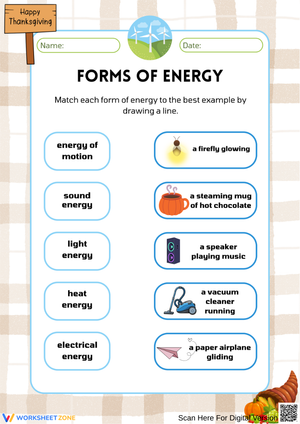
Yes. Sorting and matching worksheets work well during instruction when students are building vocabulary and need repeated exposure to the same terms in different formats. Mixed-review and short-response worksheets are better placed at the end of a unit cycle. Short written responses in particular give teachers direct evidence of student thinking — not just whether a student circled the right answer, but whether they can explain the reasoning behind it. Used this way, some worksheets in the set function as guided practice and others as formative assessment.
How do these worksheets handle kinetic versus potential energy?
Several 6th grade forms of energy worksheets in the set use paired comparisons — a ball in mid-air next to a ball sitting on a shelf, a moving skateboard next to a coiled spring — and ask students to classify and explain each example. This format works better than presenting definitions separately and asking students to apply them independently, because the contrast between examples is where the distinction between kinetic and potential energy becomes visible rather than just verbally stated.












 Interactive Worksheet Maker
 Quiz Maker
 Word Search Maker
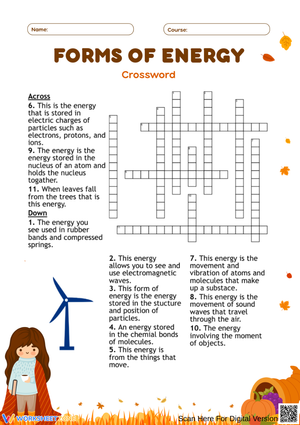
 Crossword Puzzle Maker
 Word Scramble Generator
 Sentence Scramble Generator
 Handwriting Worksheet Generator
 Name Tracing Generator
 Fill In The Blank Generator