




























Views
Downloads


Heat Transfer Methods Worksheet | Grade 6-8 Essential

Paste this activity's link or code into your existing LMS (Google Classroom, Canvas, Teams, Schoology, Moodle, etc.).
Students can open and work on the activity right away, with no student login required.
You'll still be able to track student progress and results from your teacher account.
This Grade 6-10 science worksheet helps students master the three methods of thermal energy transfer through visual analysis. Students examine 8 distinct diagrams to identify conduction, convection, and radiation in real-world scenarios. By connecting abstract physics concepts to concrete illustrations, learners develop a deeper understanding of how heat moves through different mediums.
At a Glance
- Grade: 6-10 · Subject: Science
- Standard:
MS-PS3-3— Apply scientific principles to describe and identify thermal energy transfer methods- Skill Focus: Analyzing and identifying heat transfer
- Format: 2 pages · 8 problems · Answer key included · PDF
- Best For: Formative assessment or quick sub plan
- Time: 15–20 minutes
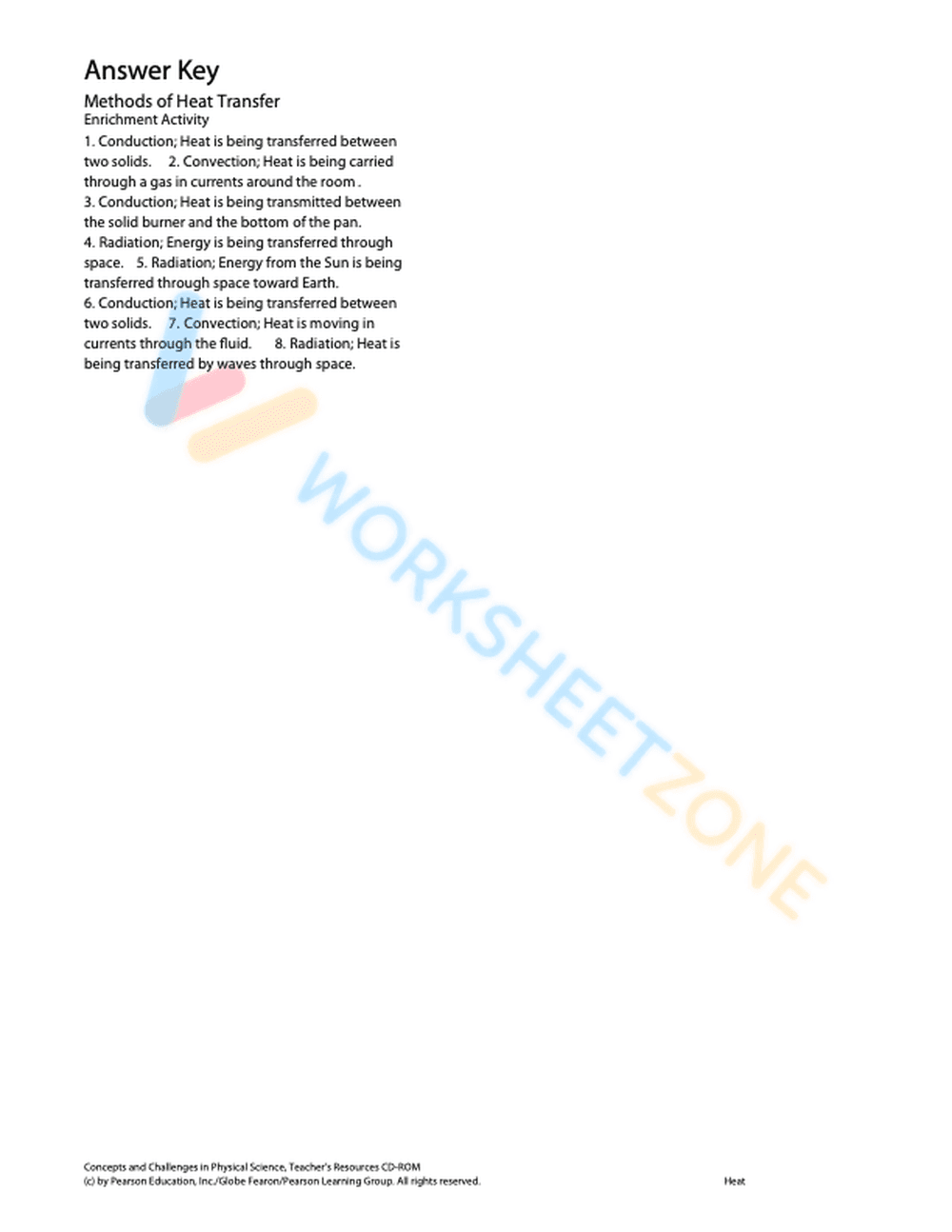
The resource consists of a single-page student activity featuring 8 high-quality diagrams and a comprehensive second-page answer key. Each diagram depicts a specific thermal event—such as a pot on a stove, a person by a fire, or solar radiation—requiring students to categorize the heat transfer method. The layout includes dedicated lines for identification and a prompt for written explanations to encourage higher-order thinking.
This worksheet is designed for immediate classroom implementation with a total teacher prep time of under 2 minutes. Simply print the single-page student sheet and distribute it to the class. Students can complete the 8 identification tasks independently, while the provided answer key allows for rapid grading or immediate peer-review sessions. It serves as an ideal resource for substitute folders or end-of-unit reviews.
Primary alignment is to MS-PS3-3, which requires students to apply scientific principles to thermal energy transfer. The activity also supports MS-PS3-4 by reinforcing the conceptual framework needed to plan investigations into energy relationships. Both standard codes can be copied directly into lesson plans, IEP goals, or district curriculum mapping tools.
Use this as a formative assessment mid-way through a unit on thermodynamics to check for misconceptions between convection and conduction. Alternatively, assign it as a bell-ringer activity to activate prior knowledge before a lab experiment. Expect students to spend 15 to 20 minutes completing the identifications and drafting their written justifications on a separate sheet of paper.
This resource is tailored for middle school physical science students and high school physics learners who need visual reinforcement of thermal concepts. It is particularly effective for English Language Learners (ELLs) due to the heavy reliance on visual diagrams. Pair this worksheet with a heat transfer anchor chart or a digital simulation for a multi-modal learning experience.
According to the RAND AIRS 2024 report on science literacy, visual-to-conceptual mapping is a critical component of long-term retention in physical science. This worksheet leverages that research by requiring students to translate complex diagrams into specific scientific categories like radiation and convection. By identifying these methods across 8 varied contexts, students move beyond rote memorization toward functional mastery of the MS-PS3-3 standard. The inclusion of a written explanation component aligns with Fisher & Frey (2014) recommendations for literacy-integrated science instruction, ensuring that students can articulate the reasoning behind their scientific classifications. This dual-approach—visual identification paired with verbal reasoning—provides a robust framework for assessing student readiness for more advanced thermodynamic engineering challenges or laboratory investigations.


