These 6th grade waves worksheets resources give middle school science teachers targeted practice materials for a unit that confuses students more than the vocabulary difficulty alone would suggest — the real challenge is that students can sound fluent with terms like amplitude and wavelength while still misreading a basic wave diagram. The set covers wave properties, sound and light distinctions, and diagram interpretation, which are the three places where the gap between apparent and actual understanding tends to show up most clearly in student work.
Concepts in Each Worksheet
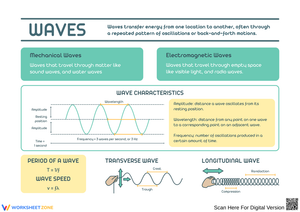
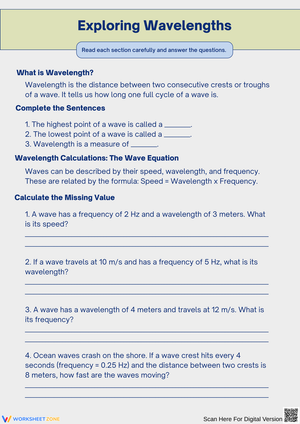
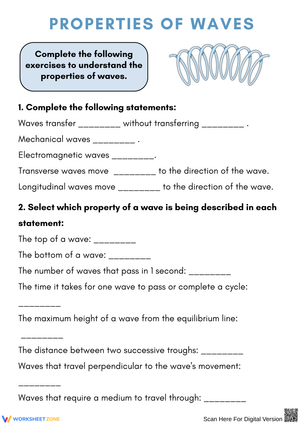
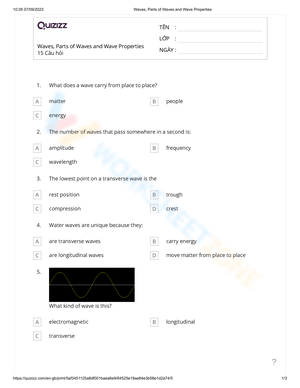
Each worksheet targets a specific area of the waves unit so students revisit each concept in more than one format. Amplitude, wavelength, and frequency appear not just as vocabulary entries but in questions that ask students to connect each property to an observable effect — amplitude to the energy a wave carries, frequency to pitch, wavelength to the measurable spacing between repeated points on a diagram. That application layer is where the practice does its actual work.
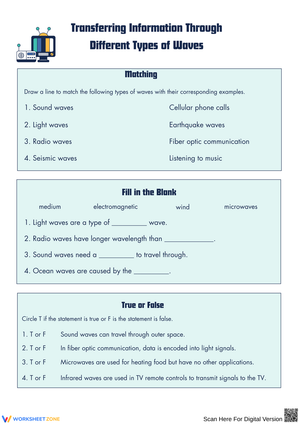
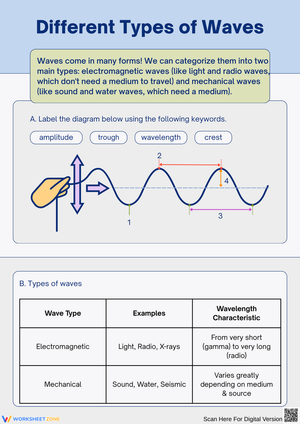
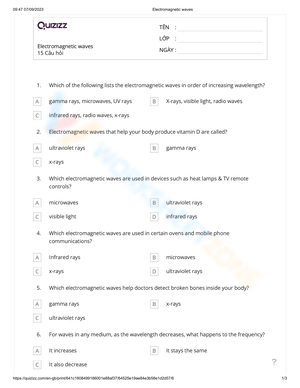
The set also addresses the mechanical versus electromagnetic distinction, which requires more than a definition to stick. Students compare the two wave types through real-world examples — why sound cannot travel through the vacuum of space, how light reaches Earth from the sun — rather than simply writing that one needs a medium and the other does not. Diagram reading runs throughout multiple worksheets, so students encounter wave drawings in different contexts and build confidence interpreting science visuals over the course of the unit rather than all at once.
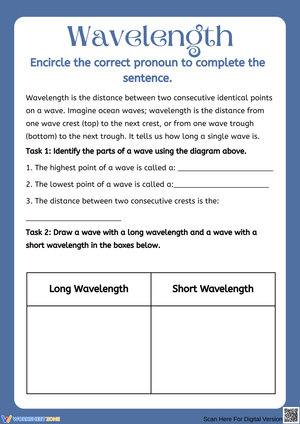
- Wave vocabulary: amplitude, wavelength, frequency, crest, trough, and rest position
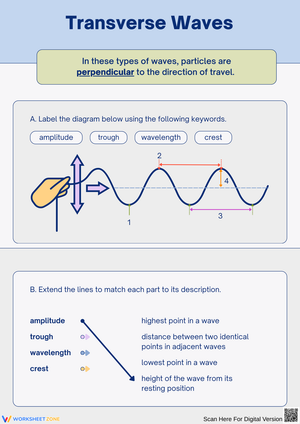
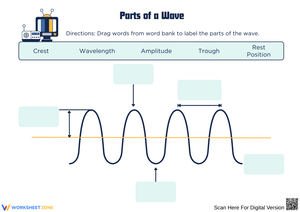
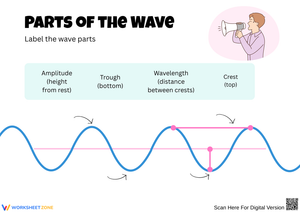
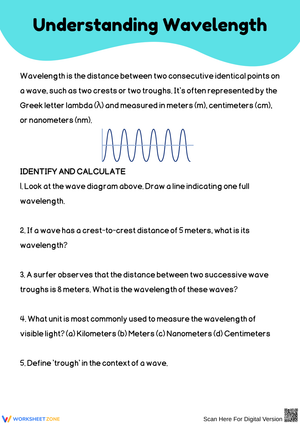
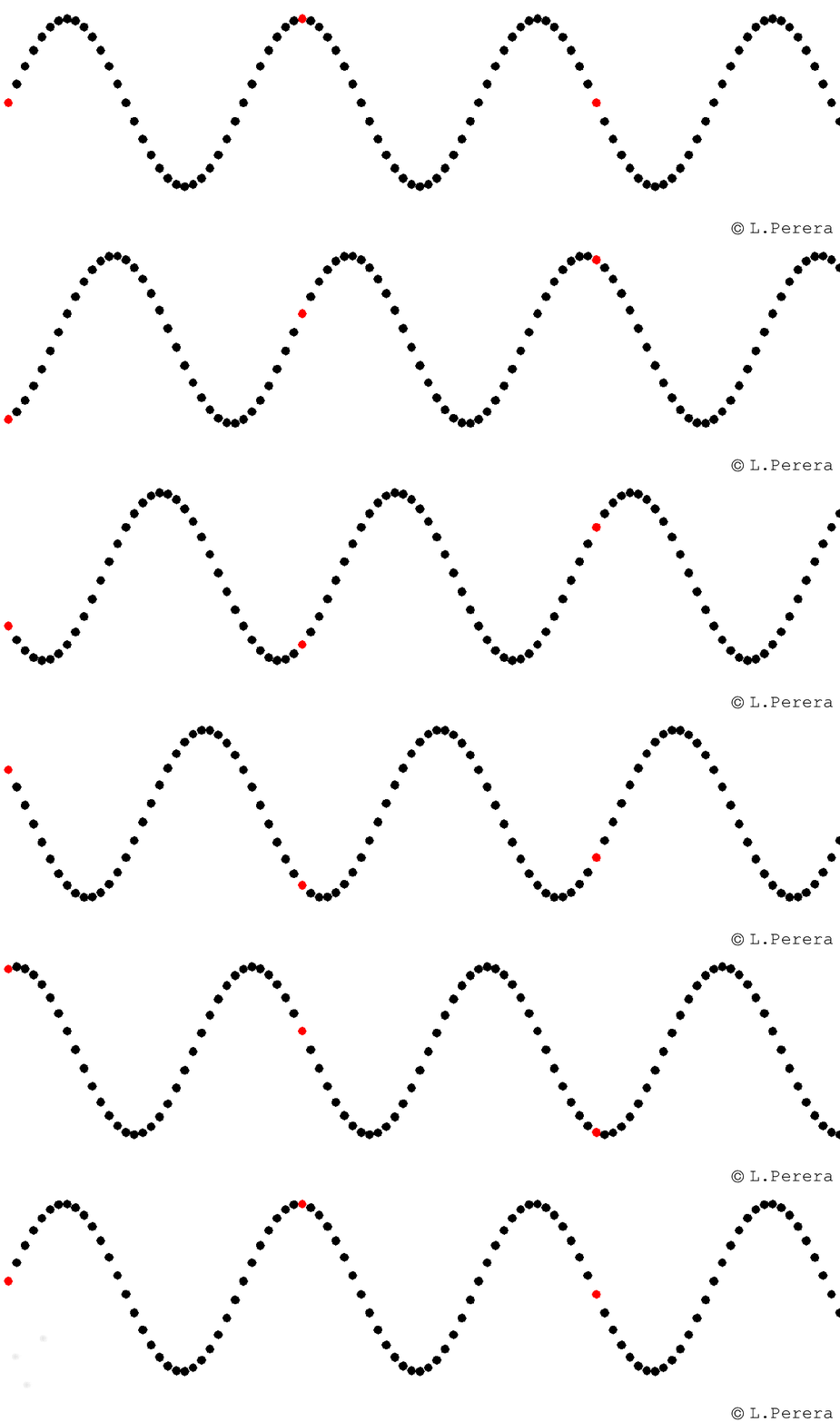
- Diagram labeling: marking parts of a transverse wave on drawings with and without the midline shown
- Wave property relationships: connecting each property to observable changes in sound or light
- Mechanical vs. electromagnetic comparison: structured contrast tasks with real-world examples built in
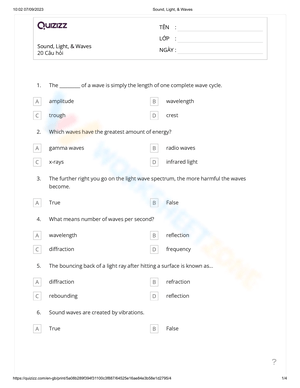
- Sound and light applications: short-answer questions that require explanation, not just identification
Mistakes Students Make That These Worksheets Help You Catch
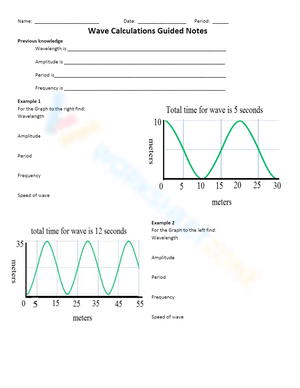
The most consistent diagram error is measuring amplitude from crest to trough rather than from the midline to the crest. Students who measure correctly on a clean diagram with a visible center line will revert to crest-to-trough as soon as that midline disappears or the wave orientation shifts. Re-reading the definition does not fix this — the correction comes from having students mark the midline themselves before measuring, across several diagrams that vary in layout.
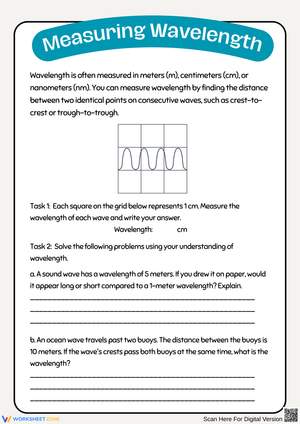
A second pattern involves wavelength: students mark it at the highest point on the wave rather than measuring the horizontal distance between two equivalent points in the cycle. Related to this, many students assume a longer wavelength means a higher frequency, inverting the actual inverse relationship. The compare-and-contrast questions in the set surface this confusion directly. When students write out an explanation — "as wavelength increases, frequency..." — the error becomes visible in a way that a multiple-choice answer does not reveal.
The mechanical versus electromagnetic distinction produces a different kind of mistake. Students learn the rule that sound needs a medium, then apply it inconsistently: some conclude that all waves require a medium; others decide light must travel through air specifically because they observe it doing so. Short-answer questions that ask students to explain why sound cannot travel through space — not merely state that it cannot — expose this reasoning gap and give teachers something concrete to address before the unit assessment, not after.
How to Work These Worksheets Into Your Weekly Lesson Plans
Assigning each worksheet a specific instructional role in the lesson sequence gets more out of the set than distributing worksheets as general practice. A vocabulary-focused worksheet works as a bell ringer on the day a new wave property is introduced. A diagram labeling worksheet belongs immediately after a physical demonstration — a slinky stretched across two desks, a tuning fork held near the surface of water — while students still have the visual in mind. That connection between observation and written practice keeps the work from becoming abstract seatwork. Keeping a 6th grade waves worksheets set stored and printed also makes substitute planning straightforward: each worksheet is self-contained, directions are built in, and students can work independently without setup from a substitute.
For small-group reteach, the same diagrams used in whole-class instruction can be revisited with more guided support — completing the first two questions together before students work on their own reduces the barrier enough for developing learners to engage with the content. In science stations, the worksheets divide cleanly: one station for diagram labeling, another for compare-and-contrast questions, a third for short-answer application. Students cycle through different formats without feeling like they are repeating the same task.
- Vocabulary worksheet as a warm-up before introducing a new wave property
- Diagram labeling worksheet immediately after a physical demonstration
- Compare-and-contrast sheet completed in pairs after discussing wave types
- Short-answer worksheet assigned as homework the evening after direct instruction
- Mixed-review worksheet pulled out two days before the unit assessment
Standard Alignment
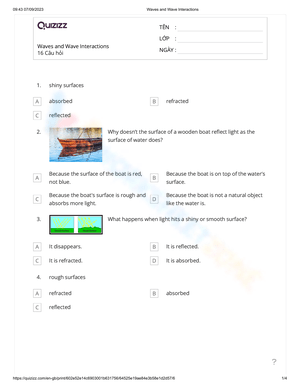
The worksheets align to NGSS MS-PS4-1, which asks students to use mathematical representations to describe how the amplitude of a wave relates to the energy it carries, and MS-PS4-2, which addresses how waves are reflected, absorbed, or transmitted through different materials. Both standards sit in the 6–8 grade band and are commonly introduced in 6th grade physical science courses. The diagram labeling and property-relationship practice directly supports MS-PS4-1, where students must read and interpret wave representations rather than retrieve isolated facts. The short-answer and compare-and-contrast questions connect to the explanatory demand of both standards — students are expected to reason with models, not simply name them.
Adapting the Set for Different Learners
For students still building science literacy, start with matching and labeling tasks. Providing a wave diagram with the midline already drawn before asking students to measure amplitude removes one cognitive hurdle without reducing the conceptual demand. Sentence frames help on short-answer questions — a prompt like "Sound waves need a medium because ___" focuses student writing without doing the thinking for them.
On-level students move well through the compare-and-contrast worksheets and benefit most from questions that ask them to predict: what changes about sound if the amplitude of the wave increases? That kind of question requires applying the property relationship rather than retrieving a memorized answer. For students ready to go further, the application questions that connect wave properties to musical instruments, speaker design, or radio transmission offer enough complexity to carry an independent work block without requiring additional materials from a different source.
One consistent finding in actual classroom use: assigning ten focused questions from the set generates stronger student responses than assigning an entire worksheet straight through. The thinking quality drops when students feel they are moving through a long list. Fewer questions with brief discussion between them closes the gap between marking a correct answer and being able to explain it — and that explanatory fluency is what shows up on assessments.
Frequently Asked Questions
What wave topics are typically taught at this grade level?
Most 6th grade physical science courses introduce amplitude, wavelength, frequency, the parts of a wave, and the difference between mechanical and electromagnetic waves. Sound and light are usually taught in the same unit because they give students concrete examples of each wave type. The worksheets in this set cover all of those areas, with particular emphasis on explanation and diagram interpretation alongside vocabulary practice.
Can these worksheets be assigned as homework, or are they better suited to classwork?
Vocabulary and labeling worksheets work best in class, where students can raise questions about unfamiliar terms as they appear. Short-answer and compare-and-contrast worksheets hold up well as homework once students have had direct instruction on the relevant concept. Splitting the set by format — labeling and matching in class, short-answer for homework — is a practical way to use the same resource across lesson types without sourcing separate materials for each purpose.
Will these work for a substitute teacher day?
Yes. Each worksheet is self-contained with clear, built-in directions, which is what makes a 6th grade waves worksheets set useful in a substitute folder. A substitute does not need to understand the science content to run the lesson — students read the directions, complete the worksheet, and a structured period follows. Pairing the worksheets with a short PBS LearningMedia waves video at the start of class gives a substitute an easy way to open the period before students work independently.
How does the set handle the difference between sound waves and light waves?
Sound and light are treated as distinct examples throughout — not collapsed into a single comparison worksheet, but woven into how the property-relationship questions are framed. Students apply amplitude to volume and to brightness separately before comparing the two. The mechanical versus electromagnetic contrast appears in its own structured task and surfaces again in the short-answer questions, where students explain the medium requirement rather than just state it. A 6th grade waves worksheets resource that separates these explanatory tasks tends to produce cleaner formative data than one that combines sound and light into a single matching exercise, because the individual explanations reveal where the reasoning breaks down.












 Interactive Worksheet Maker
 Quiz Maker
 Word Search Maker
 Crossword Puzzle Maker
 Word Scramble Generator
 Sentence Scramble Generator
 Handwriting Worksheet Generator
 Name Tracing Generator
 Fill In The Blank Generator