These gravity printable worksheets for 6th grade give teachers a set of focused practice resources that move students past surface-level definitions and toward a more precise understanding of forces, mass, weight, and motion. The set covers the concepts that appear consistently in middle school science units and carry forward into later work on physics and earth science. Each worksheet is printable, classroom-ready, and varied enough in format to serve several different lesson structures within the same unit.
The Specific Skills Each Worksheet Targets
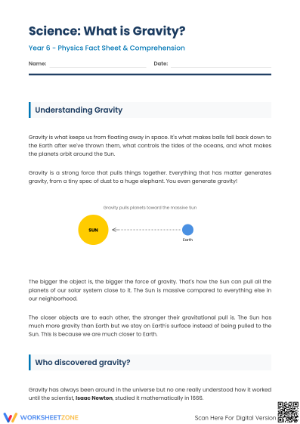
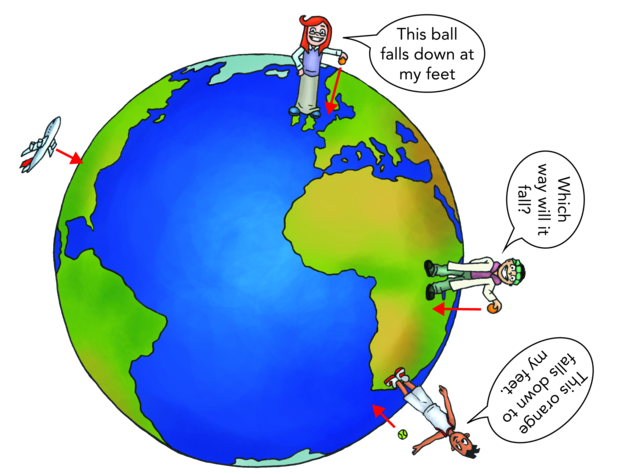
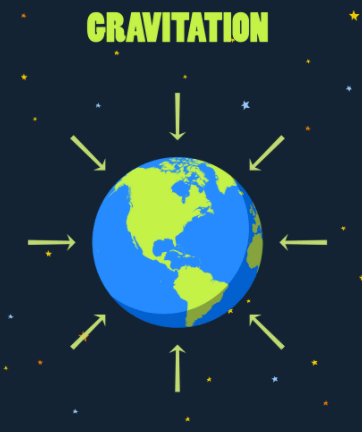
The core target across the set is helping students understand gravity as a force of attraction between objects with mass — not just a word for "falling." Each worksheet asks students to apply that understanding in a specific context rather than simply repeat a memorized statement.
Skills addressed across the set include:
- Defining gravity using precise, science-accurate language — "a force that pulls objects with mass toward each other" rather than "the force that makes things fall"
- Identifying that gravity acts on objects at rest, not only those in visible motion
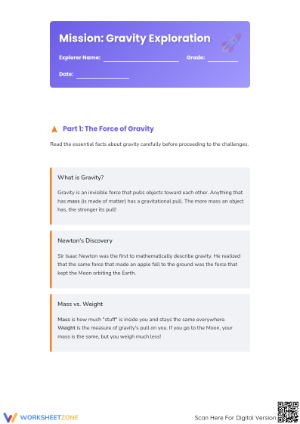
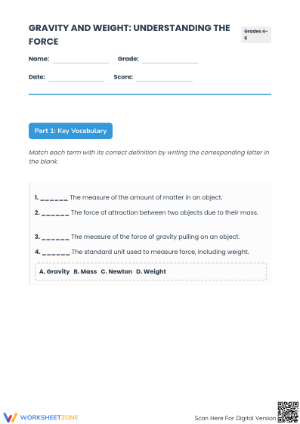
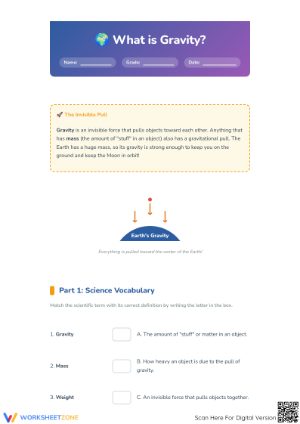
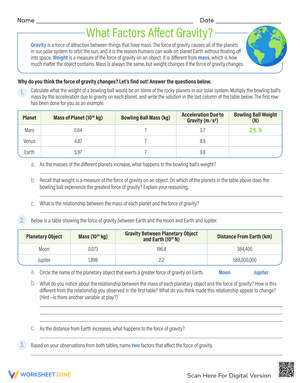
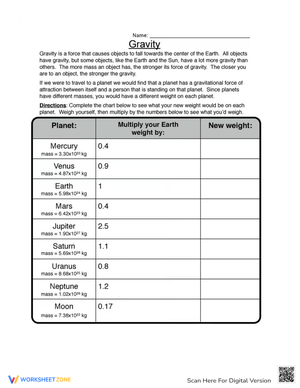
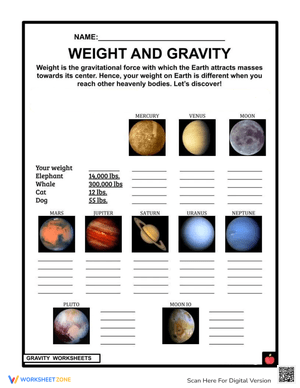
- Distinguishing between mass (the amount of matter in an object) and weight (the gravitational force acting on that mass)
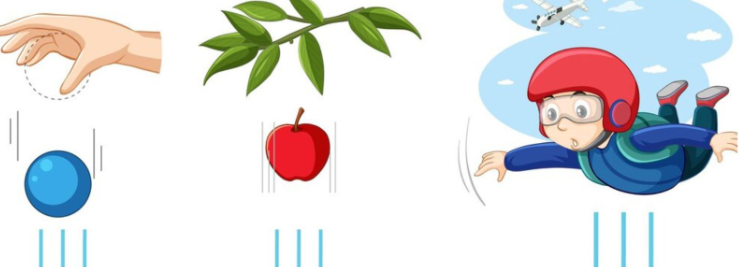
- Predicting and describing how gravity changes the direction and speed of moving objects
- Comparing situations where air resistance affects the rate of fall with those where its effect is minimal
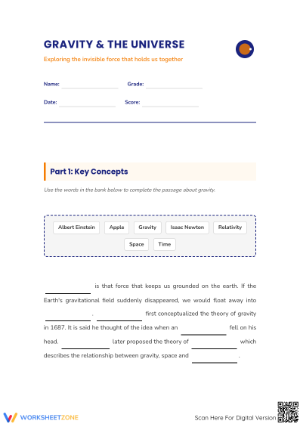
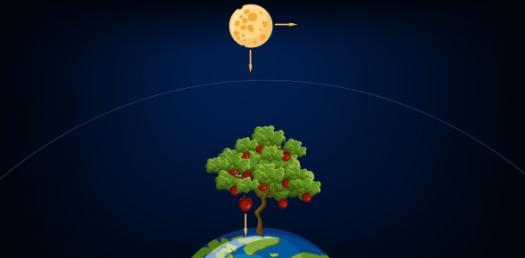
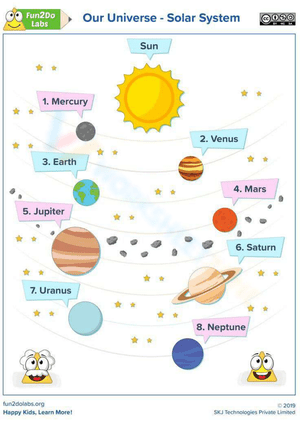
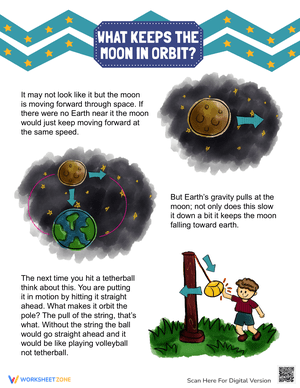
- Connecting gravity to simple space examples, including why objects orbit rather than fly off into space
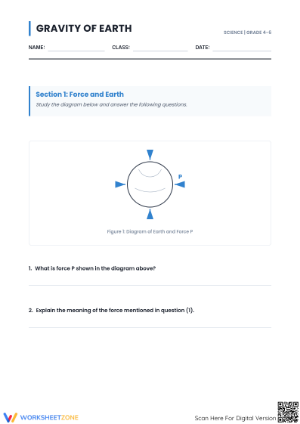
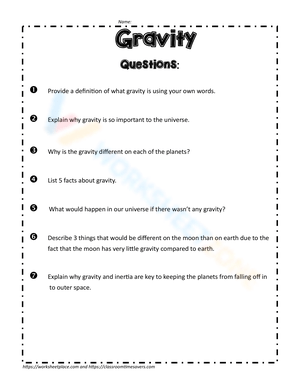
That last skill marks a developmental shift that appears right at sixth grade. Students at this level are moving from concrete, drop-it-and-watch science toward reasoning about forces that act over long distances. The worksheets address that transition with short reading passages and diagram questions that ask students to explain — not just identify — what is happening.
Student Errors That Surface Predictably at This Grade Level
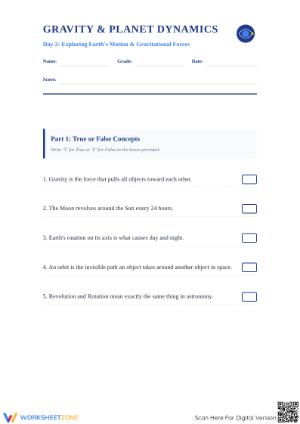
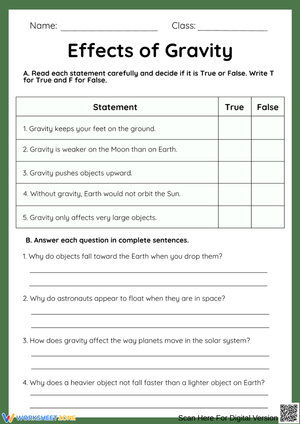
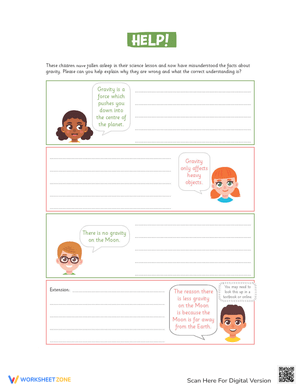
The most stubborn misconception is that gravity only acts when something is clearly moving. Ask students whether gravity is pulling on a textbook resting on a desk, and a significant portion will say no — because nothing visible is happening. A well-designed worksheet confronts this directly by presenting static situations and asking students to decide whether gravitational force is present. That question type reveals more about student understanding than five fill-in-the-blank definitions.
The mass-weight confusion is the other recurring problem. In class discussion, students use the two terms interchangeably, partly because everyday language gives them no reason to separate them. What shows up consistently in student writing is this: a student correctly states that mass is "the amount of matter in an object" and then, three questions later, writes that an astronaut on the Moon has "less mass than on Earth." Placing both questions on the same worksheet — one asking about the backpack's mass on the Moon, the next asking about its weight — forces students to hold that distinction clearly at the same time rather than switch between definitions as the context shifts.
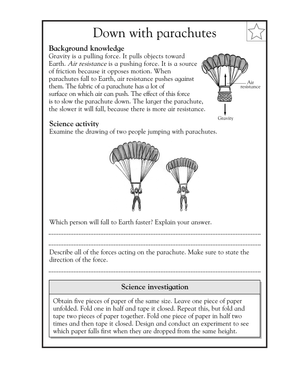
A third error involves air resistance. Students often explain that a heavy book falls faster than a sheet of paper because "gravity pulls harder on heavier things." That reasoning is partially right but misses the role of air resistance entirely. Worksheet questions that compare a crumpled piece of paper to an uncrushed sheet — same mass, different fall rate — require students to separate the two forces, and that separation produces one of the more genuinely surprising scientific results sixth graders encounter when they reason from actual observation rather than memorized rules.
Standard Alignment
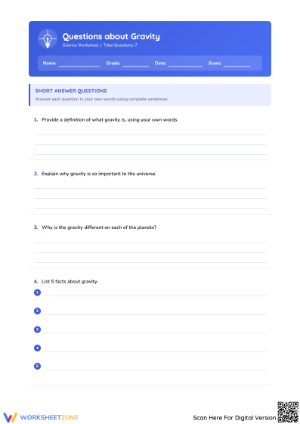
These worksheets align primarily with NGSS MS-PS2-4, which asks students to construct and present arguments using evidence to support the claim that gravitational interactions are attractive and depend on the masses of interacting objects. In classroom terms, that means students need to do more than recognize that gravity exists — they need to articulate why it matters in a specific situation and back their explanation with evidence. The short-response and diagram questions on each worksheet build directly toward that expectation, pushing students away from one-word answers and toward evidence-based explanation.
Many states that have adopted the Next Generation Science Standards place this content in sixth or seventh grade depending on how the district sequences the physical science strand. Teachers in states using different frameworks will find the core content — forces, motion, mass, and weight — maps onto similar grade-band expectations regardless of the specific standard code used locally.
Building These Worksheets Into a Unit on Forces and Motion
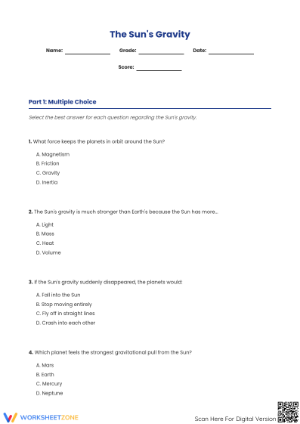
The most natural placement for these resources is early in a forces-and-motion unit, where gravity appears as the most familiar example of a non-contact force before students move to friction, applied forces, and Newton's laws. Vocabulary and diagram questions work best at the start of a lesson or unit, when students are still building the conceptual foundation. Mixed-format practice — short response combined with multiple choice — fits better mid-unit, after direct instruction and at least one class discussion that gives students a shared vocabulary to draw on in writing.
For warm-up use, pulling one worksheet per week during the gravity portion of a forces unit keeps the vocabulary active without eating into instruction time. The first two minutes of class on Monday — before attendance and morning routines — is often when a vocabulary match or a single diagram question lands best. Students complete it quickly, and it creates a low-stakes entry point for a concept that some students find abstract until something concrete is on the page in front of them.
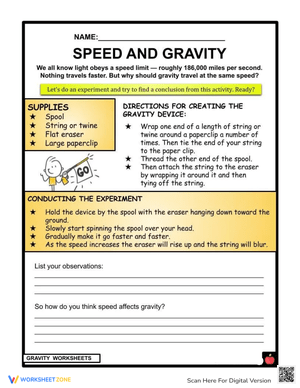
Gravity printable worksheets for 6th grade also work well as station materials when paired with a short visible demonstration. Drop two objects of different mass from the same height, or compare a crumpled piece of paper to a flat one. Students then use the corresponding worksheet to record what they observed and explain it using force vocabulary. That sequence — watch, discuss, write — consistently produces stronger written explanations than sending students straight to the worksheet without a shared event to anchor their thinking.
Adjusting the Work for Students Who Need More or Less Support
For students who struggle to express scientific ideas in writing, the most effective adjustment is adding structure before asking for a response. Sentence frames like "Gravity causes _______ to _______" or "The difference between mass and weight is _______" give a clear starting point without supplying the answer. Word banks help students who understand the concept but freeze when unfamiliar vocabulary blocks them from writing. These modifications let teachers use the same set of worksheets across an entire class without printing separate alternate versions for different groups.
Students who move through the material quickly benefit from prompts that push toward comparison and application. Instead of "Does gravity act on a resting book?" ask them to write two situations — one where gravity's effect is obvious and one where it is easy to overlook — and explain what is happening in each. Or ask them to describe what would change about the motion of a thrown ball if gravity were suddenly half as strong. Those questions require the same core understanding but demand more deliberate reasoning. Gravity printable worksheets for 6th grade that include optional extension prompts let teachers challenge students who finish early without building a separate assignment from scratch.
Frequently Asked Questions
Can these worksheets work as a standalone review before a forces-and-motion quiz?
Yes. A mixed-format review worksheet — vocabulary, diagram, and short response — covers the main concepts students need to revisit before an assessment. Pull it out a day before the quiz and have students work through it independently. The errors they make on paper show exactly where to spend the last few minutes of instruction, which is more targeted than a general whole-class review.
What grade level is this content appropriate for?
The content is written for sixth grade, but teachers at fifth and seventh grade find it useful depending on where gravity appears in their district's science sequence. Fifth-grade teachers can use the vocabulary and diagram worksheets to introduce the concept early. Seventh-grade teachers often return to the same set for reteaching, particularly when students need to revisit the mass-weight distinction before moving into more complex force and motion topics.
How do these worksheets fit into a station rotation?
Each worksheet works independently, so you can assign one per station without students needing to complete them in a specific order. A station might pair gravity printable worksheets for 6th grade with a short demonstration — dropped objects, a ball rolled across an inclined surface, or a diagram showing orbital motion — and each worksheet becomes the recording and explanation tool rather than the primary activity itself.
Do students need prior knowledge to use these worksheets?
A basic introduction to the idea that forces are pushes and pulls is enough. The worksheets build from that starting point, so students who have encountered the word "force" in earlier grades — even informally — have enough context to engage with the material. Teachers opening a unit on forces can use an early worksheet in the set to surface what students already believe about gravity before any formal instruction begins, which often reveals misconceptions worth addressing directly in the first lesson.












 Interactive Worksheet Maker
 Quiz Maker
 Word Search Maker
 Crossword Puzzle Maker
 Word Scramble Generator
 Sentence Scramble Generator
 Handwriting Worksheet Generator
 Name Tracing Generator
 Fill In The Blank Generator