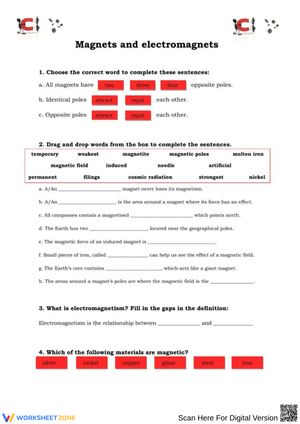
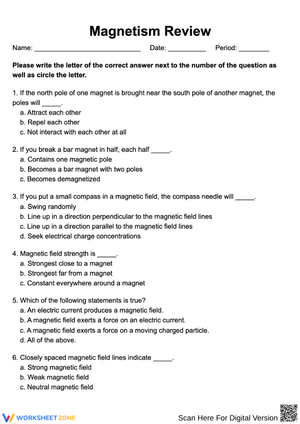
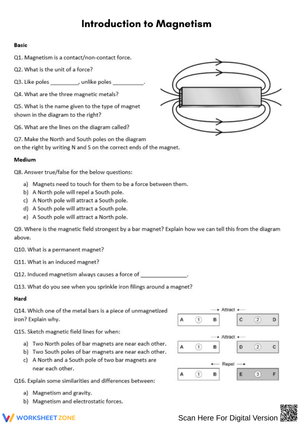
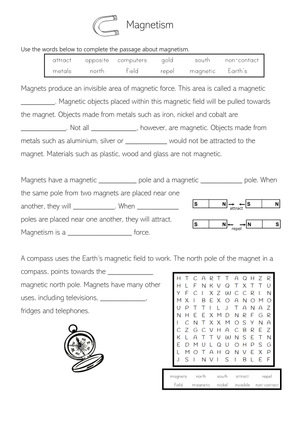
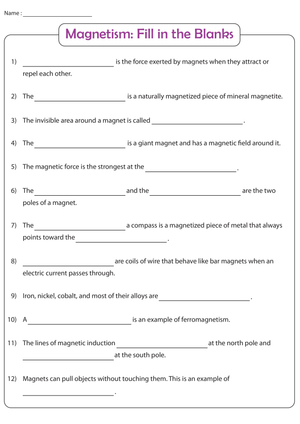
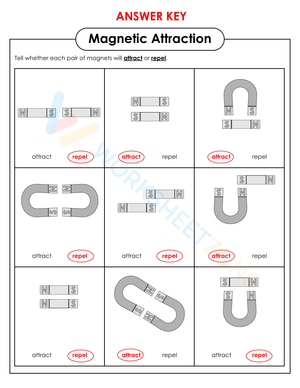
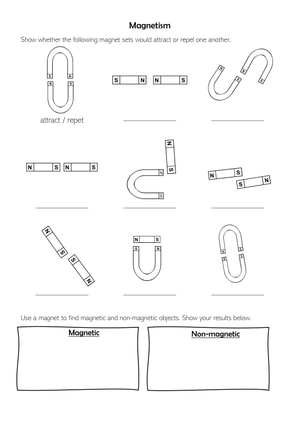
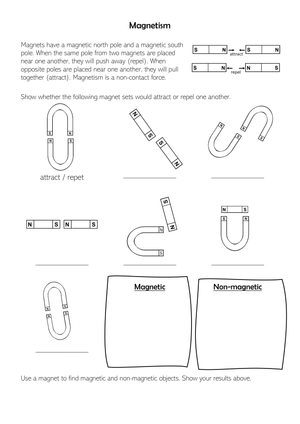
Magnetism printable worksheets for 6th grade give teachers a ready set of science practice resources that push students beyond vocabulary recall — into labeling magnetic field diagrams, predicting pole interactions, sorting materials by magnetic properties, and writing short explanations of how force acts at a distance without physical contact. The set fits inside force-and-motion units, physical science strands, or standalone magnetism blocks, wherever the topic falls in a teacher's sequence.
The Specific Skills These Worksheets Build
Each worksheet targets a defined piece of the magnetism concept, which matters because students at this level often hold unexamined assumptions: they tend to think all metals are magnetic, or that a magnet has to touch something to affect it. The targeted practice in this set surfaces those gaps before they calcify.
- Vocabulary in context: terms like pole, attract, repel, magnetic field, and ferromagnetic applied in sentences and diagrams rather than memorized from a list.
- Diagram work: labeling north and south poles, interpreting field line patterns around a bar magnet, and identifying regions of stronger and weaker pull.
- Prediction and classification: deciding which materials a bar magnet will attract, recording results, and accounting for surprises — including objects that seem like they should respond but don't.
- Short constructed responses: explaining in one or two sentences why a compass needle aligns the way it does, or why two magnets pushed together might slide sideways rather than come apart cleanly.
- Real-world application: connecting magnetism to tools students recognize — speakers, electric motors, door latches — at a level of detail appropriate for sixth grade.
Student Errors Worth Catching Before They Stick
The most consistent misconception in student work on this topic is that all metal objects are magnetic. A student who correctly identifies an iron nail will also circle an aluminum soda can or a copper penny as magnetic — because they are shiny and metallic, so the assumption holds. Classification worksheets paired with actual test objects surface this error immediately, and the correction lands harder when students have just predicted wrong and can see why.
A second pattern worth watching: students understand, in an abstract way, that magnets can attract without contact. But when pressed to explain it in writing, many say the magnet "pulls the air" or that the object "senses" the magnet nearby. Constructed-response prompts that ask students to define a magnetic field — not what it does to the object, but what the field itself is — expose that gap in a way that multiple-choice items cannot. Catching it during practice rather than on the unit assessment is the point.
How to Build These Worksheets Into Your Science Block
The handoff from demonstration to worksheet is where these resources do their clearest work. Show students two bar magnets attracting and repelling — or test a few mystery objects in front of the class — then move immediately into the corresponding worksheet. Students are still holding the visual in working memory, and the written task channels that observation into organized thinking rather than letting it evaporate.
Magnetism printable worksheets for 6th grade also hold up well as bell ringers, exit tickets, and sub-plan materials because the directions are self-contained and the content is visual enough that students work independently without a lot of front-loading. A worksheet dropped into the last ten minutes of class, after a lab day where students tested magnetic objects, gives them a place to organize what they noticed and frame it as explanation rather than just a list of results.
A practical 35-minute class flow that works with this set:
- 5 minutes: warm-up question about a real-world magnet they have encountered
- 10 to 15 minutes: worksheet completion, independent or with a partner
- 10 minutes: hands-on check with magnets, paper clips, and two or three mystery objects
- 5 minutes: whole-class debrief or written exit ticket
Splitting the set across multiple days also works. Vocabulary on day one, diagram labeling on day two, short-response writing on day three — that pacing respects the cognitive load of building a new conceptual model and keeps daily prep minimal.
Adjusting the Set for a Range of Learners
Magnetism printable worksheets for 6th grade differentiate well without major redesign. The main lever is the response format. Students who need more structure do better when a word bank is visible, answer options are limited, and diagrams include clear reference labels. A response stem like I know this object is magnetic because... gives those students an entry point without doing the thinking for them.
Students ready for more challenge need the explanation tasks extended. Instead of identifying which pole is north on a diagram, they explain why a compass needle points the same direction regardless of where in the room you hold it. Instead of sorting materials, they write a claim-evidence-reasoning response after testing objects: the claim, the specific evidence from the investigation, and the reasoning that ties both to the concept of ferromagnetic materials. That kind of extension stays inside the same content area without pulling students into entirely separate territory.
One grouping approach that works: one group completes a hands-on sorting worksheet with physical objects while another works through a scenario-based worksheet asking them to predict and explain field interactions in situations they haven't directly tested. Both groups are doing magnetism — just at different levels of abstraction.
Frequently Asked Questions
What core concepts do these worksheets cover?
The set addresses poles and their interactions, attraction and repulsion, magnetic fields, the distinction between magnetic and nonmagnetic materials, and basic real-world applications. Students label diagrams, classify materials, make predictions, and write short explanations — not just match terms to definitions.
Are these worksheets useful for review and assessment, or mainly for initial instruction?
Both. Vocabulary and diagram worksheets support initial concept building during direct instruction. Mixed-question worksheets work well the day before a unit test or as a post-lab summary. Short-response worksheets function as exit tickets. Each worksheet stands alone rather than requiring a fixed sequence, so teachers pull individual resources as the lesson demands.
What materials pair well with these worksheets during a hands-on lesson?
Bar magnets, paper clips, metal washers, copper pennies, aluminum foil, craft sticks, and iron nails cover most of the prediction-and-test tasks in this set. Magnetism printable worksheets for 6th grade that include a prediction column, an observations section, and a short conclusion prompt work especially well when students complete them during a materials investigation rather than reconstructing results after the fact.
How long does each worksheet take to complete?
Most students finish in 10 to 15 minutes working independently. Diagram-heavy worksheets run a few minutes longer because students spend time on labeling decisions. That timing makes them easy to fit into a center rotation, the end of a lab day, or a homework assignment without adjustment.












 Interactive Worksheet Maker
 Quiz Maker
 Word Search Maker
 Crossword Puzzle Maker
 Word Scramble Generator
 Sentence Scramble Generator
 Handwriting Worksheet Generator
 Name Tracing Generator
 Fill In The Blank Generator