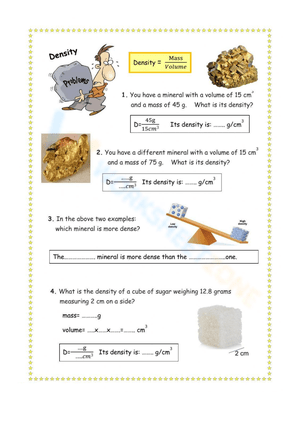
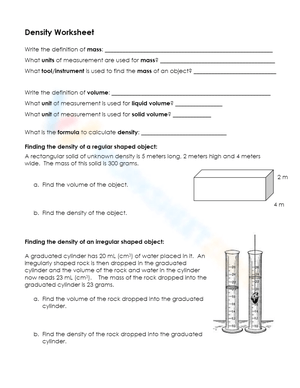
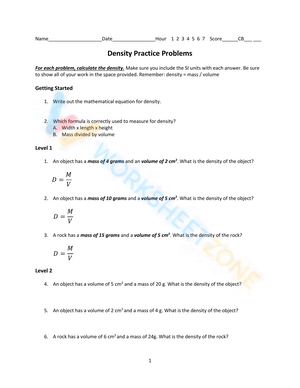
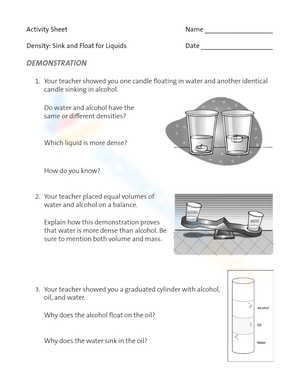
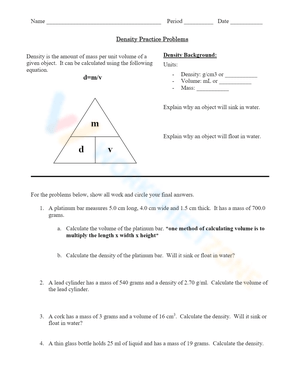
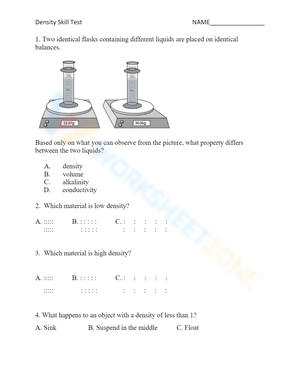
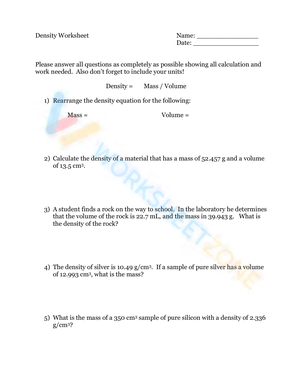
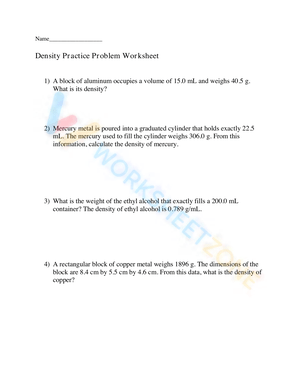
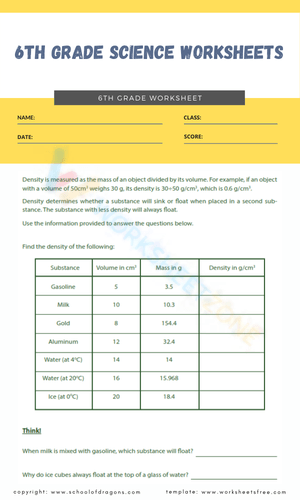
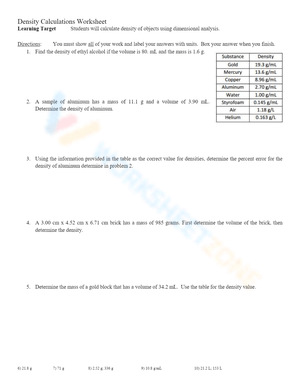
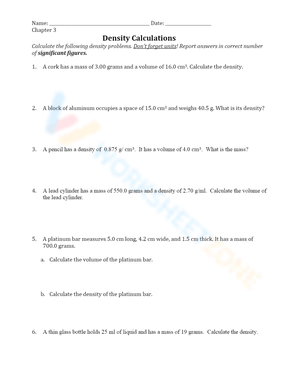
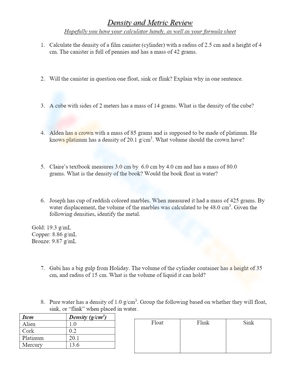
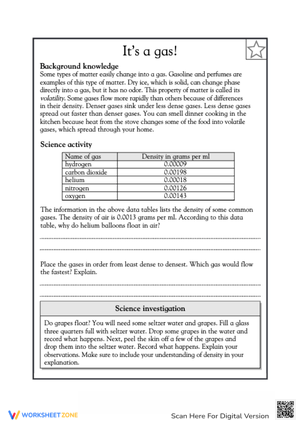
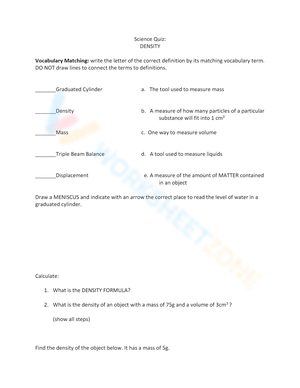
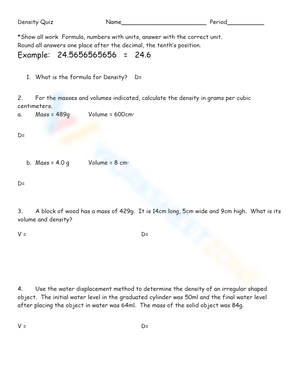
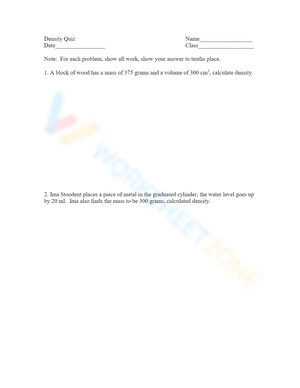
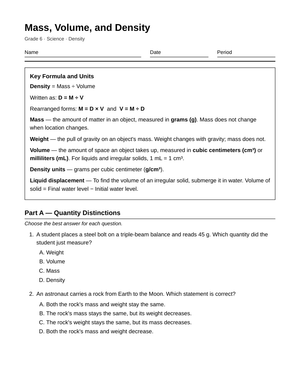
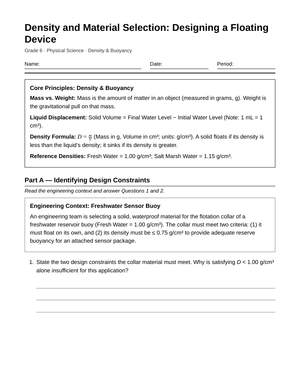
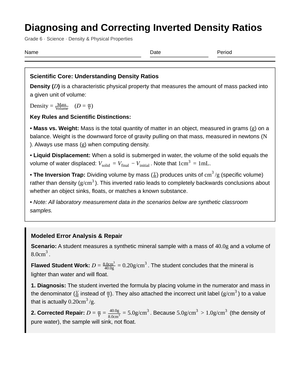
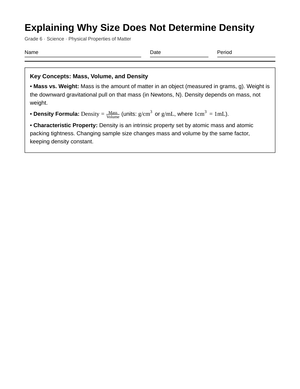
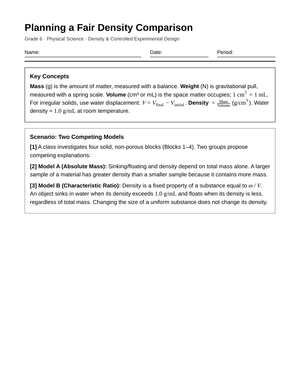
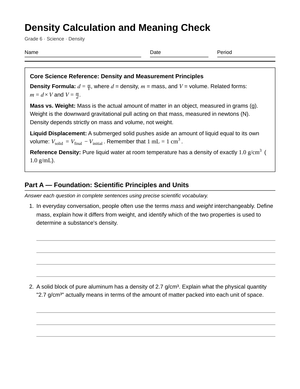
These density pdf worksheets for 6th grade give teachers targeted, print-ready practice that connects the D = m/V formula, unit labeling, and real-world reasoning about floating and sinking. The problems move from basic calculation toward interpretation, so students work the full sequence — identify, compute, explain — rather than stopping when they get a number. That range makes the set useful across multiple points in a unit, from first exposure through review.
The Specific Skills Targeted
Density sits at an intersection sixth graders find genuinely tricky: it demands number fluency, attention to units, and the ability to draw a scientific conclusion from a numerical result. These worksheets push students to work all three of those angles rather than stopping at arithmetic.
- Vocabulary recognition: students match and define terms — mass, volume, matter, density — before any calculation appears
- Formula application: writing D = m/V, substituting values correctly, and dividing to reach a result
- Unit discipline: identifying whether an answer belongs in grams per milliliter or grams per cubic centimeter and labeling it that way every time
- Comparative reasoning: deciding which of two materials is denser given a set of measurements
- Float-or-sink explanation: using a calculated density value to predict and justify observable behavior — not guess based on weight alone
That last skill — interpreting the number — is where most students stall. A student can divide 24 by 6 and arrive at 4 without grasping that 4 g/mL means the object sinks in water. Each worksheet includes short follow-up prompts after calculation problems so students are required to make that interpretive step explicit rather than optional.
Frequent Student Errors Worth Watching For
Density is one of those topics where students can produce a number and still be entirely confused about what they did. The errors we see most often follow a few consistent patterns, and it is worth knowing them before assigning practice.
The most common mistake is inverting the division — writing V ÷ m instead of m ÷ V and arriving at a result that makes no physical sense, then recording it anyway. This happens even after direct instruction. A formula reference box printed on each worksheet cuts this down noticeably, because students can check the order before they divide rather than after they are already wrong.
Dropping units is the second persistent problem. Students write "4" when the answer is "4 g/mL" and consider the problem finished. This matters beyond neatness: a density answer without units cannot support a floating or sinking claim, because the reference point — 1 g/mL for water — becomes meaningless without matching units attached. Requiring the unit label on every answer line, rather than once at the bottom of the worksheet, keeps the habit visible throughout the exercise.
A third error reflects a genuine conceptual gap rather than carelessness: students conflate mass with density and assume the heavier object always sinks. A bowling ball sinks; a much larger but hollow foam block floats. Worksheets that include at least one comparison problem — where students calculate the density of two objects with different masses and determine which one sinks — address this directly rather than leaving the misconception in place.
How to Build These Worksheets Into Your Lesson Plans
Gradual release works well for density. Open with one fully teacher-modeled problem on the board: state the mass, state the volume, write the formula, substitute, divide, label the unit, interpret the result. Then hand off a partner problem from the worksheet before moving students to independent work. That routine becomes predictable within two or three lessons, which frees up mental space for the harder conceptual work of interpretation.
A simple annotation habit reduces the most common errors significantly. Ask students to circle the mass value and underline the volume before writing anything else. That two-second check stops the inversion mistake before it starts. When students also show their setup step separately from the answer, grading gets faster and error diagnosis gets specific — you can see in seconds whether the mistake came from misreading the problem, flipping the division, or forgetting the unit label.
These worksheets pair naturally with observation activities. After a float-or-sink demonstration with objects of known mass and volume, students use density pdf worksheets for 6th grade to calculate each object's density and compare that result against their initial prediction. That sequence — observe, calculate, confirm or revise — gives the arithmetic a reason to exist beyond the grade book.
Adjusting the Worksheets Across Different Readiness Levels
For students who are still shaky on division or unit identification, work with whole-number problems that have obvious quotients — 18 ÷ 3, not 17.4 ÷ 3.2 — and reduce the number of problems per sitting. A formula reference at the top of each worksheet removes one working-memory demand so students can focus on setting up the problem correctly. Sentence stems placed after each calculation ("This object would _____ in water because its density is _____ 1 g/mL") give lower-readiness students a structured entry point into the explanation step without removing the expectation entirely.
Students ready for more challenge can work with missing-variable problems — given density and mass, solve for volume — which requires rearranging the formula rather than applying it in one direction. Comparison sets, where students rank three or four materials by density and justify the ordering in writing, push toward the analytical thinking that appears on state science assessments. The density pdf worksheets for 6th grade in this set include problems at both levels, so teachers assign what matches their students rather than rewriting items by hand.
Frequently Asked Questions
What prior knowledge do students need before starting these worksheets?
Students should be comfortable with basic division, including simple decimal quotients, and should understand what mass and volume measure as physical quantities. They do not need prior exposure to the D = m/V formula — each worksheet introduces or reinforces the formula as part of the practice rather than assuming students have already memorized it.
How do these worksheets fit with a hands-on density lab?
Use them after the lab, not before. When students have already watched a grape sink and a wax crayon float in the same container of water, the numerical work has an observable referent. Calculating 0.9 g/mL for the crayon means something concrete because they watched it float. Assigning calculation practice before any hands-on experience tends to reduce density to arithmetic with no scientific meaning attached.
Can students self-correct using these worksheets?
Yes. The answer key included with each worksheet supports self-correction during independent work time or homework review. In class, some teachers project the solutions after independent practice and ask students to locate and explain their own errors before the lesson moves on — a step that is more instructionally useful than simply marking answers right or wrong.
How much time should I plan for each worksheet?
Completion time varies. The density pdf worksheets for 6th grade in this set generally run 15 to 25 minutes depending on the number of problems and where individual students are with the formula. The shorter worksheets function well as bell ringers or exit tickets; the longer ones carry a full guided-practice block.












 Interactive Worksheet Maker
 Quiz Maker
 Word Search Maker
 Crossword Puzzle Maker
 Word Scramble Generator
 Sentence Scramble Generator
 Handwriting Worksheet Generator
 Name Tracing Generator
 Fill In The Blank Generator