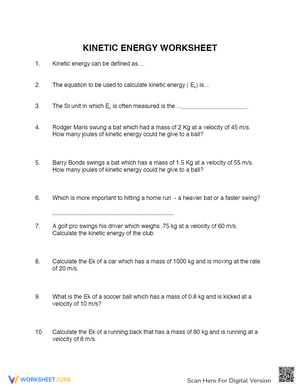
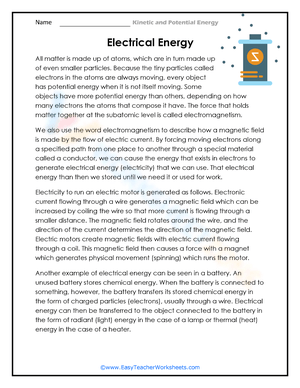
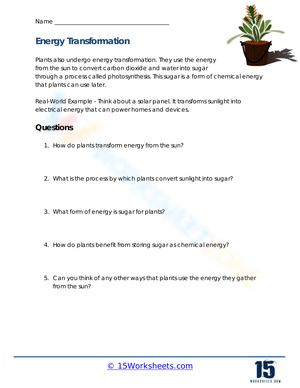
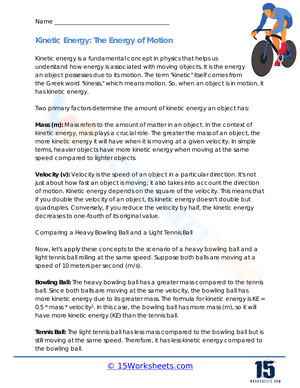
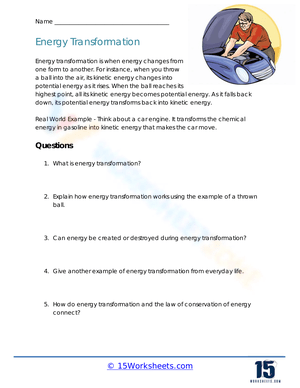
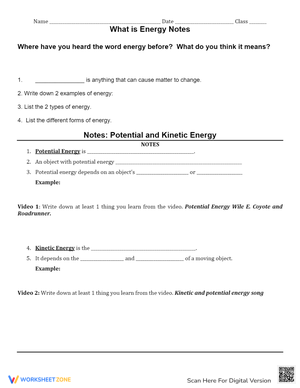
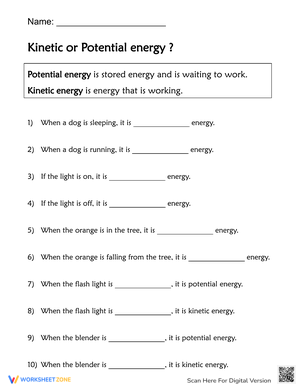
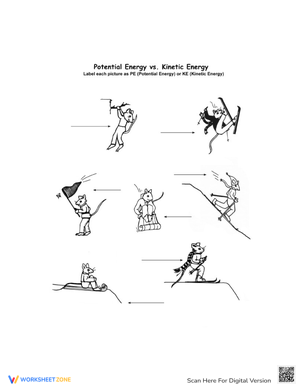
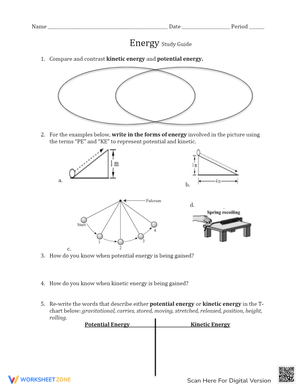
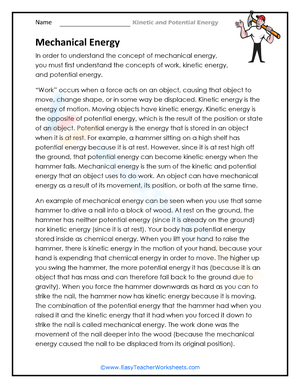
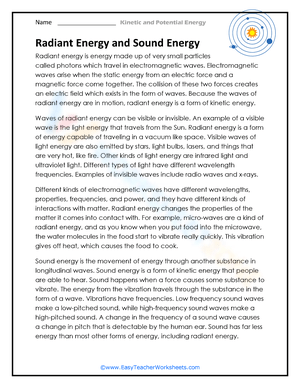
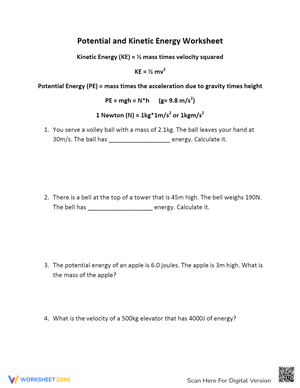
These kinetic and potential energy worksheets for 6th grade put two of the most misidentified concepts in middle school physical science side by side — energy of motion versus energy stored by position or condition — and give students repeated practice classifying, labeling, and explaining before those ideas calcify into misconceptions. The set spans identification tasks, transformation analysis, and vocabulary work, staying concept-centered rather than pushing into formula-heavy calculation that belongs in later courses.
Mistakes Students Make That These Worksheets Help You Surface
The error that appears earliest: students conflate energy with force. A student who knows that a push makes an object move will confidently label both "the push" and "the rolling ball" as kinetic energy, collapsing cause and effect into the same category. That confusion undermines transformation analysis later — if students don't separate the initial stored condition from the resulting motion, they can't coherently trace how energy shifts on the way down a ramp or a slide.
A second persistent problem is students mapping potential energy exclusively to height. They accept that a book on a high shelf stores energy, but when shown a drawn bow or a compressed spring, they hesitate — or flatly deny it. The phrase "stored because of position" is broad enough to cover gravitational potential energy but narrow enough that students exclude elastic examples entirely. Each worksheet in the set addresses this by presenting multiple types of stored energy rather than relying on raised objects alone.
Perhaps the most diagnostic error is what teachers sometimes call the frozen-motion mistake. When students see a roller coaster car paused at the top of the first hill, many label it kinetic because "it's about to move fast." They are describing the anticipated outcome, not the current energy state. The repeated prompt "What is the energy at this exact moment?" — built into several worksheets — pulls students back to present conditions. That distinction separates students who understand the concept from students who are pattern-matching to contextual clues about what comes next.
Skills These Worksheets Build
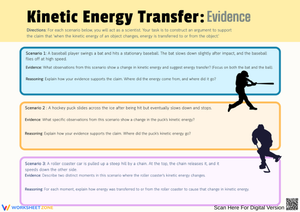
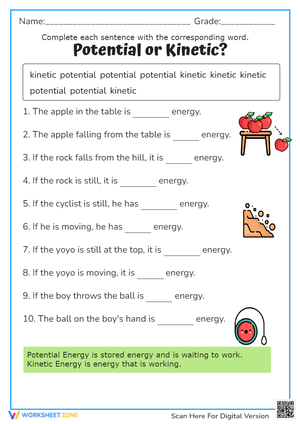
The core work across the set is classifying and explaining, not calculating. Students sort everyday objects and events into kinetic or potential categories, then justify each choice in one or two sentences. Justification is not optional — identification-only tasks let students guess correctly without understanding why, which makes it nearly impossible to catch the frozen-motion error or the elastic-potential blind spot.
- Identification and evidence: Students mark whether a described object or event demonstrates kinetic or potential energy and cite the specific detail from the example that supports their answer.
- Diagram labeling: Students annotate images of ramps, roller coasters, pendulums, and playground equipment at different points in motion or rest.
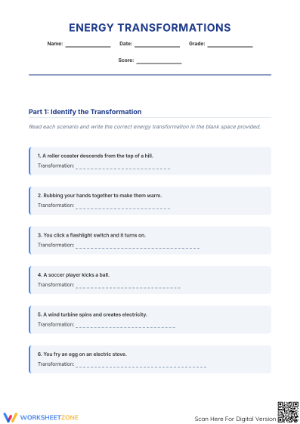
- Transformation sequences: Students trace how energy changes form across a described event — a child at the top of a slide, the descent, the landing — and name the form present at each stage.
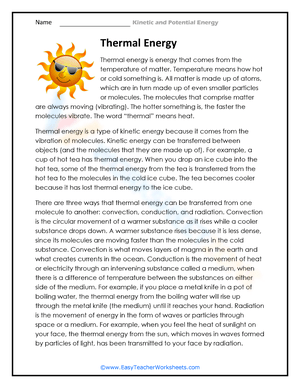
- Vocabulary in context: Students match and apply terms like transfer, transform, stored, and motion inside realistic scenario sentences rather than isolated definition drills.
- Written explanation: Students describe why a stretched rubber band, a raised object, or a moving marble fits one category, using complete sentences that require more than a circled answer.
The progression within each worksheet moves from obvious to more demanding — rolling balls and dropped objects first, then less familiar situations like a pendulum at its highest point or a compressed spring mid-release. That sequence builds confidence while creating natural checkpoints where confusion becomes visible before students reach the transformation questions.
Building These Worksheets Into Your Lesson Planning
A reliable three-day sequence starts with a short demonstration — drop a ball from different heights while students observe and describe — then moves into guided practice on a classification worksheet. Day two works through a diagram-labeling worksheet as a class, pausing after each item to hear student reasoning aloud. Day three is independent: students complete a transformation-focused worksheet and close with a two-sentence exit reflection. That arc gives repeated exposure across a logical concept sequence without repeating the same task format twice.
For Monday mornings after a weekend away from science vocabulary, a short matching worksheet works better than jumping directly into transformation analysis. The five-minute warm-up reactivates the language students need before they reason through harder examples. The kinetic and potential energy worksheets for 6th grade in this set include shorter, lower-demand options that fit that warm-up slot without requiring additional setup beyond placing the worksheet on desks.
In centers, place one worksheet at each station with a single clear task direction on an index card beside it. A definition-matching station, a picture-analysis station, and a write-your-own-example station can hold four to six students each working simultaneously. The write-your-own station — where students generate a kinetic or potential example from sports or daily life and explain their reasoning — produces the most useful data on where misconceptions still linger, because students can't copy from a provided list.
Adjusting the Set for Mixed-Readiness Classes
The most practical approach to differentiation is varying the response demand while keeping the scenario consistent. Every student looks at the same image: a skateboarder at the top of a half-pipe. One student circles "potential" from a two-option list. Another writes a sentence explaining the choice. A third writes two sentences and then predicts the energy state at the bottom of the ramp. Same context, three different cognitive loads, one set of materials the teacher manages.
For students who need additional support, sentence frames make a measurable difference: "This is ___ energy because the object is ___." Two blanks require the student to both classify and justify rather than guess and move on. Pairing the sentence frame with a small visual anchor — an image key showing a moving arrow for kinetic and a stationary stored-position icon for potential — keeps instruction moving without pulling the teacher into repeated one-on-one explanation for every item a student gets stuck on.
Students ready for more demanding work respond well to comparison prompts: "Two objects are described below. Which has more potential energy, and how do you know?" or "Describe a moment in a basketball game where both energy types are present at the same instant." Those prompts push beyond classification into analysis, which is where 6th grade physical science is heading by the end of the unit. The kinetic and potential energy worksheets for 6th grade in this set include enrichment response options built directly into several worksheets so that differentiation doesn't require printing separate materials or maintaining two versions of the same task.
Standard Alignment
These worksheets align to NGSS MS-PS3-1, which asks students to construct and interpret graphical and conceptual descriptions of the relationships between kinetic energy, mass, and speed, and to MS-PS3-2, which asks students to develop models showing how changes in arrangement or position affect the amount of potential energy stored in a system. At the 6th grade band, instruction under both standards focuses on qualitative understanding — identifying, explaining, and modeling — rather than quantitative calculation. These worksheets stay within that instructional boundary: students explain and classify energy types and trace transformations rather than solve for variables, which matches the intent of both standards for this grade level.
Frequently Asked Questions
Is this set appropriate for students who haven't studied energy concepts before?
Yes. The worksheets open with familiar, concrete examples — rolling balls, dropped objects, rubber bands, raised books — before introducing less obvious situations like a pendulum at its highest point or a spring mid-compression. The earlier worksheets introduce vocabulary in context so students encounter the terms kinetic and potential through examples before they are asked to apply those terms independently.
How long does each worksheet take in a typical class period?
Most run between 10 and 20 minutes depending on format. Sorting and matching worksheets land on the shorter end. Scenario-analysis and transformation worksheets take longer because they require written responses. That range makes the set usable as a focused warm-up, a full independent practice block, or a closing exit task — without any modification to the worksheet itself.
Can these double as formative assessment tools rather than just practice?
The worksheets that include short written explanations are especially well suited to formative use. Teachers can scan for the frozen-motion error, check whether students include elastic potential examples alongside gravitational ones, and spot students who still conflate energy with force. Those patterns directly shape the next lesson — whether to review the kinetic-versus-potential distinction again or advance into more complex transformation scenarios — without creating a heavy grading load.
Do the worksheets cover energy transformation, or only identification?
Both. Earlier worksheets focus on identification and classification. Later ones ask students to trace how energy changes form across a described sequence — a ball dropped from a height, a child swinging on a pendulum through its arc, a spring releasing from compression — and explain what form of energy is present at each stage. Transformation practice is built into the set's progression rather than added as a separate topic.
What is the best way to handle students who keep labeling stored-energy examples as kinetic?
The kinetic and potential energy worksheets for 6th grade in this set include a recurring self-check prompt: "Is the object moving right now, or is energy stored for a later moment?" Using that same question across multiple worksheets gives students a dependable thinking routine they can apply independently, which matters more than correcting each individual error in the moment. When that prompt becomes automatic, students catch their own frozen-motion reasoning before committing an answer.












 Interactive Worksheet Maker
 Quiz Maker
 Word Search Maker
 Crossword Puzzle Maker
 Word Scramble Generator
 Sentence Scramble Generator
 Handwriting Worksheet Generator
 Name Tracing Generator
 Fill In The Blank Generator