




























Views
Downloads




Essential MS-PS3-3 Heat Transfer Packet | Grade 6 Science

Paste this activity's link or code into your existing LMS (Google Classroom, Canvas, Teams, Schoology, Moodle, etc.).
Students can open and work on the activity right away, with no student login required.
You'll still be able to track student progress and results from your teacher account.
This Grade 6 science packet provides a comprehensive framework for understanding thermal energy and heat transfer mechanisms. Students engage with conduction, convection, and radiation through vocabulary building, conceptual questioning, and three distinct laboratory investigations. It ensures students can differentiate between energy transfer types and explain the relationship between temperature and kinetic energy.
At a Glance
- Grade: 6 · Subject: Science
- Standard:
MS-PS3-3— Apply scientific principles to explain and test thermal energy transfer mechanisms- Skill Focus: Conduction, Convection, and Radiation
- Format: 9 pages · 50 problems · Lab instructions included · PDF
- Best For: Weekly unit on thermal energy
- Time: 45–60 minutes per day
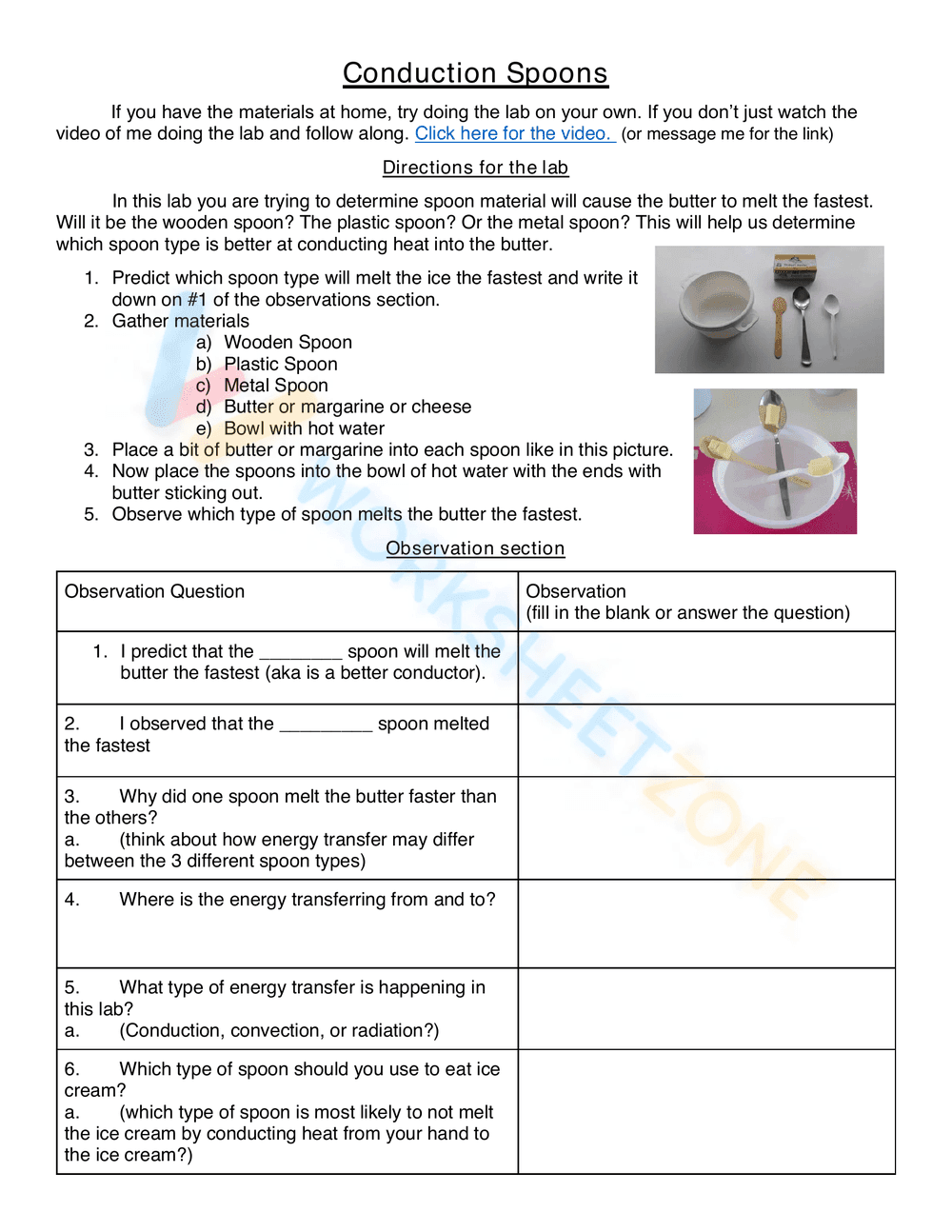
The packet contains a detailed five-day lesson plan, a visual vocabulary guide with nine key terms, and a 23-question concept review. It also features three structured lab reports: the Conduction Spoons lab, the Butter Boat investigation, and the Ice and the Balloon experiment. Each section includes space for predictions, observations, and evidence-based conclusions to support scientific writing.
Mastery Evidence
Tasks are scaffolded to demonstrate mastery of PS3.A. The initial vocabulary and matching exercises assess "Approaching" levels of understanding. The concept review questions require "Meeting" level application of heat transfer laws to real-world scenarios. Finally, the three laboratory investigations provide "Exceeding" level evidence as students must predict outcomes and analyze energy flow within closed and open systems. Scores can be entered directly into gradebooks or IEP progress notes.
Standards Alignment
Primary standard `MS-PS3-3`: Apply scientific principles to design, construct, and test a device that either minimizes or maximizes thermal energy transfer. This resource also supports `MS-PS3-4` by investigating the relationships among the energy transferred, the type of matter, and the change in the average kinetic energy of particles. Both standard codes can be copied directly into lesson plans, IEP goals, or district curriculum mapping tools.
How to Use It
Use this packet as a core instructional unit over one school week. Start with the vocabulary and concept review during direct instruction to establish a baseline. Transition to the hands-on labs as formative assessments to observe how students apply theoretical knowledge to physical phenomena. Completion typically takes 50 minutes per section across five instructional days, allowing for deep exploration of each transfer method.
Who It's For
This resource is designed for general education sixth-grade science classrooms, but the visual vocabulary supports English Language Learners and students with IEPs. It pairs naturally with an anchor chart on the kinetic molecular theory or a direct instruction slide deck on the laws of thermodynamics. It is ideal for teachers seeking a structured, multi-day curriculum for physics units.
This Grade 6 science resource aligns with the NGSS MS-PS3-3 standard, focusing on the plain-English skill of explaining how thermal energy moves through different media via conduction, convection, and radiation. Research from Fisher & Frey (2014) emphasizes that the gradual release of responsibility—moving from structured vocabulary to independent laboratory investigation—is critical for student mastery of complex physical science concepts. By integrating 50 specific tasks and three hands-on labs, this packet addresses the need for multiple exposures to scientific phenomena. The inclusion of PS3.A disciplinary core ideas ensures that students understand temperature as a measure of average kinetic energy, a foundational concept for middle school physics. This structured approach is supported by the RAND AIRS 2024 analysis, which highlights the efficacy of multi-day instructional packets in maintaining curriculum coherence and improving student outcomes in STEM subjects.


