Day and Night PDF Worksheets for 6th Grade
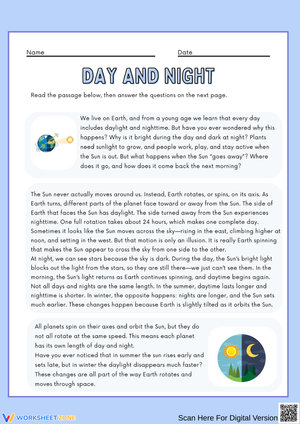
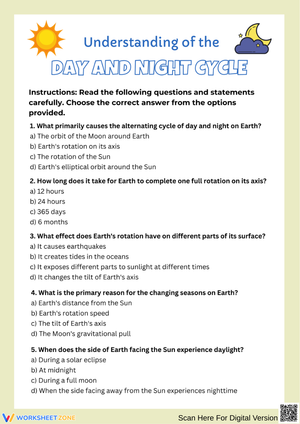
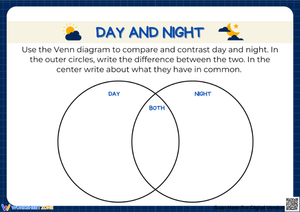
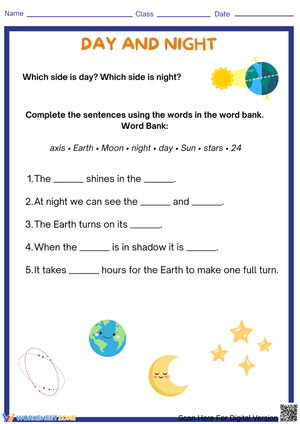
These day and night pdf worksheets for 6th grade give Earth science teachers a set of printable, standalone resources that move students past casual sky-watching into the actual mechanics of Earth's rotation — who's in sunlight, who's in shadow, and why those zones shift continuously over 24 hours. Each worksheet targets a specific conceptual piece rather than surveying the whole topic at once, so teachers can pull individual resources into any point of a unit without disrupting sequence. The set covers rotation direction, apparent solar motion, the terminator line, daylight-hour data tables, and rotation-versus-revolution comparison.
Concepts Covered Across the Set
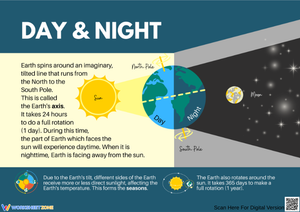
The core diagram tasks ask students to label Earth's rotation direction from a North Pole perspective, trace the terminator line across successive diagrams, and draw ray diagrams showing why exactly half of Earth is illuminated at any given moment. These aren't decorative exercises — students who can accurately complete a ray diagram from memory have genuinely internalized why night is shadow, not distance from the sun.
Data analysis worksheets use sunrise and sunset tables organized by latitude and month. Students identify patterns — why daylight hours near the equator stay relatively consistent year-round while high-latitude locations swing dramatically — and connect those patterns back to rotation and axial tilt. The vocabulary work is embedded in context: students define rotation and revolution on the same worksheet where they're applying both concepts to diagrams, so the distinction becomes functional rather than memorized.
- Labeling Earth's west-to-east rotation direction on North Pole perspective diagrams
- Drawing the terminator line and predicting sunrise and sunset positions
- Completing daylight-hour data tables across seasons and latitudes
- Writing short explanations distinguishing apparent solar motion from Earth's actual movement
- Comparing rotation and revolution using side-by-side visual anchors
- Identifying the axis, equator, and poles on unlabeled globe diagrams
Frequent Errors to Anticipate Before These Worksheets Go Out
The most persistent misconception at this grade is that night happens because Earth moves away from the sun during each rotation cycle. Students who hold this belief draw orbital diagrams with Earth looping in and out, and their written explanations emphasize distance rather than shadow. Every worksheet in the set that includes a written explanation prompt surfaces this error quickly — which is exactly why those prompts are there.
The subtler error is directional. Students who correctly understand that Earth rotates will often draw the rotation going east to west — the opposite of actual. When you see a student place sunrise on the western horizon in a completed diagram, that's the tell. A third pattern worth anticipating: students conflate axial tilt with the cause of day and night. Because tilt comes up repeatedly in season discussions, some students over-apply it and write explanations of the day/night cycle that mention tilt but never mention rotation. That error appears almost exclusively in short-answer responses, not in diagram labeling, which is why both task formats appear across the set.
Standard Alignment
These day and night pdf worksheets for 6th grade align to NGSS MS-ESS1-1 (Earth's Place in the Universe), which requires students to develop and use a model of the Earth-sun-moon system to describe cyclic patterns. The day/night cycle is the foundational pattern in that standard — it sits before lunar phases and before seasons in most instructional sequences, and students who understand it clearly have significantly less confusion when those more complex patterns are introduced. The diagram and ray-drawing tasks map directly to the NGSS practice of developing and using models. The data table exercises align with analyzing and interpreting data. Teachers in states following NGSS can treat these as direct instructional support for MS-ESS1-1 before advancing to eclipses and seasonal variation.
Working These Worksheets Into Your Instruction
The globe-and-flashlight demonstration is a natural setup for several worksheets in the set. After students watch a flashlight illuminate exactly half of a globe, the ray diagram worksheet asks them to recreate that geometry on paper — the physical experience makes the abstract diagram feel like documentation rather than invention. That sequence, demonstration first and diagram second, produces more accurate student work than handing out the diagram cold. For an even stronger setup, have students place a small sticker on their hometown on the globe and rotate it slowly, observing the exact moment the sticker enters the light and then disappears into shadow. That detail makes the worksheet feel like a record of something they watched happen rather than an abstract exercise in shading.
These day and night pdf worksheets for 6th grade also hold up well as formative checks after a lecture or video. A five-minute exit task using the rotation-direction worksheet tells you immediately which students reversed east and west, and you have that information before the next class period. The data table worksheets work well at the start of a period — students spend ten minutes finding patterns in the numbers before the class discussion pulls those patterns into focus. That ordering keeps the discussion from becoming a passive listen; students arrive with observations already formed.
Adjusting the Set for Different Learner Levels
Students who struggle with spatial reasoning — and Earth science surfaces this challenge more than most middle school science topics — benefit from completing the physical globe rotation before working with the North Pole perspective diagram. Day and night pdf worksheets for 6th grade that begin with a labeled, color-coded diagram (day side shaded yellow, night side shaded gray) give those students a concrete reference before the worksheet moves to blank diagrams they complete themselves. That progression, from color-coded to student-labeled, reduces the number of students who freeze in front of an empty circle and guess randomly.
For students moving faster through the material, the data table worksheets offer natural extension. Instead of just identifying daylight patterns, those students can hypothesize why Anchorage, Alaska, experiences far longer summer days than Miami, Florida, and write a paragraph connecting their reasoning to both rotation and axial tilt. That prompt requires synthesizing concepts from across the unit rather than applying a single rule, and it pushes those students without requiring an entirely separate resource.
Frequently Asked Questions
Are these worksheets better used before or after a physical globe demonstration?
Most work better after. The ray diagram and terminator-line worksheets ask students to represent a three-dimensional phenomenon on paper, and students who have first seen it with a physical globe produce more accurate diagrams. The vocabulary comparison worksheet is the exception — it works as a pre-teaching tool or a warm-up before any demonstration.
How long does a typical worksheet in this set take to complete?
Diagram worksheets take most sixth graders 10–15 minutes. The data table and short-answer worksheets run closer to 15–20 minutes because students slow down when writing explanations rather than labeling or shading. Budget extra time on the first data table worksheet; students need a few minutes to orient to how the table is organized before they start finding patterns.
Do the worksheets address the rotation-versus-revolution confusion directly?
Yes. One worksheet places both definitions side by side with labeled diagrams of each movement, then follows up with a scenario-based task where students determine which type of motion is being described. That direct comparison is more effective than addressing each term separately, which is how most textbooks handle it and how the confusion typically starts.
Can these be used in an interactive science notebook?
Yes. Each worksheet trims and pastes into a standard composition notebook without modification. The completed diagram worksheets become useful reference materials students return to when reviewing for assessments. Some teachers have students annotate finished diagrams with colored pencils to reinforce the distinction between the illuminated and shadow zones — a step that adds no prep time on the teacher's end.
Clear All