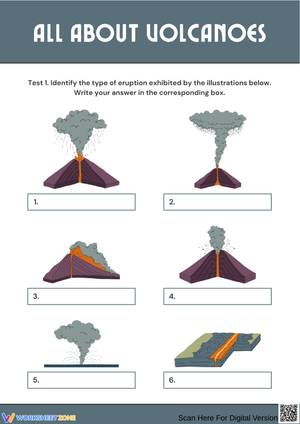
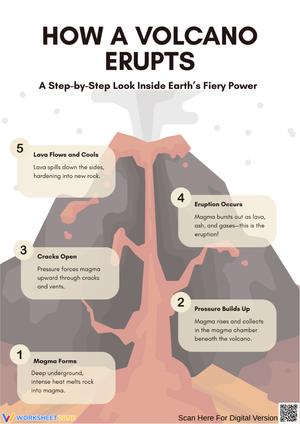
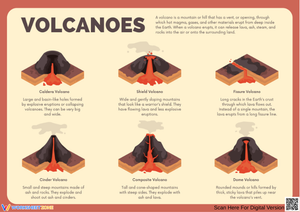
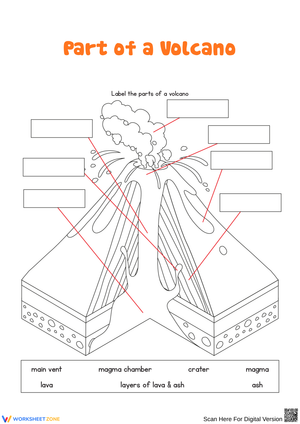
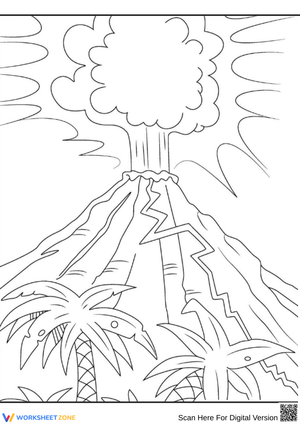
These volcano printable worksheets for 6th grade give teachers a direct entry point into Earth science with no lab setup required — the set covers volcanic structure, eruption differences, plate tectonic connections, and academic vocabulary through labeling diagrams, short reading passages, cause-and-effect questions, and comparison charts. Each worksheet targets a specific concept and can stand alone in a lesson or sit within a larger unit sequence.
The Specific Skills Targeted
Sixth grade is when most science curricula formally introduce plate tectonics, which makes volcanoes both timely and conceptually demanding. Students at this level stop treating a volcano as simply a mountain that erupts and start working with layered ideas: how magma forms and moves, why eruption style varies, and how volcanic activity links to plate boundaries and hotspots. That conceptual range is why the topic fits comfortably at this grade — students have enough background in Earth structure to make the connections meaningful rather than arbitrary.
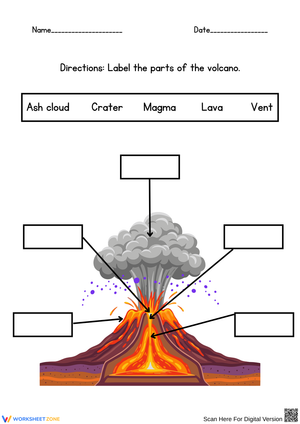
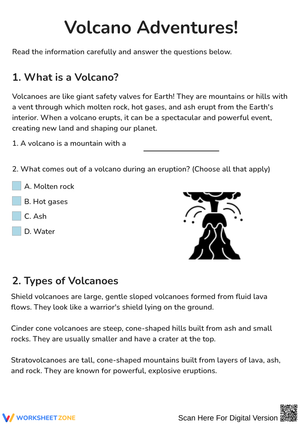
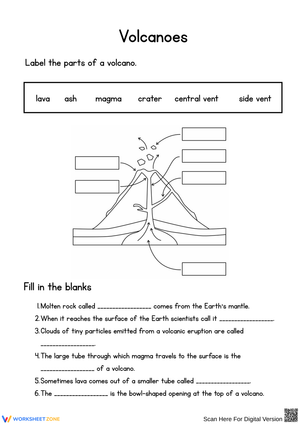
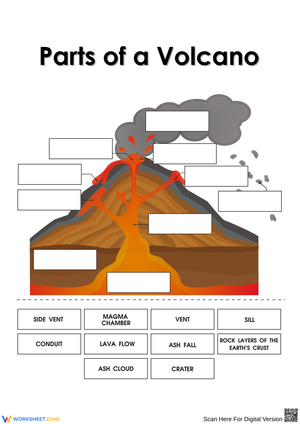
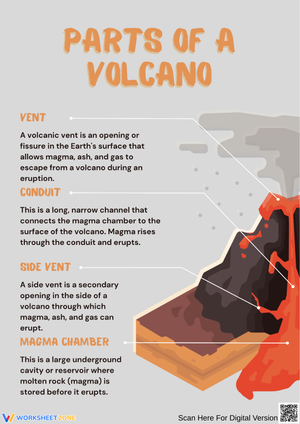
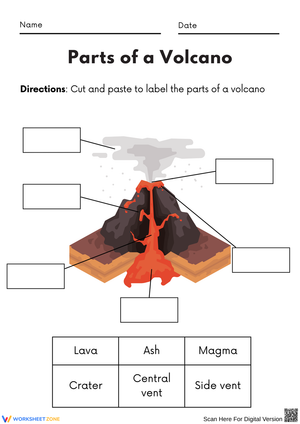
Each worksheet builds those ideas through specific, testable tasks. Students label a cross-section diagram naming the magma chamber, conduit, vent, crater, and ash cloud. They sort shield, composite (stratovolcano), and cinder cone volcanoes by shape and eruption behavior. They read short passages and answer questions that require them to distinguish between processes, not just recall terms. Core vocabulary addressed throughout includes magma, lava, vent, crater, conduit, magma chamber, viscosity, hotspot, plate boundary, eruption, shield volcano, composite volcano, and cinder cone — and students use these words in labeling and written explanations, not only in definition-matching exercises.
The set includes multiple worksheet formats, each suited to a different instructional moment:
- Labeled cross-section diagrams for visual vocabulary and structural understanding
- Compare-and-contrast charts for sorting volcano types and eruption patterns
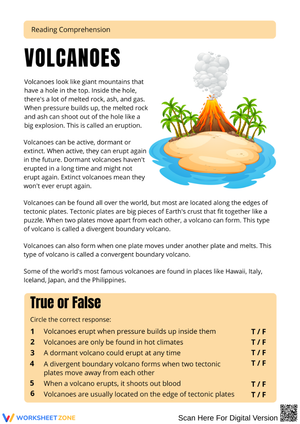
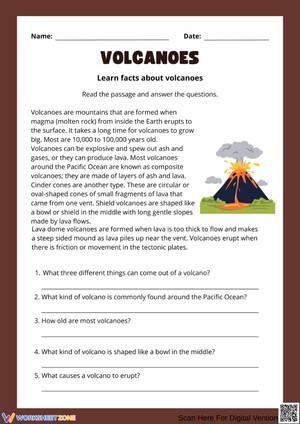
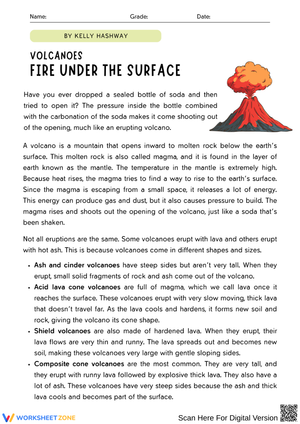
- Reading passages with short-answer questions for content and literacy integration
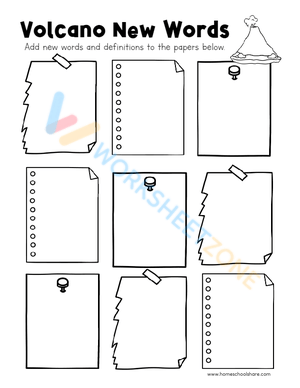
- Vocabulary review worksheets for term reinforcement
- Exit ticket prompts for quick checks at the close of a lesson
Rotating these formats across a unit keeps practice purposeful. Students who work only with labeling tasks can identify parts without ever explaining a process; rotating in cause-and-effect and short-answer work pushes them past recognition into reasoning.
Student Mistakes Worth Catching Before the Quiz
The magma-versus-lava distinction looks easy but breaks down regularly in student writing. Even after labeling a diagram correctly, students write sentences like "lava rises through the conduit" — applying the surface-material term to an underground process. The worksheets address this by presenting both words in diagram and sentence contexts, which forces students to apply the distinction rather than recognize it passively.
A second error pattern involves eruption type. Many sixth graders assume all volcanoes erupt violently, so they struggle to explain why a shield volcano produces slow lava flows while a composite volcano can produce an explosive blast. The underlying confusion is usually viscosity: students learn the word but do not connect it to gas behavior in high-silica magma. Compare-and-contrast worksheets in the set place eruption characteristics alongside magma composition, making that causal relationship visible rather than leaving it implicit.
A third pattern worth watching: when students see a hotspot question, they frequently fall back on plate boundary explanations. They have learned that plate movement causes volcanoes, so they apply that reasoning everywhere — including to the Hawaiian Islands, where it does not fit. A short-answer prompt on hotspot formation, written without plate boundary vocabulary in the question stem, surfaces that confusion quickly and gives teachers a clear next teaching move.
How to Fit These Worksheets Into Your Lesson Plans
Volcano printable worksheets for 6th grade serve different instructional purposes depending on where they land in a unit. A labeled cross-section works well on day one — labeling activates prior knowledge and surfaces vocabulary gaps before students have done much reading. A cause-and-effect worksheet on eruption style belongs in the middle of the unit, after students have enough vocabulary to reason through the underlying process. Exit ticket prompts and short-answer review worksheets land best in the two or three days before a quiz, when retrieval practice does more good than presenting new content.
Station setups work particularly well with this topic. One station has students label the cross-section diagram. A second has them sort three volcano types by shape, eruption pattern, and real-world location using a comparison chart. A third includes a short reading about Mauna Loa and four to five comprehension questions. That rotation keeps groups active for 20 to 25 minutes without requiring elaborate materials at each station — different worksheets, same concept set.
For homework, focused worksheets outperform dense review. A vocabulary worksheet or a brief compare-and-contrast chart travels home better than a multi-question extended response. Students working independently at 8 p.m. do better with a bounded task that has a clear stopping point than with something that feels unfinishable without a teacher nearby.
Working With a Range of Learners
The diagram worksheets carry built-in flexibility. Students who need more support complete labeling tasks with a word bank provided; students who are ready for more challenge label the same diagram without support and then write two to three sentences explaining how a volcano's structure connects to its eruption type. The science target stays constant while the level of support differs — which makes this format practical in a class where readiness levels vary widely.
For students working below grade level in reading, a brief whole-class preview of key vocabulary before the reading worksheet lowers the processing load without softening the content expectations. This matters especially for English language learners encountering terms like conduit and viscosity for the first time. Hearing those words used in a sentence or two before meeting them in print makes a noticeable difference in what students write back.
At the upper end, open-ended synthesis prompts extend the work without requiring a different worksheet entirely. Asking students to write a paragraph explaining why Kilauea and Mount St. Helens behave so differently — using at least three vocabulary terms — goes well beyond a labeled diagram but grows directly from the same concepts the set builds. Teachers can attach that kind of prompt to the end of a comparison chart or assign it as a stand-alone extension for students who finish early.
Standard Alignment
These volcano printable worksheets for 6th grade align most directly with NGSS MS-ESS2-3, which asks students to analyze and interpret data on the distribution of fossils, rocks, and seafloor structures to provide evidence of past plate motions. Volcanic activity patterns are central to that standard — understanding where and why volcanoes form gives students the conceptual base they need before they can interpret distribution data accurately. The diagram and comparison worksheets build the vocabulary and structural knowledge that MS-ESS2-3 assumes students bring to that analysis task.
The vocabulary-in-context approach across the set also supports RST.6-8.4, which addresses determining the meaning of domain-specific words and phrases as they appear in science texts. Teachers who need to document literacy integration in their Earth science planning can point to this connection directly.
Frequently Asked Questions
Are these worksheets usable for sub plans?
Yes. Each worksheet has self-contained directions that do not depend on prior class discussion to make sense. A labeling or vocabulary worksheet works cleanly when a substitute is covering the class — students know what to do from the prompt itself, and the returning teacher can review the work quickly without needing to reconstruct what the sub explained.
How long does each worksheet take to complete?
Labeling and vocabulary matching worksheets typically run 10 to 15 minutes. Reading-with-questions worksheets run closer to 20 minutes depending on passage length. Compare-and-contrast charts and short-answer worksheets take 15 to 25 minutes when students write in full sentences. Exit ticket formats are built for 5 minutes or fewer at the end of a lesson.
Can these worksheets double as assessment evidence?
Several teachers use the labeling worksheet as a formative check after the first day of instruction and the comparison chart as a pre-quiz review tool. Individual items from the short-answer worksheets transfer cleanly into unit tests. Volcano printable worksheets for 6th grade at this content depth give teachers enough rigor to treat student responses as genuine evidence of understanding — not just completion data.
Do the resources cover the connection between volcanoes and the rock cycle?
One worksheet addresses how lava cools into extrusive igneous rock and how that process fits into the broader rock cycle. The treatment is direct and brief — enough for students to see the link clearly without turning a volcano unit into a full-scale rock cycle lesson.












 Interactive Worksheet Maker
 Quiz Maker
 Word Search Maker
 Crossword Puzzle Maker
 Word Scramble Generator
 Sentence Scramble Generator
 Handwriting Worksheet Generator
 Name Tracing Generator
 Fill In The Blank Generator