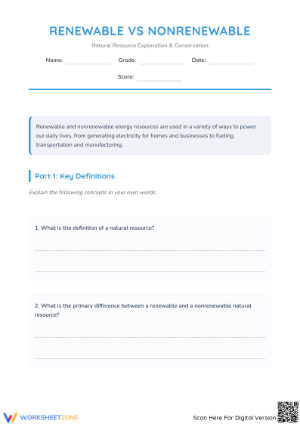
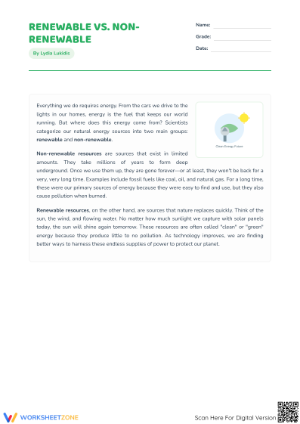
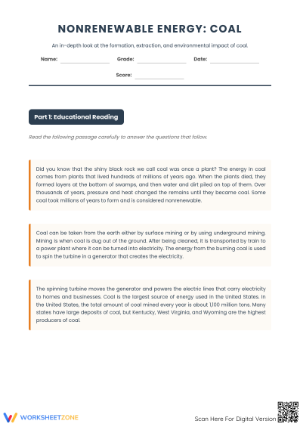
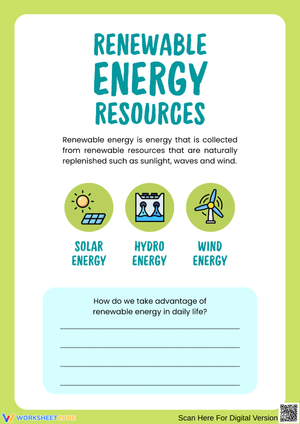
6th grade renewable and nonrenewable resources printable worksheets give middle school science teachers a reliable entry point into one of the trickier classification tasks at this level — asking students not just to sort resources into two columns, but to explain in writing why a resource belongs where they placed it. That explanation requirement is where most 6th graders stall, and where these worksheets do the most work.
Skills These Worksheets Target
The core goal here is classification with reasoning, not memorization. Students sort resources and defend each placement in writing — a requirement that separates students who genuinely understand the concept from students who are pattern-matching from examples they've heard before.
- Vocabulary building: Students match terms like conservation, finite, and extraction to definitions, then apply those terms in short-response prompts rather than leaving them on a glossary list.
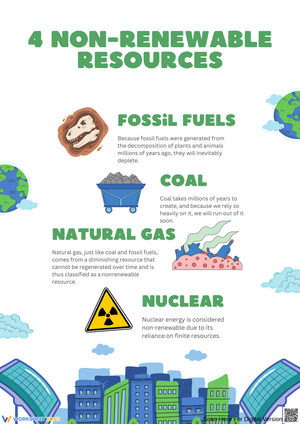
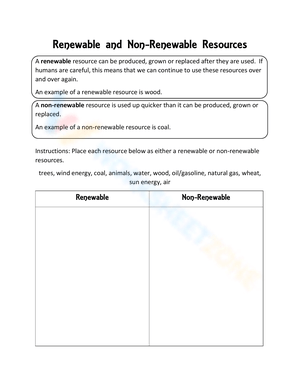
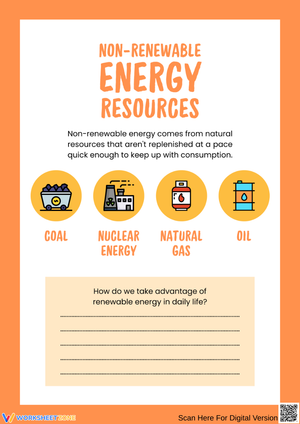
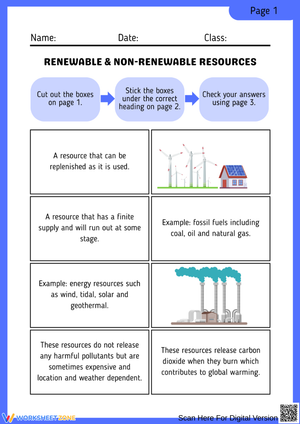
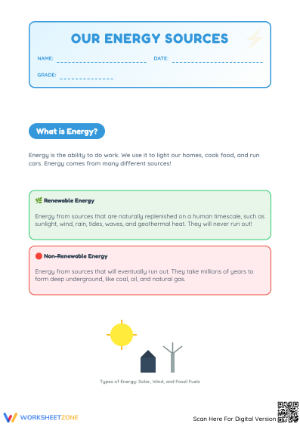
- Resource sorting: Students place examples — coal, wind, soil, natural gas, sunlight, forests, various metals — into categories and write at least one sentence justifying a contested choice.
- Real-world scenario analysis: A brief description of a community's energy or material choices asks students to identify which resources are being used and which face long-term depletion.
- Comparison prompts: Students weigh two resources against each other — natural gas versus solar energy, for instance — and identify one tradeoff each involves.
- Misconception checks: Correct-the-statement tasks address the recyclable-versus-renewable confusion and other predictable errors before they calcify into habit.
Across the set, tasks move from identification toward explanation. A student who can sort oil, wind, copper, and sunlight correctly demonstrates recall. A student who can write, "I classified copper as nonrenewable because metal deposits take far longer to form than humans extract them," demonstrates understanding. The worksheets build toward that second standard.
Mistakes Students Make That These Worksheets Help You Catch
The most stubborn misconception at this grade is the conflation of recyclable and renewable. Students reason that because aluminum cans get recycled, aluminum must be a renewable resource. It isn't — bauxite deposits are finite, and recycling the product doesn't replenish the mineral source. A worksheet that places these two terms side by side and includes at least one sorting item designed to pull them apart handles this faster than a class discussion alone.
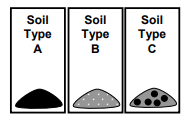
A second consistent error: students assume that "natural" means "renewable." Soil is natural. So is old-growth forest timber, and so is peat. None of these replenishes quickly enough to qualify as renewable under standard scientific definitions, and all three make excellent worksheet items precisely because they don't fit the instinctive answer. When students have to commit a written justification to paper, the thinking becomes visible in a way that a show-of-hands check never achieves.
A third pattern, less often addressed in classroom materials, is the assumption that renewable automatically means environmentally benign. Hydropower dams disrupt river ecosystems. Wind energy installations require land and structural materials that are themselves nonrenewable. Worksheets that include a brief compare-the-tradeoffs prompt — rather than treating one category as simply good and the other as simply bad — help students develop a more accurate mental model before that simplification gets reinforced.
Building These Worksheets Into Your Week
The sorting tasks work especially well as bell ringers on days when the previous lesson introduced the core vocabulary. A short list of eight to ten examples — five minutes to classify independently, then two minutes to compare with a partner — surfaces disagreement quickly and gives teachers a real-time read on where the class actually is before instruction begins. The worksheet becomes formative data before the lesson even starts.
For a standard 50-minute block, one structure that holds up reliably: 15 minutes of direct instruction using anchor examples, 20 minutes of independent classification-with-justification work, then a 10-minute debrief on two or three contested items. Soil, paper, and aluminum tend to generate the most productive disagreement and the strongest whole-class conversation — they're the items where students discover their own reasoning doesn't hold.
6th grade renewable and nonrenewable resources printable worksheets also work well in science centers. One group completes a basic sort with a word bank and teacher support; another tackles a scenario passage about a community's energy decisions and answers two short-response questions. Both groups practice the same underlying science concepts at different levels of independence — no separate lesson plan required for each group.
Adapting the Set for a Range of Learners
For students who need more support, a partially completed graphic organizer — with category headers, a few examples already placed, and a word bank — reduces cognitive load without eliminating the classification task itself. Multilingual learners benefit from picture cues alongside vocabulary terms: a photograph of a wind turbine next to the words "wind energy" gives a concrete referent before the sorting task begins.
Students ready for a greater challenge can work through scenario prompts that ask for policy-level reasoning: given a community that currently relies on coal for electricity, recommend two alternatives and explain one limitation of each. That structured argument connects naturally to opinion and informational writing, extending the science task into a literacy block without requiring a separate assignment.
One practical addition that improves results across all levels: require a sentence stem after every sort. A stem like I classified this as ___ because ___ turns a basic worksheet into visible evidence of thinking, and it helps teachers catch guesses before they become entrenched misunderstandings. Students who complete the stem correctly almost always understand the reasoning; students who can't complete it have revealed exactly what needs reteaching.
Standard Alignment
These worksheets address NGSS MS-ESS3-1, which asks students to construct explanations based on evidence for how the uneven distribution of Earth's mineral, energy, and groundwater resources results from geoscientific processes. 6th grade renewable and nonrenewable resources printable worksheets align directly with the evidence-based explanation expectation at the center of that standard — classification paired with written justification mirrors the kind of reasoning MS-ESS3-1 assessment tasks require at the classroom level. Teachers working in states with their own science frameworks will find comparable alignment in middle school earth science strands that address natural resource management, energy choices, and human impact on Earth's systems.
Frequently Asked Questions
Is water a renewable or nonrenewable resource, and how should that example be handled on a worksheet?
Fresh water cycles through precipitation and qualifies as renewable in most contexts, but it can be depleted locally faster than it's naturally replenished — which makes it a genuinely complex example rather than a clean classification item. Worksheets that include water work best when the answer key acknowledges that complexity or flags the item as a discussion point rather than a scored sort. Treating it as a clear-cut answer in either direction invites confusion that's hard to walk back later in the unit.
What grade range suits this resource set?
The classification and short-response format fits grade 6 most directly, but the simpler sorting tasks work well for strong 5th graders or for 7th graders reviewing before a unit assessment. The scenario-based tradeoff prompts are better suited to independent work at the 7th or 8th grade level. 6th grade renewable and nonrenewable resources printable worksheets sit at the exact point in the curriculum where students are expected to move beyond listing examples and start explaining the science behind their classifications — that shift in expectation is what this format addresses.
What should an answer key include for this topic?
An answer key that only lists the correct category isn't enough here. Including a brief rationale — nonrenewable because deposits take millions of years to form and are extracted far faster than they accumulate — gives teachers a model response to share with students and makes grading consistent across sections or co-taught classrooms. Students who see the reasoning alongside the answer learn more from reviewing their work than students who only see a checkmark or an X.
Can these worksheets connect to current events or local contexts?
Yes, and that connection is worth making deliberately. A short news story about a coal plant closure, a new solar installation, or a regional water shortage gives students a real context to apply their classifications before the unit ends. Even a five-minute discussion tied to a local energy story, followed by one classification task, anchors the science vocabulary to something students have actually encountered outside school — which is where middle school engagement tends to live or die.












 Interactive Worksheet Maker
 Quiz Maker
 Word Search Maker
 Crossword Puzzle Maker
 Word Scramble Generator
 Sentence Scramble Generator
 Handwriting Worksheet Generator
 Name Tracing Generator
 Fill In The Blank Generator