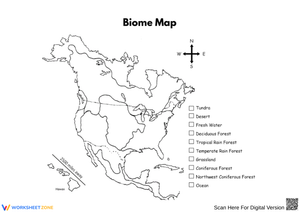
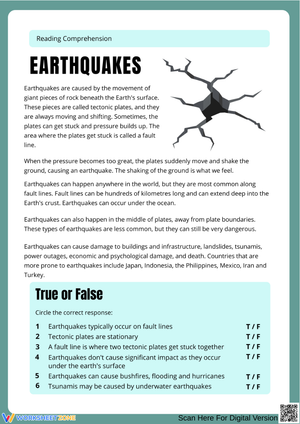
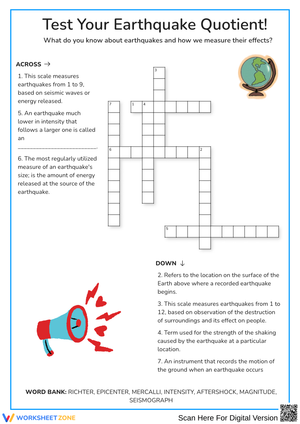
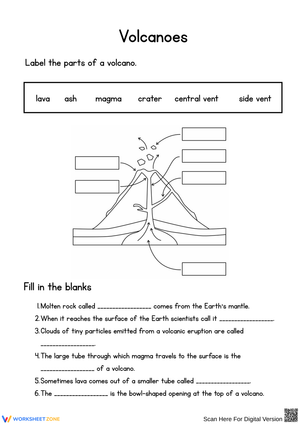
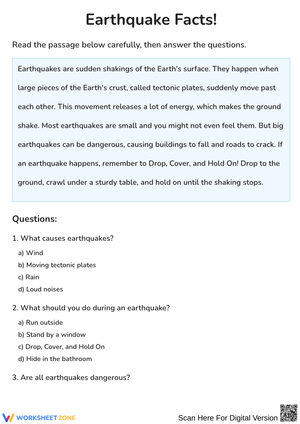
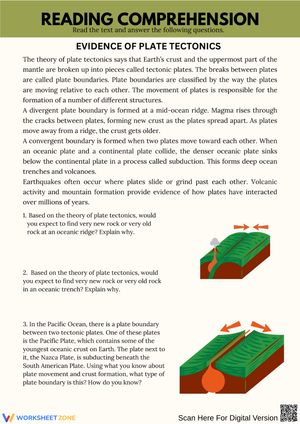
These 6th grade earth science worksheets cover the core territory of the middle school Earth science sequence — Earth's interior and surface processes, rocks and minerals, the rock cycle, weathering and erosion, the water cycle, atmospheric science, and space systems — with enough task variety that a single topic can be approached through diagram labeling, cause-and-effect writing, short reading response, or vocabulary review depending on what a lesson needs that day. Teachers get organized, topic-specific resources they can slot into warm-ups, stations, homework, or sub plans without having to adapt an entire unit.
Concepts and Skills Across the Set
Middle school Earth science asks students to do something harder than naming things — it asks them to explain how processes work over time. How does heat and pressure transform sedimentary rock into metamorphic? How does water move from the surface back into the atmosphere? How does Earth's axial tilt produce seasonal change? Each worksheet targets that process-level understanding alongside the vocabulary and visual reading that support it.
- Rocks, minerals, and the rock cycle: Students identify mineral properties using hardness, luster, and streak, then classify rock samples as igneous, sedimentary, or metamorphic. Diagram tasks track how heat, pressure, weathering, and cooling move materials through the cycle.
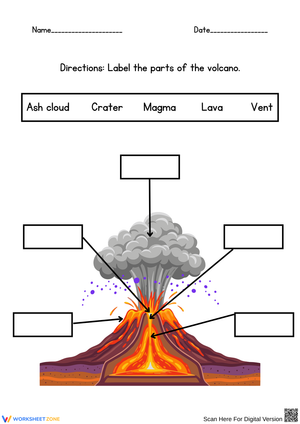
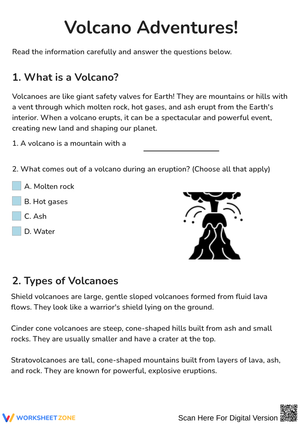
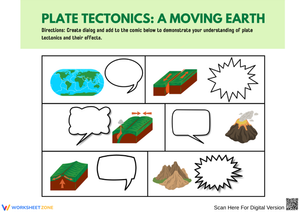
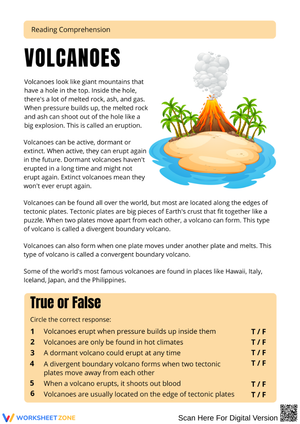
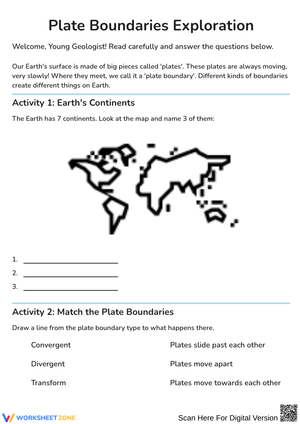
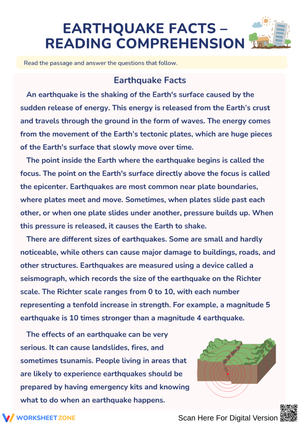
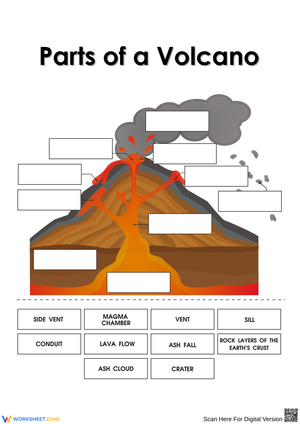
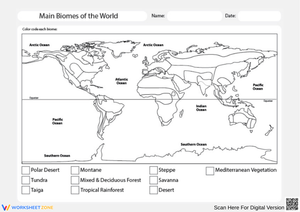
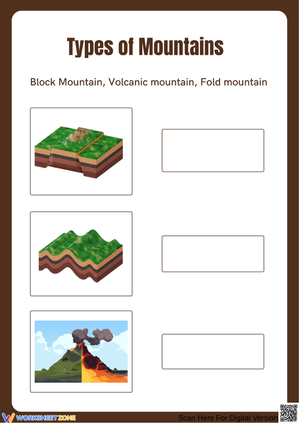
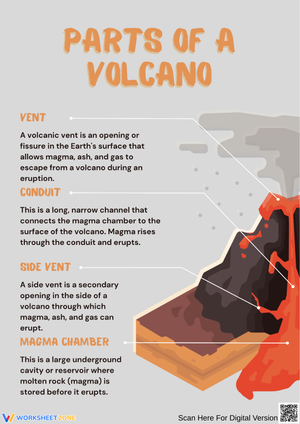
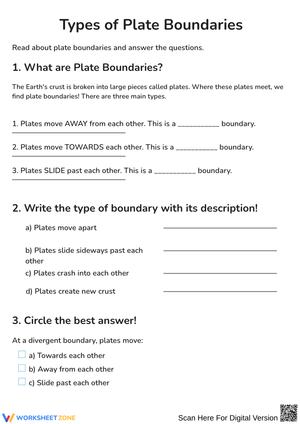
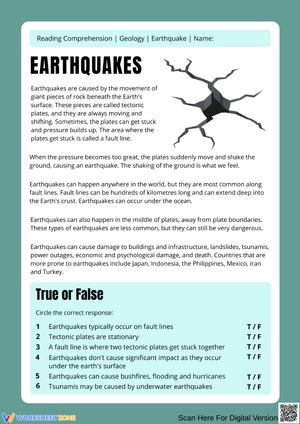
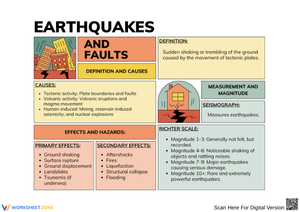
- Earth's interior and surface processes: Students label the crust, mantle, outer core, and inner core, then connect internal forces to surface features — volcanoes, mountain ranges, and fault lines.
- Weathering, erosion, and deposition: Students distinguish mechanical from chemical weathering, identify which forces move material, and explain where deposition builds new landforms.
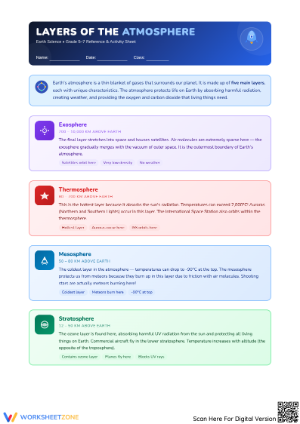
- Water cycle and atmosphere: Sequence charts and vocabulary tasks address evaporation, condensation, precipitation, and collection, extending into cloud classification, humidity, and layers of the atmosphere.
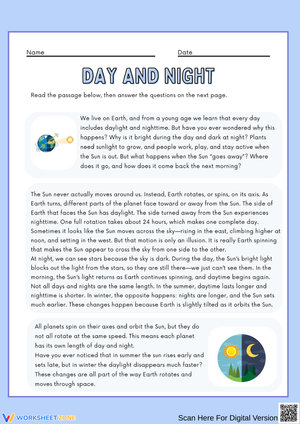
- Space systems: Moon phase diagrams, rotation versus revolution distinctions, gravity, and solar system comparisons appear through visual tasks and short written explanations.
Several worksheets pair reading and visual interpretation in the same task — a paragraph describing how a glacier carves a valley followed immediately by a diagram the student labels. That combination gives two entry points into the same concept, which matters when students are still building both their vocabulary and their visual literacy at the same time.
Mistakes Students Make That These Worksheets Help You Catch
The weathering-erosion distinction produces the most durable confusion in this content area. Students who can define each term correctly on a vocabulary quiz will still write "the river weathers the bank" when describing what running water does to a streambed. They are describing transport — erosion — but "weathering" has become a general-purpose word for any kind of change. Worksheet items that ask students to name the process and identify its agent in the same response surface this conflation in a way a matching task cannot.
Moon phase geometry creates a different problem. Students memorize what each phase looks like from Earth but don't hold the underlying Earth-Sun-Moon geometry in mind. When a diagram shows the Moon to the right of Earth rather than below it — a simple rotation of perspective — students frequently reverse which half is lit. Items that show the system from multiple vantage points reveal whether a student understands the spatial relationship or just recognizes a familiar picture.
Rotation and revolution are another reliable sticking point. Even after students write accurate definitions of both terms, they flip the application: seasons explained by rotation, day-night cycles explained by revolution. The problem isn't recalling a definition — it's connecting the concept to the correct phenomenon. Items that lead with a scenario ("It is December in Sydney, Australia — what explains the longer daylight hours compared to New York?") force students to reason from situation to concept rather than from term to definition.
Building These Worksheets Into Your Lesson Plans
In practice, these 6th grade earth science worksheets work best when they're tied to a question students are actively trying to answer — not assigned as completion work. At the start of a water cycle lesson, project the diagram and give students three minutes to label what they already know. After instruction, they return and add what changed. That two-pass approach turns the worksheet into a record of their own learning, which students tend to treat with more seriousness than a new task that arrives cold.
For science stations, placing one worksheet at a diagram-reading station, one at a short-passage station, and one at a written explanation station creates a natural rotation without requiring additional materials or teacher facilitation for each group. Sub plans are another reliable fit — the accessible directions and clear visual anchors on most worksheets mean a substitute doesn't need subject expertise to keep the class productive. The 10 minutes at the end of a lab day — after students have observed something but before they've put language to it — is also a productive window. A cause-and-effect worksheet on weathering immediately after a vinegar-and-limestone demonstration helps students attach vocabulary to what they just watched, while the observation is still present in working memory.
One consistently effective move is connecting each worksheet to something students can locate nearby. Students studying erosion work more precisely when the example isn't abstract — point them toward the runoff channel along the school's grass slope or the silt accumulation at the edge of the parking lot. Students reviewing weather systems can compare the worksheet diagram to that morning's forecast. This connection doesn't require extra preparation; it's a short verbal cue that shifts the worksheet from isolated content to a tool for reading the world they actually walk through.
Standard Alignment
These worksheets address several disciplinary core ideas from the Next Generation Science Standards for middle school Earth and space sciences. MS-ESS2-1 asks students to develop models of how Earth's materials cycle — rock cycle diagram tasks and process-labeling items address this directly. MS-ESS2-4 covers water cycling and how water moves through Earth's systems, which maps to the sequence charts and evaporation-to-precipitation tasks. MS-ESS1-1 addresses Earth's place in the solar system, including rotation, revolution, and the Moon's changing appearance, which appears across the space systems worksheets.
In classroom terms, these standards expect students to use models as explanatory tools rather than recognition aids. A student who can label a water cycle diagram has satisfied only part of the standard; the full intent is that students explain the cycling using the model as evidence. That's why the most useful items in the set ask students to annotate a step in their own words or justify an answer using a diagram — and it's what distinguishes a formative check that reveals real understanding from one that reveals only successful guessing.
Adjusting the Worksheets for a Range of Learners
For students who need more support, the most effective adjustments are reducing the number of items per section, adding a word bank to any labeling task, and providing a partially completed diagram so spatial orientation isn't an additional barrier on top of the content itself. Sentence stems help considerably on cause-and-effect prompts: "When water evaporates from the ocean, it ____" gives a struggling student a grammatical starting point without removing the scientific reasoning the item is meant to measure.
On-level students generally move through the tasks as written — the mix of diagram work, brief reading, and short written explanation keeps the demand appropriate without becoming overwhelming. For advanced learners, the move is to flip the task: instead of labeling a provided moon phase diagram, a student draws the Earth-Sun-Moon geometry for a given phase and explains what an observer on Earth would see. Instead of classifying rock types from descriptions, a student defends a classification using evidence and addresses one plausible alternative. Fast finishers can write three quiz questions for a classmate using a completed worksheet as their source — a zero-prep extension that deepens retrieval and gives the teacher something usable for later review.
Frequently Asked Questions
Do these worksheets work for students who struggle with reading?
Most worksheets lead with a visual — a diagram, sequence chart, or labeled comparison table — so students who find dense text difficult have a non-reading entry point from the start. Reading passages that do appear are short and paired with focused questions. Teachers can reduce the load further by reading a passage aloud with the class before releasing students to respond independently.
Can I use these for formative assessment, or are they only for practice?
They work for both, depending on how the task is framed. As practice, students use notes and the goal is rehearsal. As a formative check, run the same worksheet without notes at the end of a lesson to see where gaps remain before moving forward. The written explanation prompts — where students justify an answer or describe a process in their own words — function well as low-stakes quiz items when you need quick evidence that a concept has actually landed.
How do these worksheets fit into a course that relies heavily on labs?
They slot in at the processing stage — after observation, before formal assessment. After a lab, students often have a clear sensory memory of what happened but haven't yet connected those observations to science vocabulary and concepts. A short worksheet during the last 10 minutes of a lab day helps students make that language connection while the experience is still active. The 6th grade earth science worksheets covering weathering and erosion are especially well-suited for this because the processes are easy to demonstrate and the vocabulary-to-observation connection is precisely where students tend to get stuck.
Will the set cover a full-year curriculum?
The worksheets span all major Earth science domains taught at the middle school level — interior Earth, surface processes, rock and mineral identification, water systems, atmospheric science, and space — so the topic coverage aligns with a typical grade 6 scope and sequence. Whether that fills an entire year depends on how your units are structured and how much instructional time goes to labs, projects, and summative assessments. Most teachers treat the 6th grade earth science worksheets as a reliable supplemental layer alongside those activities rather than as a standalone curriculum.












 Interactive Worksheet Maker
 Quiz Maker
 Word Search Maker
 Crossword Puzzle Maker
 Word Scramble Generator
 Sentence Scramble Generator
 Handwriting Worksheet Generator
 Name Tracing Generator
 Fill In The Blank Generator