These layers of the earth pdf worksheets for 6th grade give teachers a set of standalone resources that move students past basic diagram labeling into comparative thinking — students record each layer's thickness, composition, temperature range, and physical state, then use those observations to answer explanation questions. Two or three worksheets placed across a unit build repeated exposure without requiring students to sit through the same activity twice.
What Each Worksheet Asks Students to Do
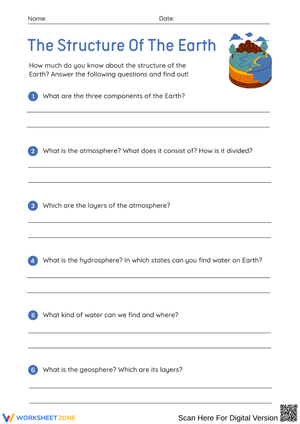
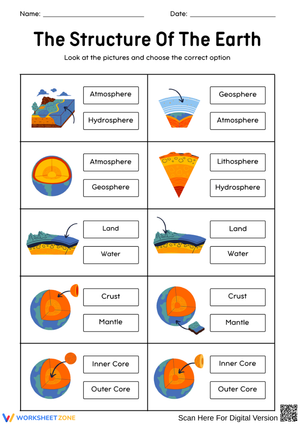
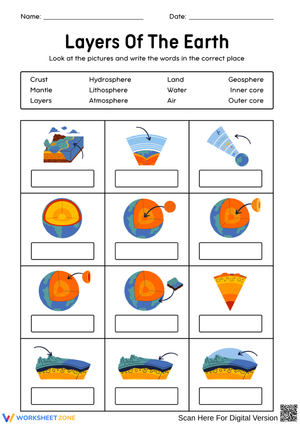
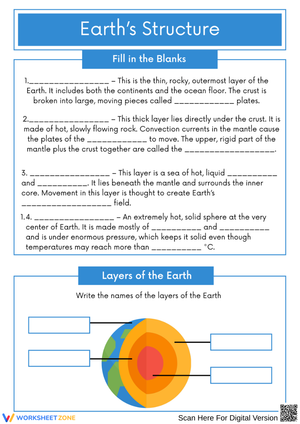
The set covers five task formats, each targeting a different entry point into the content:
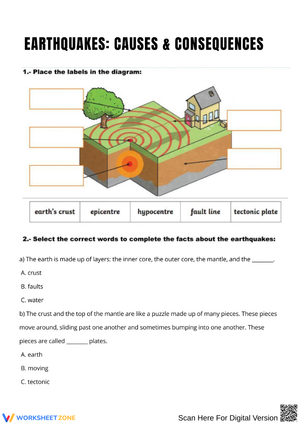
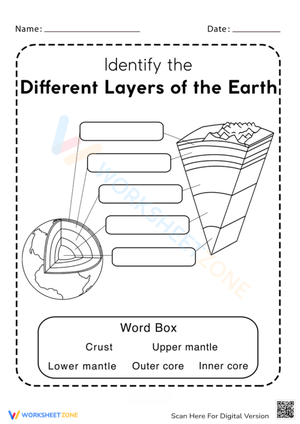
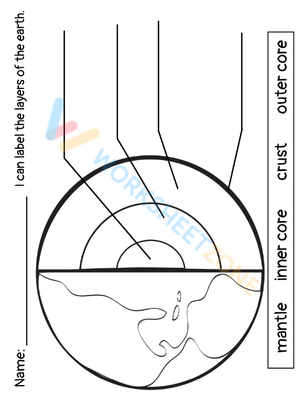
- Label-and-color cross-sections: students mark the crust, mantle, outer core, and inner core on a cutaway Earth diagram, then color-code each layer using a provided key.
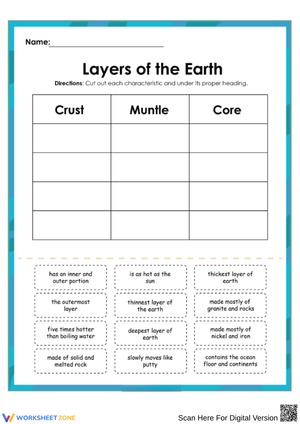
- Comparison tables: students fill in each layer's position from surface inward, approximate thickness, dominant composition, temperature range, and physical state — the table format makes the solid-versus-liquid distinction visible across all four layers at once.
- Vocabulary match and definition writing: students connect terms like lithosphere, composition, and pressure to their meanings, then use three of those terms in original sentences.
- Constructed-response prompts: students write two to four sentences explaining why the inner core is solid despite being the hottest region, or how movement in the liquid outer core connects to Earth's magnetic field.
- Sequencing tasks: students order the layers from surface to center, then again from center to surface — a small format shift that catches students who have memorized only one direction.
The constructed-response items are the most revealing. Students who label the four layers correctly will still write "the inner core is liquid because it's the hottest part" on an explanation question — the labeling task didn't expose that gap, but the short-answer prompt does every time.
Frequent Student Errors Worth Catching Before the Unit Assessment
Four misconceptions appear reliably in 6th grade student work on this topic. The first is the assumption that Earth's interior is uniformly molten. Students arrive with the image of a planet that is "all lava" inside, so they need explicit instruction that three of the four layers are solid. The second — which resists correction even after direct teaching — is the idea that the inner core must be liquid because it is the hottest layer. Students who understand that temperature determines state of matter have not yet encountered the concept that pressure can override temperature, and a single labeled diagram rarely makes that relationship concrete enough.
The third error is scale. Because the crust is the layer students experience directly, they tend to draw or imagine it as roughly equal in thickness to the mantle. A comparison table that includes approximate thicknesses — crust ranging from 5 to 70 km, mantle close to 2,900 km — makes the actual proportions land in a way that color-coding alone does not. The fourth misconception is conflating the mantle with molten rock. Students who have heard that tectonic plates "float" on the mantle often write "the mantle is liquid," missing the critical distinction that it behaves plastically over geologic time while remaining technically solid.
Fitting These Worksheets Into Your Week
The most effective placement for the labeling and comparison worksheets is right after initial instruction — not the day before it, and not a week later. Students who complete the comparison table while the lesson is still recent notice relationships they would not catch during a lecture alone: that both the crust and inner core are solid but for entirely different reasons, or that the mantle is thicker than every other layer combined. That observation-within-the-worksheet moment tends to stick in a way that copying from a slide does not.
On Monday mornings after a weekend break, the sequencing worksheet works well as a three-minute warm-up. Students list the layers from surface to center and from center to surface from memory, then check against their notes. That low-stakes spaced retrieval costs almost no instructional time and significantly cuts down on the number of students who show up to Friday's quiz having reversed the outer and inner core. The vocabulary and short-answer worksheets fit naturally into a center rotation, where pairs can talk through explanations before writing — that oral rehearsal step helps multilingual learners access the constructed-response prompts without requiring a separate modified worksheet.
One approach worth trying: hand out the diagram worksheet at the start of a lesson and ask students to fill in as much as they can from memory, then set it aside. After instruction, return a clean copy and have them complete it again. The before-and-after comparison lets students see exactly what the lesson added, and that visibility motivates in a way that a single completed diagram does not. Layers of the earth pdf worksheets for 6th grade used this way become a learning record rather than just review.
Adjusting the Set for a Range of Learners
The comparison table is the easiest format to tier. For students who need additional support, pre-fill the layer names and one or two property cells, then ask students to complete the remaining columns. A word bank on the vocabulary worksheet removes the retrieval burden without changing the matching and definition tasks. Sentence frames help students structure explanation responses: "The inner core is solid because __________, even though __________." That frame pushes students toward the pressure-versus-temperature distinction without letting them dodge it.
Students who move quickly through labeling and vocabulary tasks are ready for the explanation prompts. Asking them to write a second response — which two layers are most different from each other, and why — forces comparative reasoning across the full set of layer properties rather than a single-layer description. Layers of the earth pdf worksheets for 6th grade also extend naturally into evidence-based work: students can research seismic wave data and add a "how scientists know this" column to the comparison table, connecting the content to scientific measurement rather than textbook assertion.
Standard Alignment
These worksheets connect most directly to NGSS MS-ESS2-1, which asks students to develop a model describing how Earth's materials cycle and how energy flow drives those processes. A working mental model of Earth's interior — knowing where each layer sits, what it is made of, and whether it is solid or liquid — is foundational to that modeling work. Students cannot reason about convection currents or material cycling without first understanding the physical conditions in the mantle and outer core. In most 6th grade Earth science sequences, this content falls in the first few weeks of the unit, before instruction shifts toward plate tectonics and surface processes, giving students a structural framework they return to throughout the year.
Frequently Asked Questions
Do these worksheets come with answer keys?
Yes. Each worksheet includes a corresponding answer key covering diagram labels, vocabulary matches, comparison table entries, and sample constructed responses. Sample answers for open-ended prompts include the key science vocabulary students are expected to use, so teachers can quickly identify when a student's response is missing a critical term like pressure or composition.
How long does each worksheet take in class?
The labeling and comparison worksheets together take about one full class period when paired with direct instruction and independent practice. The vocabulary and short-answer worksheets work well as homework or center activities. The sequencing worksheet is short enough to function as a warm-up or exit check — most students finish it in under five minutes.
Are these worksheets workable for students reading below grade level?
The diagram and sequencing tasks require minimal reading and hold up well for students who struggle with extended text. The comparison table works for below-level students when two or three cells per row are pre-filled to reduce the amount of retrieval happening at once. The constructed-response prompts are the most demanding format and benefit from sentence frames for students significantly below grade level.
Can teachers use these for pre-assessment or end-of-unit review?
The comparison table and short-answer prompts make strong review tools because they target the exact concepts that appear on most 6th grade assessments — layer order, physical state, and key properties like thickness and composition. Layers of the earth pdf worksheets for 6th grade used this way typically run 15 to 20 minutes at the close of a unit and surface the specific gaps that re-reading notes often misses entirely.












 Interactive Worksheet Maker
 Quiz Maker
 Word Search Maker
 Crossword Puzzle Maker
 Word Scramble Generator
 Sentence Scramble Generator
 Handwriting Worksheet Generator
 Name Tracing Generator
 Fill In The Blank Generator