Blood Flow Printable Worksheets for 6th Grade
Blood flow printable worksheets for 6th grade address one of the genuine inflection points in middle school life science — the shift from identifying body parts to explaining how they work together as a system. Students at this level can usually point to a diagram and name heart chambers in isolation, but tracing why blood moves through two separate loops, and what each loop actually accomplishes, requires a different kind of thinking. The worksheets in this set push students past labeling and into that explanatory work.
The Specific Skills Targeted in This Set
Each worksheet focuses on a particular aspect of circulatory function rather than covering everything at once. Students who try to hold the full pathway, the vessel types, and the academic vocabulary simultaneously tend to mix up the pieces. Breaking the content this way gives teachers a cleaner route toward a complete picture.
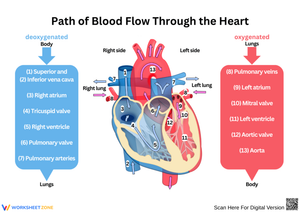
- Pathway sequencing: Students number or arrange the steps of blood's route — from the body to the right side of the heart, through the lungs, back to the left side, and out to the body again.
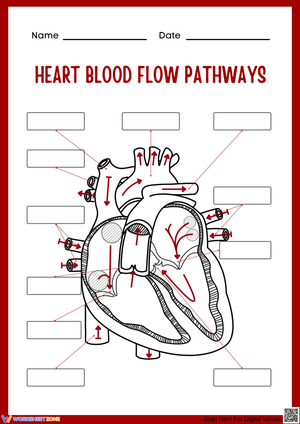
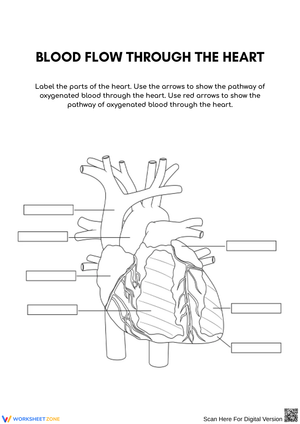
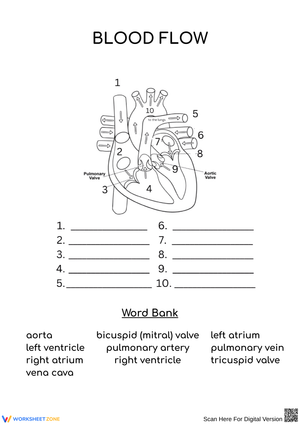
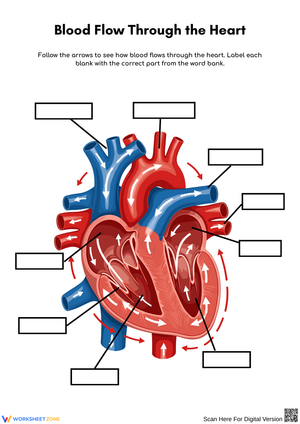
- Diagram labeling: Students mark chambers, major vessels, and key route points on a simplified cross-section of the heart, using anatomical terms in context rather than matching isolated words to a list.
- Vessel classification: Students compare arteries, veins, and capillaries by noting direction of flow, where exchange happens, and what moves across capillary walls — oxygen, carbon dioxide, nutrients, and waste.
- Pulmonary vs. systemic circuits: Students sort or match descriptions to distinguish the heart-to-lungs loop from the heart-to-body loop, using the terms pulmonary circulation and systemic circulation in context.
- Vocabulary in use: Terms like atrium, ventricle, and capillary appear in sentence completion and matching tasks — embedded in the content rather than reduced to a word bank students glance past.
- Short constructed response: Students write one to two sentences explaining why blood travels to the lungs and what capillaries accomplish, moving them from passive recognition into language production.
Student Errors Worth Catching Before the Assessment
The most consistent mistake in sixth-grade blood flow work is the left-right flip. Students hear the pathway — body to right heart to lungs to left heart to body — repeat it correctly during discussion, and then write on a worksheet that oxygen-poor blood enters the left side of the heart. The error surfaces because students know the left ventricle does more mechanical work and unconsciously assign it the first role in the sequence. Diagram tasks that ask students to draw or trace arrows rather than choose from options catch this quickly, often within the first few minutes of independent work.
A second persistent misconception involves vessel type and oxygen content. Most sixth graders have absorbed a rough classroom rule: arteries carry oxygenated blood, veins carry deoxygenated blood. That rule breaks down with the pulmonary artery and pulmonary vein — the one artery in the body that carries oxygen-poor blood, and the one vein that carries oxygen-rich blood. Students who haven't explicitly worked through that exception tend to answer confidently and incorrectly when they see those terms on an assessment. Worksheets that ask students to sort vessels by oxygen content rather than just by direction of flow expose this gap before it costs them.
Fitting These Worksheets Into Your Lesson Sequence
The most reliable classroom move is to run a whole-group trace before students touch a worksheet. Draw or project a simplified heart diagram, narrate the pathway aloud, and have students say the steps back. That takes about five minutes and dramatically reduces the number of students who sit stuck at the first task. After the trace, the pathway sequencing worksheet becomes a record of what students just said aloud — not a cold problem-solving task they have to figure out from scratch.
One technique that works particularly well in sixth grade: give students two colored pencils and ask them to trace the pathway in two colors on the diagram worksheet — one color for oxygen-poor blood, one for oxygen-rich. Students who complete this correctly almost always understand where the exchange actually happens. Students who use the wrong color in the pulmonary circuit are flagging the exact misconception described above. A two-minute walk around the room during this task gives teachers a visual read on understanding before anyone has written a sentence.
Blood flow printable worksheets for 6th grade also work well as a Monday re-entry task at the start of the circulatory system week. A short five-question sequence check — run without any prior instruction — shows which students retained the pathway from a previous lesson and which need more time before moving on to vessel function. That kind of quick formative check costs almost no class time and shapes the rest of the period.
Standard Alignment
These worksheets connect most directly to NGSS MS-LS1-3, which asks students to "use argument supported by evidence for how the body is a system of interacting subsystems composed of groups of cells." Circulatory function is one of the clearest entry points for that standard at the sixth-grade level — the heart, lungs, and blood vessels form an interdependent subsystem students can trace, label, and describe with evidence. The constructed-response tasks on several worksheets ask students to explain cause-and-effect relationships within the system, which directly supports the argumentative reasoning MS-LS1-3 requires. Most state frameworks that adapt or supplement NGSS place cardiovascular content in the Grade 6–8 band for this reason, making these worksheets a natural fit in life science units organized around body systems or organism function.
Adjusting the Set for a Range of Learners
For students who need more support moving through the content, the diagram worksheets with pre-drawn arrows and a partial word bank provide enough guided structure to keep them engaged without removing the thinking. Remove the word bank for students who are further along, and the same diagram becomes a meaningfully harder task. The vessel classification worksheet is particularly flexible this way — it can run as a guided sort with terms provided or as an open comparison where students generate their own descriptions before checking against a key.
Students who are ready for more depth can work with the constructed-response prompts as extended tasks. Asking a student to explain not just what capillaries do but why the circulatory system requires a separate pulmonary loop rather than one continuous circuit pushes reasoning past recall. That particular prompt tends to produce the most useful formative information about whether a student holds an actual working model of the system or has simply memorized a sequence. Blood flow printable worksheets for 6th grade used this way function as both practice material and diagnostic tools within the same class period.
Frequently Asked Questions
Do these worksheets cover both the pulmonary and systemic circuits, or just one?
The set covers both circuits. Some worksheets walk students through the complete pathway — both loops in sequence — while others isolate pulmonary circulation for close examination before asking students to hold both circuits simultaneously. Teachers building across multiple days often start with the full-pathway overview worksheet before assigning the vessel comparison or systemic circuit tasks. That order tends to reduce confusion when students encounter the pulmonary artery/vein terminology for the first time.
What vocabulary terms appear across the set?
The core terms reinforced across multiple worksheets are atrium, ventricle, artery, vein, capillary, pulmonary circulation, and systemic circulation. Secondary terms like oxygen-rich, oxygen-poor, and exchange also appear in context. The vocabulary tasks are embedded — students use terms inside labeling, sorting, and sentence-frame activities rather than copying definitions — which gives teachers a clearer read on whether students can actually apply the words or have just seen them before.
Which worksheets work as homework, and which are better kept in class?
The pathway sequencing and vocabulary matching worksheets work well as homework after the route has been introduced during class. The diagram labeling and constructed-response worksheets are better used during class time, where errors can be caught and addressed immediately. Sending the diagram worksheet home before students have a solid mental model of the pathway tends to entrench mistakes rather than produce correct practice.
How do these fit into a station rotation?
Blood flow printable worksheets for 6th grade slot into station rotations cleanly because each worksheet is self-contained with a clear task and a defined endpoint. A station with a diagram worksheet, two colored pencils, and a self-check answer key gives students meaningful independent practice without requiring teacher presence at that station. The sequencing version that includes a cut-and-paste ordering task works particularly well as a partner station, since students tend to talk through the pathway while arranging the steps.
Clear All