































Ready Blood Flow Variables Worksheet | Grade 6-10 Science

Paste this activity's link or code into your existing LMS (Google Classroom, Canvas, Teams, Schoology, Moodle, etc.).
Students can open and work on the activity right away, with no student login required.
You'll still be able to track student progress and results from your teacher account.
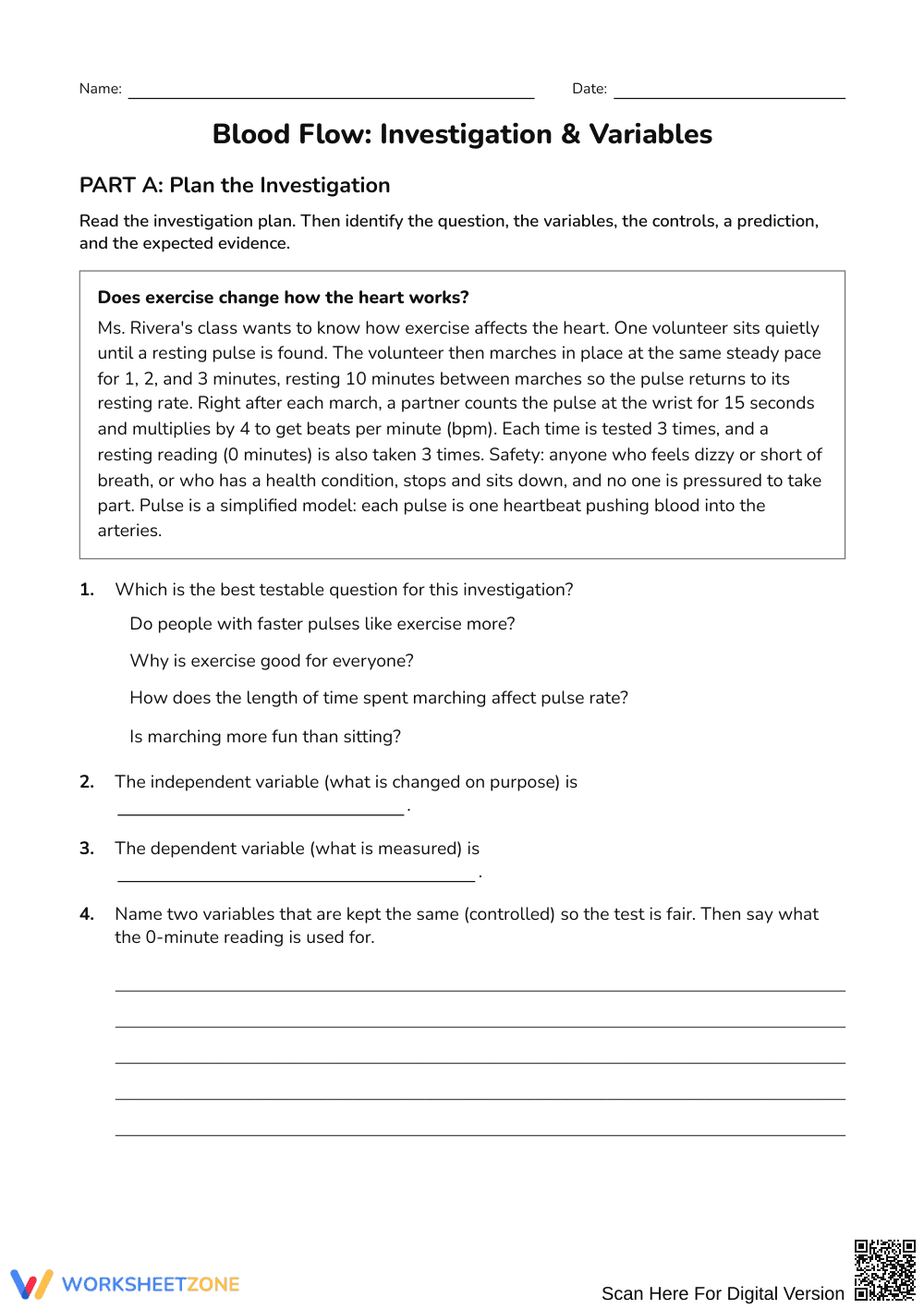
This comprehensive science worksheet guides middle and early high school students through scientific inquiry using cardiovascular physiology. Learners identify testable questions, independent and dependent variables, constants, and controls while tracing blood flow through the heart and analyzing authentic pulse data to connect exercise with physiological response.
At a Glance
- Grade: Grades 6–10 · Subject: Science
- Standard: Scientific Inquiry — Plan investigations, identify experimental variables, and construct evidence-based scientific explanations
- Skill Focus: Experimental design, heart anatomy, and pulse rate data analysis
- Format: 4 pages · 27 problems · Answer key included · PDF
- Best For: Guided inquiry and lab prep
- Time: 45–60 minutes
The 4-page resource includes 27 structured items organized into three targeted parts. Part A presents an exercise investigation where students define testable questions, identify variables, and write hypotheses. Part B provides an anatomical heart diagram for labeling chambers and mapping oxygenation. Part C provides multi-trial pulse data for calculating means and justifying conclusions.
Skill Progression
- Guided practice (Part A, 5 tasks): Students evaluate an investigation scenario, identifying testable questions, independent and dependent variables, control constants, and baseline measures.
- Supported practice (Part B, 10 tasks): Learners label eight cardiac structures, trace blood oxygenation stages, and explain ventricle muscle thickness.
- Independent practice (Part C, 12 tasks): Students compute mean pulse rates, describe quantitative trends, and synthesize anatomical evidence.
This sequence implements the gradual-release framework (I Do, We Do, You Do) to move students from guided experimental evaluation to independent synthesis.
Standards Alignment
This worksheet aligns with middle and high school life science standards requiring students to plan scientific investigations, use models, and construct explanations. Learners identify experimental variables and explain how circulatory structures maintain cellular homeostasis. Standard descriptions can be copied directly into lesson plans, IEP goals, or district curriculum mapping tools.
How to Use It
Use this worksheet as a dry-lab inquiry assignment or pre-lab preparation before physical pulse rate activities. During class, circulate during Part A to confirm that students correctly distinguish the independent variable from the dependent variable before they calculate averages in Part C. Expected completion time is 45 to 60 minutes.
Who It's For
Designed for Grades 6 through 10, this activity supports life science, biology, and health courses. Clear diagrams and structured tables support English language learners and students needing targeted academic intervention. Pair this resource with a hands-on pulse rate lab or an interactive circulatory system diagram.
According to Fisher & Frey (2014), implementing an intentional gradual release of responsibility within secondary science instruction significantly improves student retention of complex scientific inquiry skills and biological models. By systematically guiding students through explicit variable identification, scaffolded anatomical tracing, and independent numerical data interpretation, this 27-task blood flow worksheet establishes a robust instructional pathway that directly fosters higher-order analytical thinking. Learners actively progress from conceptual experimental design into authentic data calculation and physiological explanation, mastering how human cardiovascular structures adapt dynamically to meet raised cellular metabolic demands during physical exercise. Combining rigorous scientific inquiry practices with structured anatomical modeling ensures diverse learners develop durable procedural competence alongside deep conceptual understanding, effectively bridging the critical gap between abstract biological principles and empirical evidence collection across middle and secondary science learning environments.


