




























Printable Blood Flow Worksheet | Grades 6‑10 Science
Paste this activity's link or code into your existing LMS (Google Classroom, Canvas, Teams, Schoology, Moodle, etc.).
Students can open and work on the activity right away, with no student login required.
You'll still be able to track student progress and results from your teacher account.
Students will master the ability to sort, classify, and explain the relationships among heart structures, blood vessels, and circulation pathways. By completing this worksheet they solidify their understanding of how oxygen‑rich and oxygen‑poor blood travel through the pulmonary and systemic circuits.
At a Glance
- Grade: Grades 6–10 · Subject: Science
- Standard:
— Classify and explain blood‑flow structures and processes- Skill Focus: Sort, classify, or match examples and explain relationships among key structures, stages, materials, or processes in blood flow
- Format: 4 pages · 35 problems · Answer key included · PDF
- Best For: Review of circulatory system concepts
- Time: 30–45 minutes
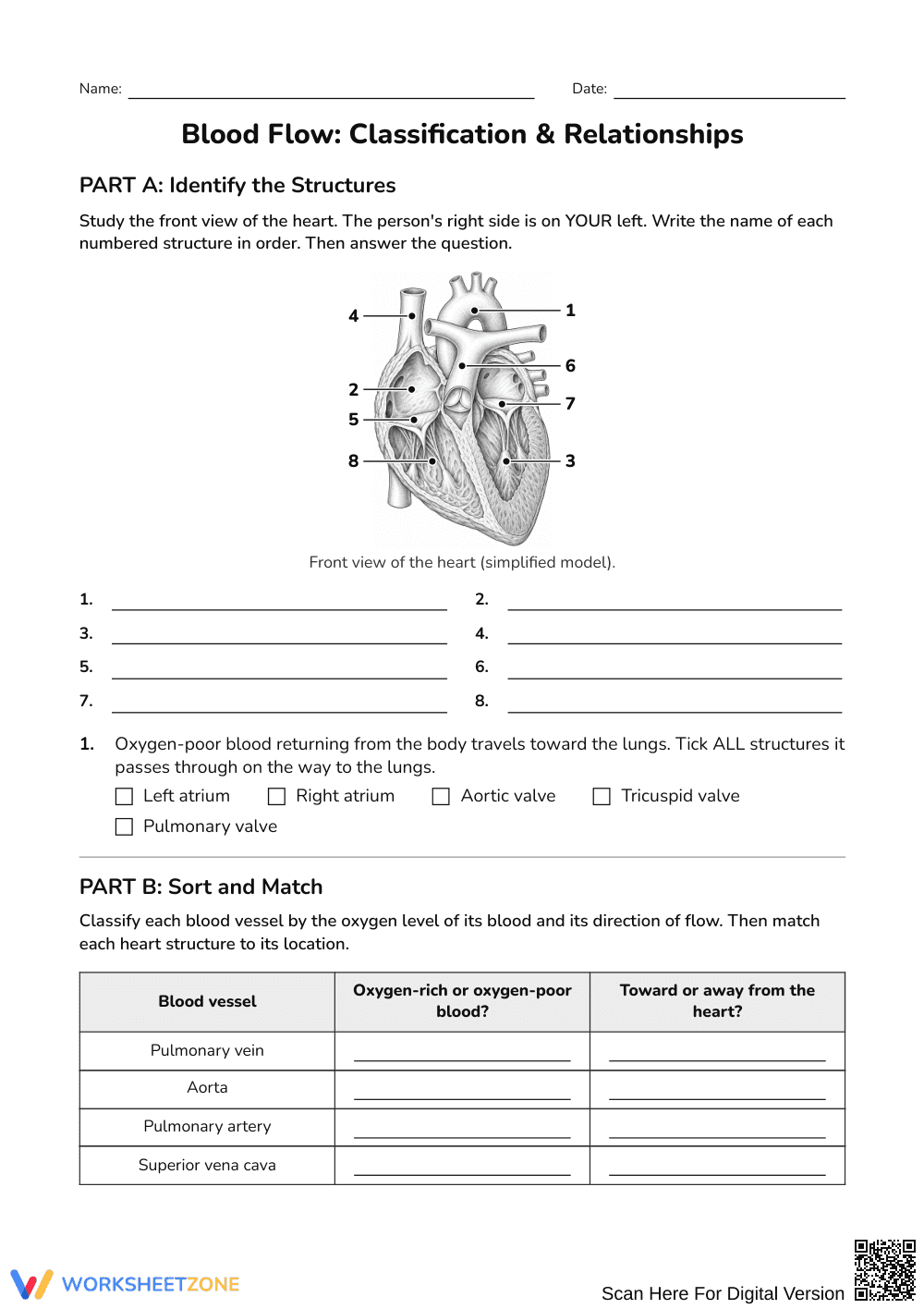
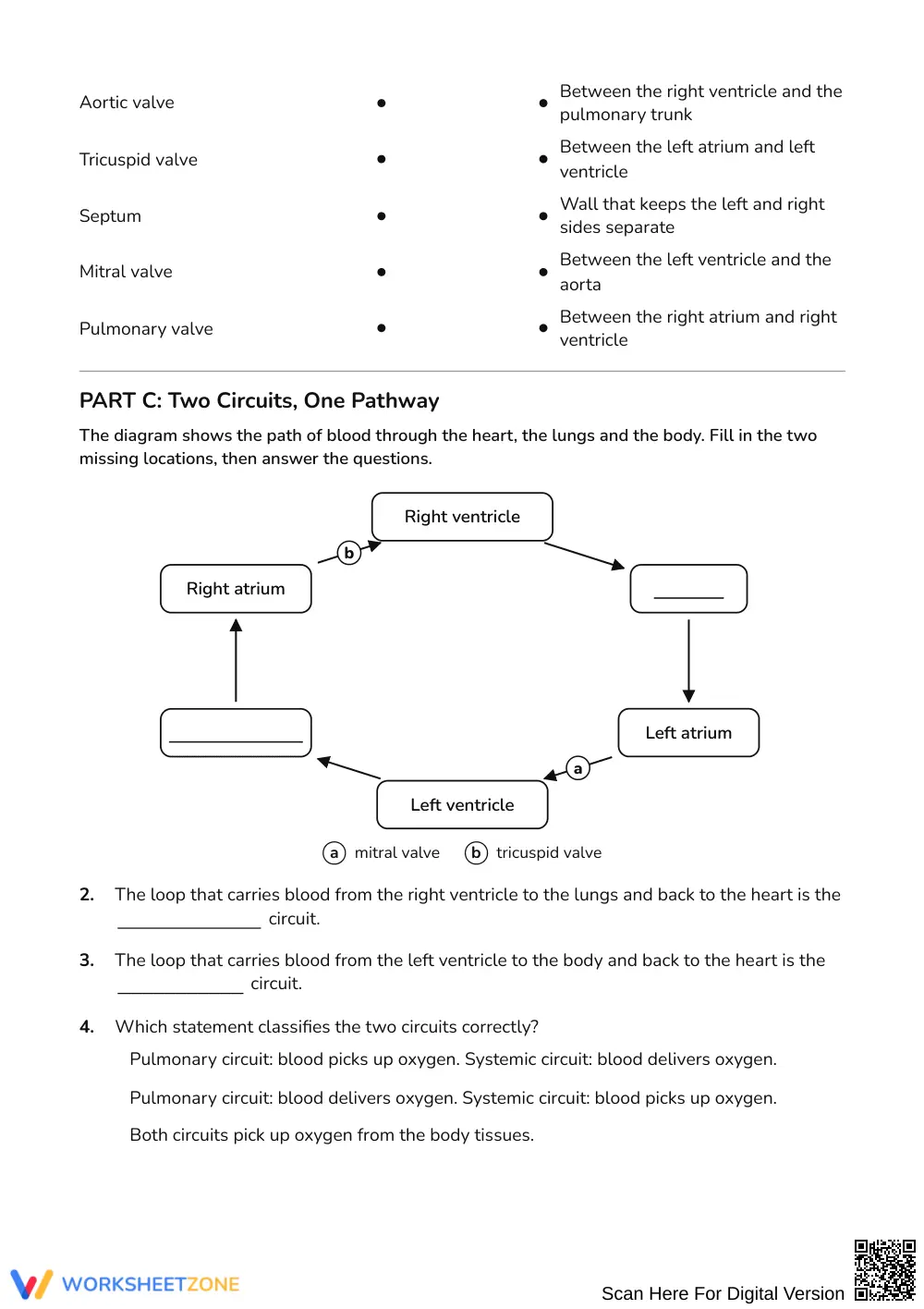
Inside the four‑page packet you’ll find a front‑view heart labeling task, oxygen‑level vessel classification, circuit‑matching activities, data‑interpretation questions, and higher‑order application prompts. An answer key follows the last page, and a word bank and sentence frames support novice readers.
- Guided practice: 10 problems with labeled heart diagrams and a word bank to help students sort and classify structures.
- Supported practice: 15 problems that include partial sentence frames and mixed‑choice items, encouraging students to apply relationships independently.
- Independent practice: 10 open‑ended problems requiring full‑sentence responses and no scaffolds, testing mastery of blood‑flow concepts.
These steps follow the classic I Do, We Do, You Do release model, moving students from teacher‑led guidance to autonomous reasoning.
Students sort, classify, and explain relationships among key structures, stages, materials, or processes in blood flow. This aligns with the overarching goal of understanding circulatory system function. Both standard references can be copied directly into lesson plans, IEP goals, or district curriculum mapping tools.
Use Case 1: Before a unit on the circulatory system, have students complete Part A and Part B as a diagnostic activity. Observe which structures they mislabel to inform targeted mini‑lessons.
Use Case 2: After direct instruction on pulmonary and systemic circuits, assign Parts C–E for practice. Quickly scan the open‑ended responses to gauge each learner’s ability to articulate circuit relationships (formative check).
Both activities typically take 30–45 minutes.
This worksheet is designed for Grades 6‑10 science students studying human anatomy. While the tasks are appropriate for the whole class, teachers can provide additional sentence frames for struggling readers or extend the independent section for advanced learners. Pair it with a large heart diagram anchor chart or an interactive 3‑D heart model for visual reinforcement.
Research shows that explicit sorting and classification activities boost conceptual retention in middle‑school science (Fisher & Frey 2014). This worksheet operationalizes the skill “sort, classify, or match examples and explain relationships among key structures, stages, materials, or processes in blood flow” by guiding students through labeled diagrams, vessel‑type tables, and circuit‑mapping questions. The progressive release model—guided, supported, then independent practice—mirrors evidence‑based recommendations for scaffolding complex biological concepts. By providing an answer key and clear rubrics, teachers can quickly assess mastery and adjust instruction, aligning classroom practice with rigorous standards. The tasks also encourage students to articulate physiological reasoning, a core component of scientific literacy highlighted in national assessments. Incorporating this resource supports differentiated instruction while maintaining fidelity to research‑backed instructional strategies. Teachers can also use the data‑interpretation section for quick formative checks during class discussions.


