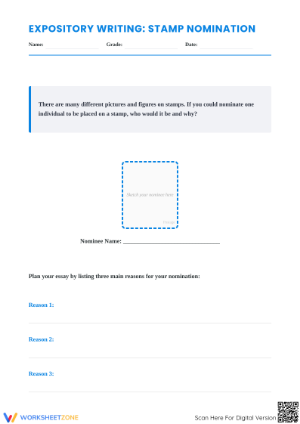
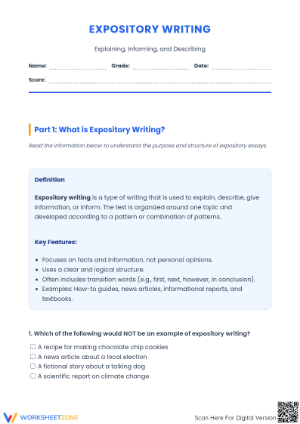
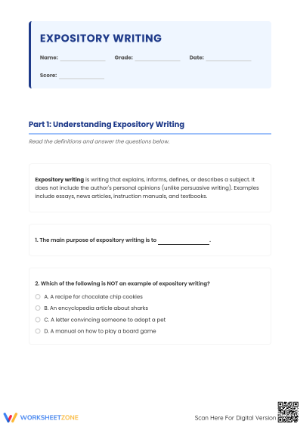
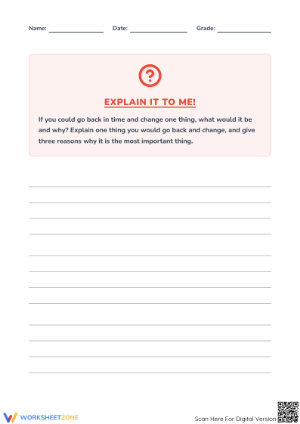
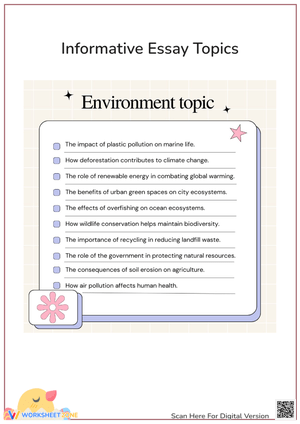
These expository writing printable worksheets for 5th grade give teachers a structured path through the full writing process — from topic brainstorming and planning through organized drafting to focused revision. The set targets the specific moves fifth graders need to shift from listing facts to genuinely teaching a reader something: introducing a topic with enough context to orient the reader, grouping related information under subtopics, supporting those subtopics with evidence, connecting ideas with precise linking language, and closing in a way that completes the explanation rather than simply stopping it. That combination of moves is harder for students to execute than it sounds, and these worksheets break the process into steps that match how good informational writing actually gets built.
The Specific Skills Each Worksheet Targets
Fifth grade is the year when informational writing expectations shift noticeably. Students are no longer asked just to report on a topic — they're expected to organize information so a reader can follow it, learn from it, and understand why the details matter. Each worksheet in this set addresses a distinct part of that process, so teachers can match the resource to the skill they're currently teaching rather than handing students a sprawling multi-step assignment and hoping the pieces come together.
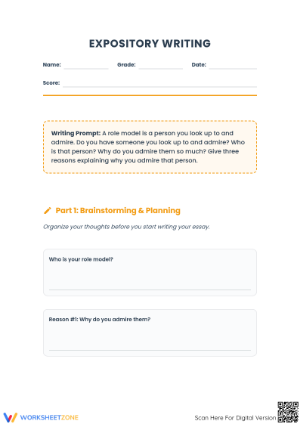
- Brainstorming and topic focus worksheets that help students narrow from a broad subject to an angle specific enough to explain in a few paragraphs without becoming superficial.
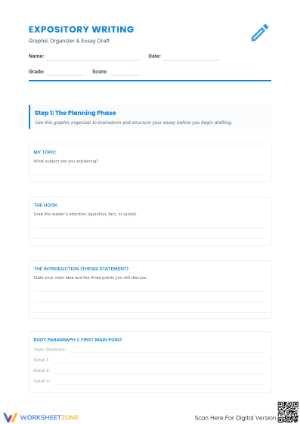
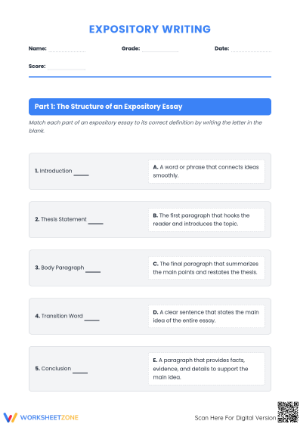
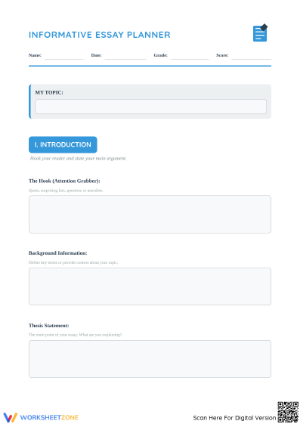
- Graphic organizers with labeled sections for introduction, body subtopics, supporting details, and conclusion — keeping the structure of the piece visible before students commit to drafting full sentences.
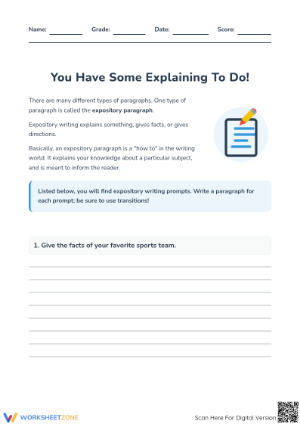
- Paragraph frame worksheets that model topic sentences and transition language (for example, as a result, in contrast) without completing the explanation for the student. The student still generates the content and chooses the evidence; the frame provides the sentence architecture.
- Drafting worksheets with section labels and adequate room for complete multi-sentence paragraphs — not abbreviated lines that force students to compress what should be developed.
- Revision and editing checklists that direct students to evaluate their own use of facts, transitions, domain vocabulary, and conclusions rather than limiting revision to surface-level corrections.
The sequencing matters for cognitive load reasons as much as instructional ones. When teachers use a consistent structure across brainstorming, organizing, drafting, and revision, students spend mental energy on the explanatory thinking — not on decoding what each new format is asking them to do.
Fitting These Worksheets Into Your Instructional Week
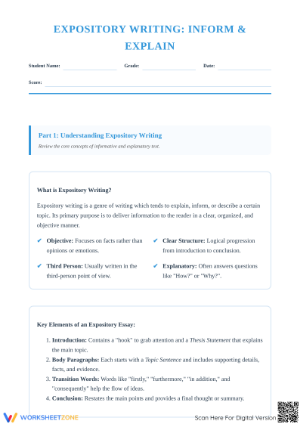
The most reliable approach is pairing each worksheet with a short focused mini-lesson. Teach one move — say, how to write a topic introduction that doesn't open with "Did you know?" — then hand students a worksheet that narrows their practice to exactly that move. The lesson stays short and the practice is immediately concrete.
The worksheets also slot into other instructional formats without extra preparation. A graphic organizer becomes a literacy station when set alongside an informational text students have already read. A paragraph frame works as a Monday warm-up after morning meeting or as a homework task tied to a content-area unit already in progress. A revision checklist converts into a peer-review guide during a writing conference day — students swap drafts, use the checklist, and give feedback that's specific rather than vague. For sub plans, these worksheets carry the lesson without a detailed verbal handoff because the directions and structure are embedded in the format itself.
Cross-curricular scheduling adds more flexibility. The same graphic organizer works for a science explanation about the water cycle, a social studies response on westward expansion, or a reading workshop summary of a biography. Students practice the same organizational moves regardless of content, which means the writing routine becomes automatic faster — and teachers don't have to choose between writing instruction and content coverage.
Student Mistakes That Show Up Consistently in Expository Drafts
The most predictable error at this grade level isn't weak facts — it's unorganized facts. A student will write three solid sentences about habitat loss, one sentence about animal migration, and then circle back to habitat loss without signaling the shift to the reader. The piece has information; it lacks grouping. Organizer worksheets that require students to sort and label facts before drafting make this pattern visible before it becomes embedded in a full draft that's far harder to untangle during revision.
Conclusions are the second consistent trouble spot. Fifth graders default to restatement — "So, that is why the rainforest is important" — when the standard calls for a closing that completes the explanation, not one that simply echoes the introduction. Slowing that step down by giving students a dedicated conclusion section on a revision checklist, separate from the drafting worksheet, tends to produce more deliberate closing sentences than asking students to just "finish" a draft.
Transition overuse is worth watching once students learn linking words. After a mini-lesson on transitions, it's common to see also opening three consecutive sentences — students adding the word without using it to actually connect ideas. A revision checklist that asks students to circle every transition and read those sentences aloud before finalizing catches this faster than teacher markup after the fact.
Standard Alignment
These resources align to W.5.2, which requires fifth graders to write informative and explanatory texts that introduce a topic clearly, group related information using paragraphs or sections, develop ideas with facts, definitions, concrete details, quotations, or examples, use linking words and phrases to connect ideas, and provide a concluding statement that fits the explanation. Choosing expository writing printable worksheets for 5th grade that explicitly target each of these moves makes the standard practical to teach and easier to assess, because a student's completed organizer or revision checklist shows precisely where the breakdown is — whether in grouping, in evidence selection, or in the close.
Adjusting the Set for Different Levels of Writers
For students working below grade level, the paragraph frame worksheets do the most to bridge the gap between having ideas and getting them onto paper in an organized way. They provide sentence-level structure — an opening phrase for a topic sentence, a labeled slot for evidence, a transition starter — without completing the writing task. What they remove is the blank-page problem, not the explanatory work. Students still choose the facts, generate the explanation, and decide what belongs in each section. That's meaningfully different from handing students a completed model to replicate.
Expository writing printable worksheets for 5th grade also adapt upward without modification. Students who organize ideas easily can bypass the planning worksheets entirely and work from a blank organizer they construct themselves. For advanced writers at the revision stage, the checklist can prompt higher-level evaluation: Are transitions doing specific connective work, or are they decorative? Do subtopics stay distinct, or do ideas bleed from one section into another? Pushing those writers to evaluate their own precision tends to produce more visible growth than simply adding length requirements.
The revision checklist in particular functions as a self-assessment tool, a peer-review guide, and a teacher conference prompt without any changes to the worksheet itself. That range matters in classrooms where small-group time is limited and differentiation has to happen efficiently rather than through separate lesson designs.
Frequently Asked Questions
What makes expository writing different from other writing types at fifth grade?
Expository writing requires students to teach a reader something — not to express an opinion or recount events in order. The reader should finish the piece understanding a topic better than when they started. That purpose changes everything: the organization, the level of detail, the word choices, and the way the piece closes. It's a distinct skill from narrative and opinion writing, and it needs instruction aimed specifically at explanatory structure rather than at writing in general.
Can these worksheets be used in science or social studies, or only in ELA?
They work well across subjects because expository structure doesn't change based on topic. The same graphic organizer that helps a student plan an explanation of animal adaptations works for a response about causes of the American Revolution or a summary of how a bill becomes law. Content-area use is often the most efficient application because students already have the facts from the unit they're studying — so the writing lesson focuses on organization and explanation rather than content recall.
How do these worksheets help students who have strong ideas but freeze when writing?
The paragraph frame worksheets address this most directly. They give students a concrete entry point — a topic sentence opener, a labeled slot for evidence, a transition starter — so the structure of the paragraph isn't an obstacle before the writing begins. Students still do the explanatory work: they select the facts, construct the sentences, and decide what to include. The frame reduces cognitive load at the structural level so the student's effort goes toward the actual explanation rather than toward figuring out how to start.
Do these resources support state assessment preparation?
Expository writing printable worksheets for 5th grade align directly with the extended writing tasks that appear on most state assessments at this level. Students who have practiced organizing subtopics, selecting and presenting evidence, using precise vocabulary, and writing conclusions that close an explanation rather than abandon it are better prepared for timed informational writing prompts. Using revision checklists that mirror the language of standard writing rubrics also gives students a concrete self-evaluation process before submitting — which most timed writing tasks allow.












 Interactive Worksheet Maker
 Quiz Maker
 Word Search Maker
 Crossword Puzzle Maker
 Word Scramble Generator
 Sentence Scramble Generator
 Handwriting Worksheet Generator
 Name Tracing Generator
 Fill In The Blank Generator