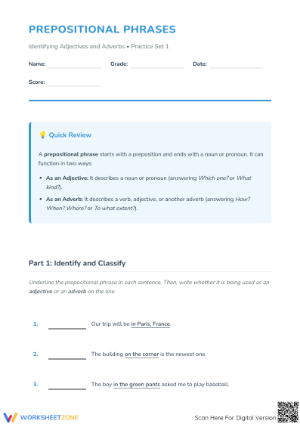
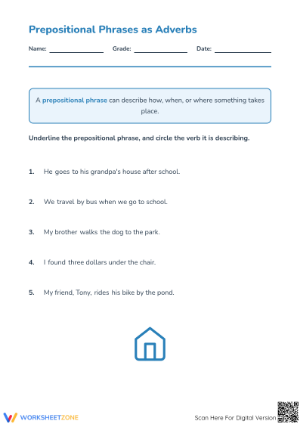
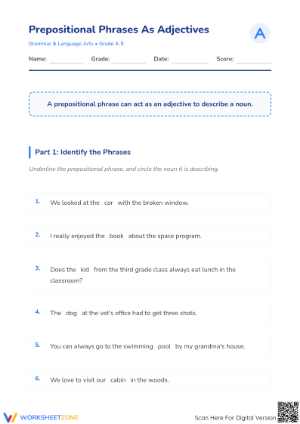
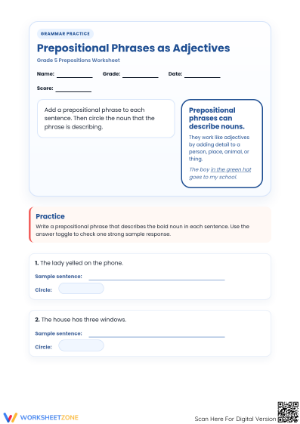
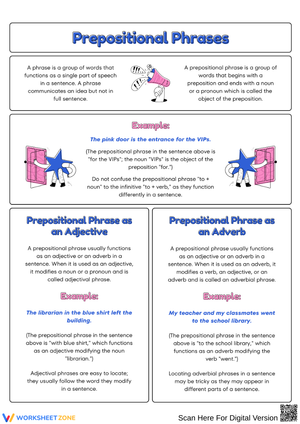
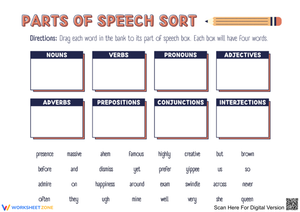
These prepositions printable worksheets for 5th grade cover the full arc of what Grade 5 grammar instruction actually demands — from spotting a preposition in an unfamiliar sentence to revising a weak draft with added phrase detail. Teachers get practice that moves in deliberate steps from recognition through phrase analysis to sentence-level writing, so the same set works for first instruction, spiral review, and quick formative checks without a separate resource hunt each time.
What's Inside the Set
The range of task types is what gives a strong collection of prepositions printable worksheets for 5th grade its classroom staying power — one worksheet handles first exposure, another handles review, and a third handles the writing-level application that the grade standard actually requires. Each worksheet targets a distinct skill rather than recycling the same exercise in slightly different clothing.
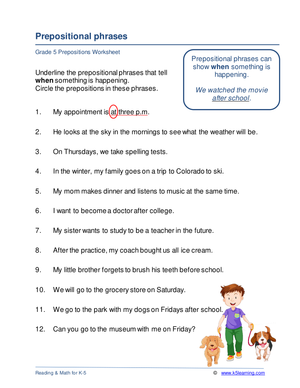
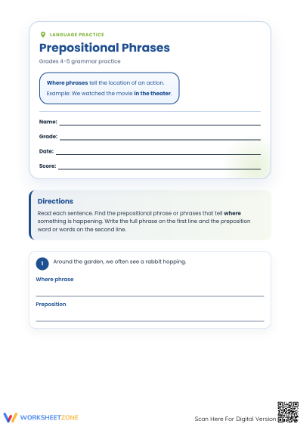
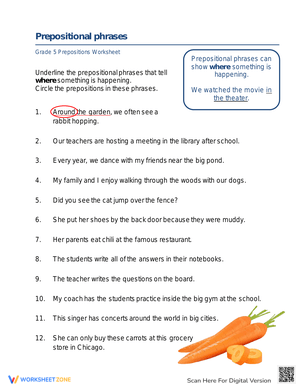
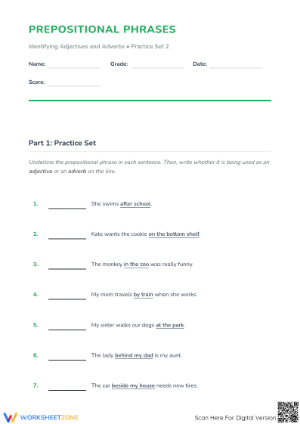
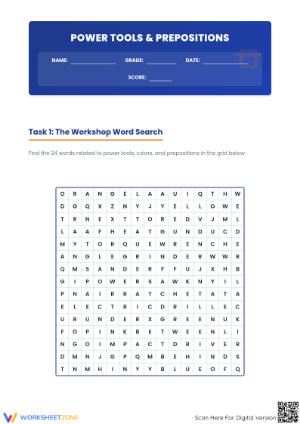
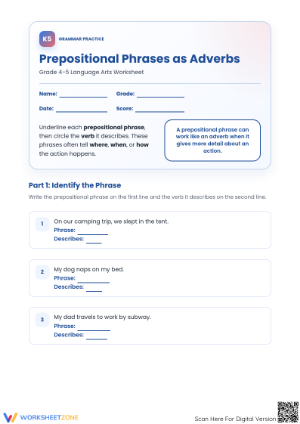
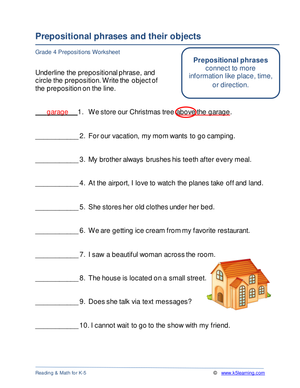
- Identification: Students underline or circle prepositions in sentences with real complexity — not only "the cat sat on the mat" but sentences where the prepositional phrase opens the clause or interrupts the subject and verb.
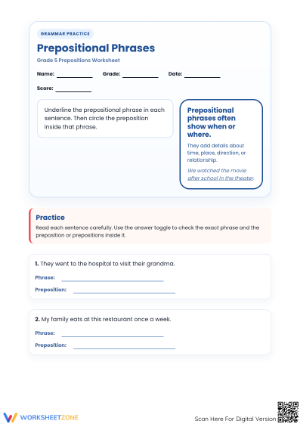
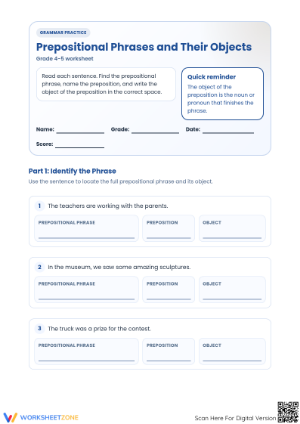
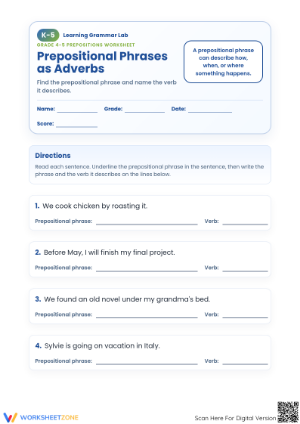
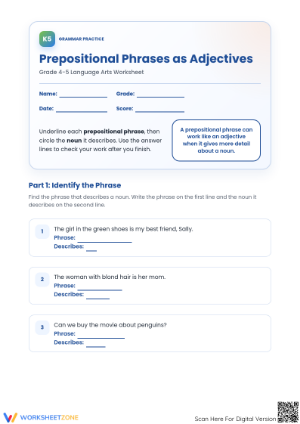
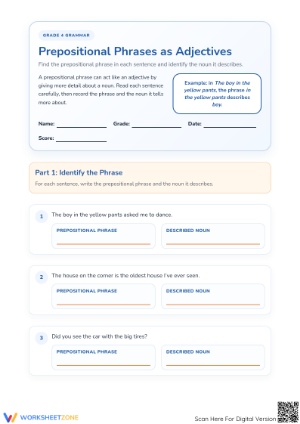
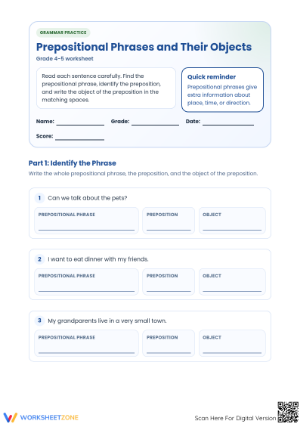
- Phrase recognition: Students locate the full prepositional phrase, name the object of the preposition, and label whether the phrase answers where, when, how, or which one.
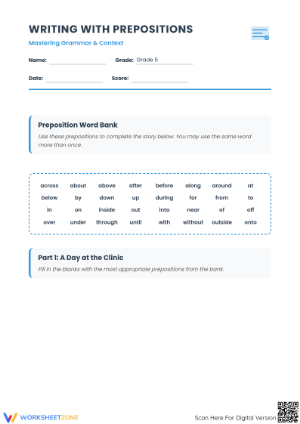
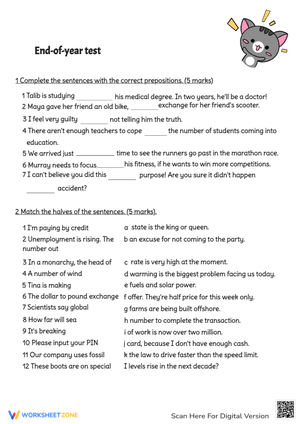
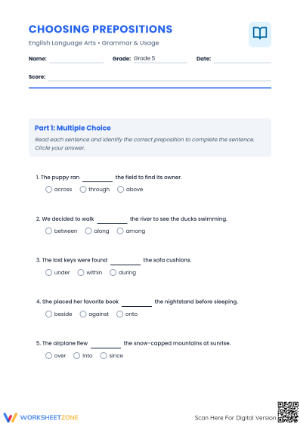
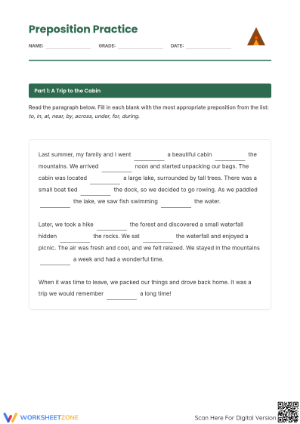
- Context choice: Students select among two or three prepositions and justify the choice — a task that catches students who can identify a preposition but are not yet reading for meaning.
- Editing: Students correct errors in short sentences or a brief passage — missing relationship words, wrong prepositions, or phrases left without an object.
- Sentence expansion: Students take a bare sentence and add prepositional phrases to sharpen it, connecting grammar practice directly to what revision looks like during writing workshop.
Where Fifth Graders Go Wrong With Prepositions
The most persistent error at this grade level is not mixing up between and among — though that does appear in student writing. The deeper problem is that many fifth graders treat prepositions as standalone words rather than the anchors of a phrase. A student can correctly circle behind on an identification worksheet and still write "She hid behind" in a paragraph, because the object has never become a natural part of how they use the word. Phrase-level practice closes that gap faster than any amount of list memorization.
Adverb confusion is the second pattern worth watching. When up, down, around, or through appear without a following noun phrase, they function as adverbs — but students who learned prepositions from a memorized list will circle them every time. A paired example like "she looked up" versus "she looked up the stairs" gives teachers a sharp teaching moment without requiring a long digression. Worksheets that include both sentence types push students to test their thinking rather than apply a rule by instinct.
Fitting These Worksheets Into a Real Week of Instruction
For bell ringers, four to six identification items take under five minutes to complete and check — clean enough to read the room before writing time begins. In literacy block stations, the sentence expansion worksheet gives students something concrete to do independently while the teacher pulls a small group. At a Friday review block, a mixed-task worksheet functions as a quick spiral check before the class moves into a new unit.
Intervention groups benefit most from the editing and context-choice worksheets. Once teachers confirm a student can spot prepositions, the more useful diagnostic is whether that student can fix an incorrect one in context or produce one under writing pressure. The expansion tasks work especially well during writing workshop when students are actively drafting — handing the expansion worksheet to a student who has written "We waited" without any further detail puts a grammar tool in front of them at the exact moment it matters. For sub plans, each worksheet carries a built-in example and a clear prompt, which means a substitute teacher can run the practice without a detailed lesson note left on the desk.
Standard Alignment
CCSS.ELA-LITERACY.L.4.1.E establishes the Grade 4 expectation that students form and use prepositional phrases, and Grade 5 instruction builds from there through L.5.1, which requires students to explain the function of parts of speech — including prepositions — in general and in particular sentences. The instructional shift between those two standards is meaningful: Grade 4 asks students to produce prepositional phrases; Grade 5 asks them to explain why a phrase functions the way it does. Any set of prepositions printable worksheets for 5th grade that stops at identification and fill-in tasks meets only part of that expectation. The analysis tasks — labeling what a phrase modifies, explaining whether it adds time, place, or manner, or justifying a preposition choice in writing — address the second-level standard directly.
Adapting the Practice for Students at Different Readiness Levels
For students still building basic identification skills, the identification worksheets are the right starting point — sentences are shorter, each prepositional phrase has a clear object, and there are no competing phrases in the same clause. Having these students read each full phrase aloud before writing helps them feel the phrase as a unit rather than isolating the preposition as a single word to circle.
Students who can identify prepositions reliably but struggle to use them in writing benefit most from the expansion tasks. Giving them a bare sentence — "The girl waited" — and asking them to add three phrases that answer where, when, and for how long pushes them to generate language under choice rather than recognize it in someone else's text. That generation task is much closer to what revision actually requires. For students who are already accurate across most task types, the paragraph-editing worksheets are a real stretch — teachers can add the challenge of deciding whether each prepositional phrase in the passage is essential or redundant, then rewriting any that are misplaced. That kind of analytical work connects directly to the revision decisions these students face in their own writing.
Frequently Asked Questions
What Grade 5 grammar skills do these worksheets cover?
Each worksheet addresses one distinct skill: identification, phrase recognition, contextual word choice, error correction, or sentence revision. When teachers use several worksheets across a unit rather than in a single sitting, they build a clear picture of where a student's understanding breaks down — whether at the word level, the phrase level, or the application level in writing. That granular view is harder to get from a mixed test that returns only a final score.
How do these worksheets connect to fifth-grade writing instruction?
Prepositional phrases add time, place, direction, and manner to sentences that would otherwise read as vague. When students practice expanding "The cat jumped" with phrases like "off the counter," "before dinner," and "toward the open door," they are doing the same cognitive work that revision demands in a writing conference. The sentence expansion worksheet gives that connection a direct point of entry during writing workshop, making it easier to show students that grammar instruction and composition are not separate subjects.
Can these worksheets support students who are still working on Grade 4 skills?
Yes. For students who didn't fully consolidate CCSS L.4.1.E, the identification and fill-in worksheets rebuild the skill using short, clear sentences with an obvious relationship between the preposition and its object. Teachers often run those worksheets with a small group while the rest of the class works on the editing or revision tasks — a practical split that keeps both groups working at the right level without requiring two separate lesson plans. That kind of targeted use is exactly where prepositions printable worksheets for 5th grade earn their place in a well-run grammar unit.
Which worksheets work best for homework assignments?
Identification, phrase recognition, and context-choice worksheets travel home well because the task is visible on the worksheet itself — students do not need the teacher present to understand what they are expected to do. Editing worksheets can also go home, though they tend to generate more parent questions when the error involves subtle preposition choice rather than a clearly missing word. Sentence expansion worksheets are best kept in class, where a brief model before independent work sets students up to succeed rather than guess.












 Interactive Worksheet Maker
 Quiz Maker
 Word Search Maker
 Crossword Puzzle Maker
 Word Scramble Generator
 Sentence Scramble Generator
 Handwriting Worksheet Generator
 Name Tracing Generator
 Fill In The Blank Generator