These life cycle worksheets for 4th grade give teachers a print-ready set that covers the specific stretch of life science where students shift from simple labeling to genuine comparison — identifying not just stages, but the structural logic that makes one organism's development different from another's. The set addresses insect metamorphosis (both complete and incomplete), flowering plant reproduction, amphibian development, and vertebrate comparisons, which are the four threads that fourth-grade life science units return to most often.
Skills Covered Across the Set
Each worksheet targets one of the following skills or concept clusters:
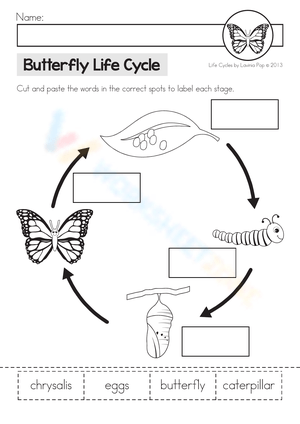
- Sequencing the four stages of complete metamorphosis — egg, larva, pupa, adult — using labeled diagrams of a butterfly and a mealworm beetle
- Distinguishing nymph-stage insects from larva-stage insects and explaining why that difference reflects a fundamentally different developmental path
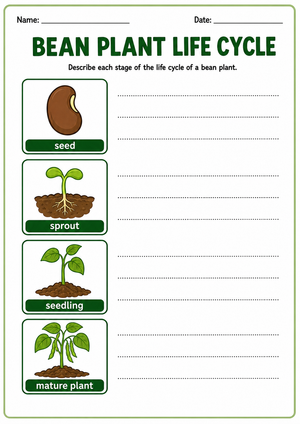
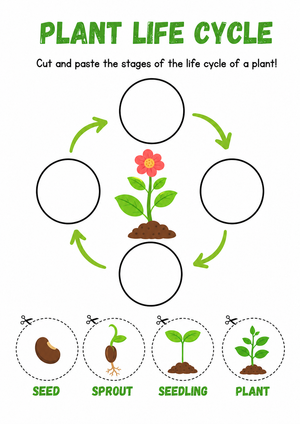
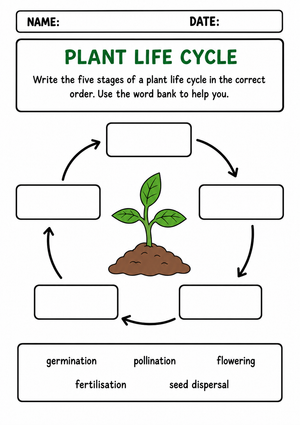
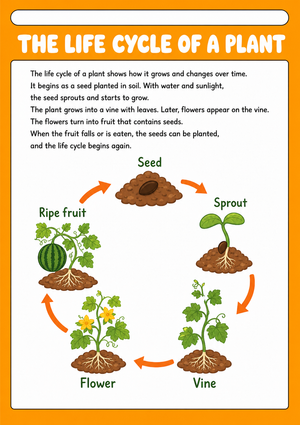
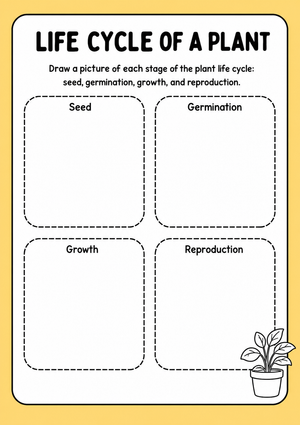
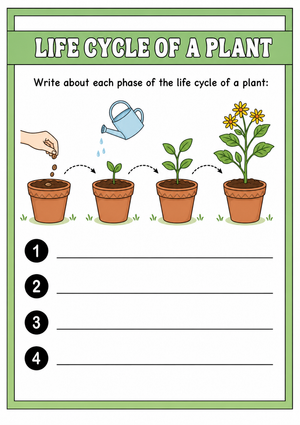
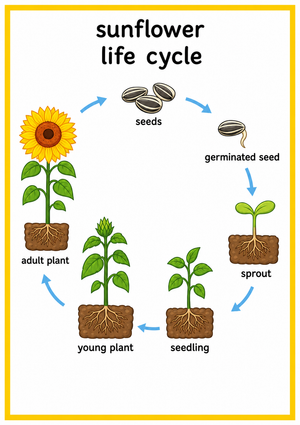
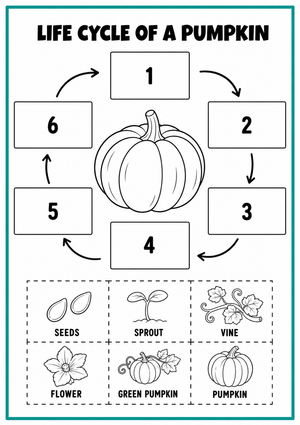
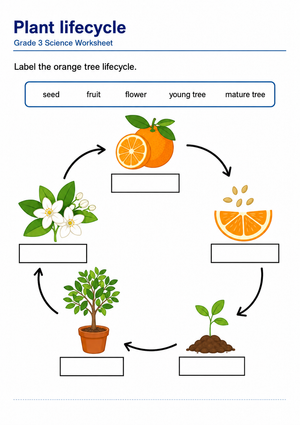
- Tracing the flowering plant cycle from germination through seed dispersal, with focused attention on the pollination step students most often skip or mislabel
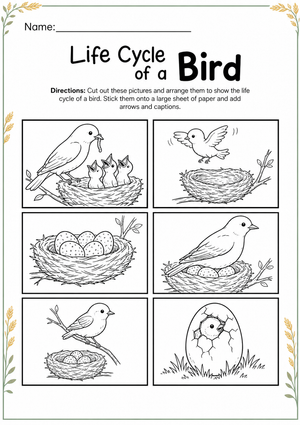
- Comparing the frog life cycle to that of a bird using a structured Venn diagram that asks students to identify the shared pattern (egg stage) alongside key differences (aquatic larval phase vs. development inside the egg)
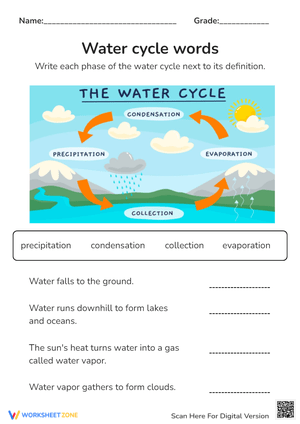
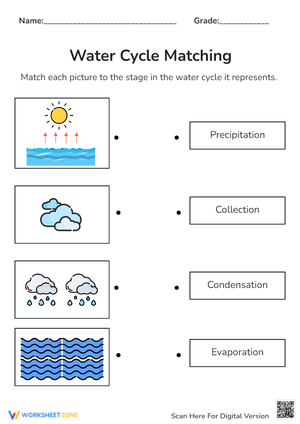
- Sorting vocabulary — larva, pupa, nymph, germination, pollination, metamorphosis — into correct categories through fill-in-the-blank and matching formats
- Writing brief explanations of why the pupa stage exists, pushing students past memorization toward understanding biological function
The vocabulary work is intentional. Fourth graders are asked to use these terms in explanatory writing, not just label diagrams, which means they need to own the definitions well enough to deploy them under slight pressure — a short constructed response, a lab write-up, a teacher question during discussion.
Student Errors Worth Catching Before the Unit Assessment
The most persistent confusion in this unit is between larva and nymph. Students hear "the young insect" enough times that both terms collapse into a single mental category. A student who correctly labels a caterpillar as a larva will often write "larva" for a young grasshopper too, because they've learned the word as a synonym for "baby insect" rather than as a stage specific to complete metamorphosis. The worksheets address this directly by placing both terms in contrast on the same activity — students have to make the distinction, not just recall one term in isolation.
Plant cycles produce a different error. When students label the flowering plant cycle, they consistently drop pollination from the sequence, jumping from "flower blooms" straight to "seeds form." They understand that seeds come from somewhere; they just haven't internalized that pollination is a required step in between, not a bonus event. After using the plant cycle worksheet, asking students one oral question during review — "What has to happen before the seed can form?" — catches more of these gaps than a second pass through the diagram alone.
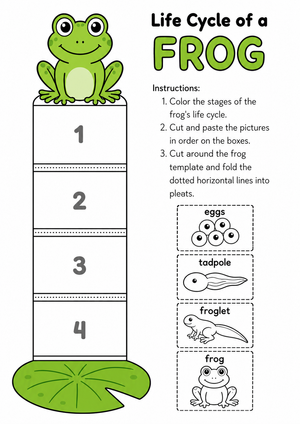
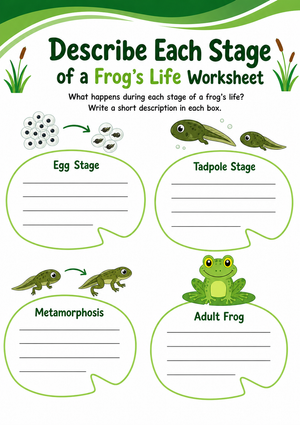
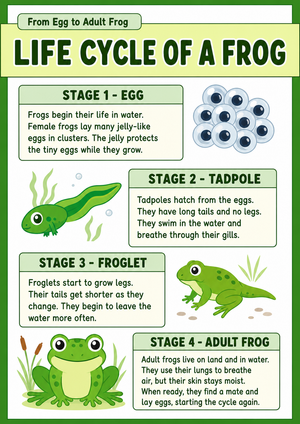
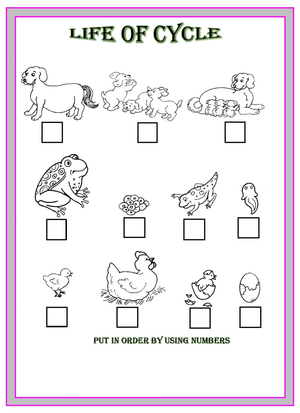
A third pattern shows up with frogs. Students who have the cycle memorized often list only three stages — egg, tadpole, frog — omitting the froglet phase. Whether a given worksheet asks for four stages or five depends on the resource, but teachers should be clear upfront about which version they're assessing, because discrepancies between the worksheet and the textbook on this point genuinely confuse students who are trying to do the right thing.
Working These Worksheets Into Your Science Block
The most practical use during a unit is as a daily warm-up at the start of the science period. Three to five minutes on a sequencing or vocabulary worksheet at the beginning of class sets a retrieval habit — students pull information back out before new content comes in, which strengthens retention more reliably than end-of-lesson review. These warm-ups also surface uncertainty before the lesson moves forward.
Station rotation works well when the class is ready to compare across organism types. Set up three stations — one on insects, one on plants, one on vertebrates — and assign a different worksheet at each. Students rotate every 12 to 15 minutes. The life cycle worksheets for 4th grade in this set work independently at each station, so students complete them without teacher direction at every table while you circulate to catch the larva/nymph confusion described above.
As a formative assessment, the sequencing worksheets tell you something quick and useful: can this student put the stages in order without a word bank? Running that version mid-unit, before the summative assessment, gives a clear signal about who needs another round of targeted review and who is ready to move into written explanations.
Standard Alignment
The core standard these worksheets address is NGSS 3-LS1-1, which asks students to develop models showing that organisms have unique and diverse life cycles but all share birth, growth, reproduction, and death. Although this standard is formally introduced in third grade, fourth-grade teachers regularly revisit it with greater analytical depth — asking students not just to model a single life cycle but to compare two, identify structural similarities, and account for differences. The comparison work in this set (frog vs. bird, butterfly vs. grasshopper) maps directly onto that analytical extension.
For states using the NGSS framework, the set also supports the crosscutting concept of Patterns. Students aren't memorizing each life cycle as a standalone fact — they're recognizing recurring features across different organisms' developmental paths, which is the reasoning skill the standard is actually building toward.
Adjusting the Set for a Range of Science Learners
Students who are still building reading fluency do better with diagram-heavy worksheets than text-heavy ones. For those learners, the sequencing activities work well because the task is visual: cut, order, glue. Vocabulary definitions can be provided as a word wall or printed reference strip so a language barrier doesn't block the science thinking.
For students who finish quickly and accurately, extend the task rather than assigning more of the same. Ask them to write a sentence explaining why complete metamorphosis might benefit a species — what advantage does a larva that looks nothing like its adult form actually have in the wild? That explanatory question targets the same standard while pushing into the reasoning tier. The worksheets in this set leave space for written responses that higher-readiness students can use for exactly this purpose.
Students who struggle specifically with the frog cycle often benefit from seeing a side-by-side comparison showing both a three-stage and a four-stage version, with a brief explanation of why scientists divide the sequence differently depending on how finely they're drawing the lines. That kind of honest explanation — "scientists don't all use the same count, and here's why" — tends to reduce the frustration that comes from seeing conflicting answers across different classroom materials.
Frequently Asked Questions
Do these worksheets cover both complete and incomplete metamorphosis?
Yes. The insect-focused worksheets address both types side by side. Students label the four stages of complete metamorphosis for a butterfly and the three stages of incomplete metamorphosis for a grasshopper, then respond to a prompt asking them to name what stage one type has that the other does not. That comparison prompt is what turns the labeling work into actual conceptual understanding.
How does this set handle the frog life cycle — three stages or four?
The frog worksheet uses four stages — egg, tadpole, froglet, adult — which aligns with the more detailed treatment found in most fourth-grade science textbooks. A brief note on the worksheet acknowledges that some resources use three stages and explains that "froglet" names the transitional phase where the tadpole has developed legs but still retains a tail. This prevents the confusion that comes up when students encounter the three-stage version on a standardized test or in a different resource.
Can these worksheets be assigned as homework, or do they work better in class?
Teachers use the life cycle worksheets for 4th grade both ways, but with different worksheets for each setting. The vocabulary matching activities travel well as homework because they're self-contained and low-ambiguity. The sequencing worksheets are more effective in class where you can watch students make decisions and ask them to explain their reasoning aloud. The comparison tasks — Venn diagrams, written explanations — are better kept in class where students have access to their notes and can ask terminology questions as they come up.
What's the best worksheet to start with when opening this unit?
Start with the butterfly life cycle worksheet before introducing any other organism. The butterfly is the most culturally familiar example, students arrive with strong prior knowledge to connect to, and complete metamorphosis — with its four visually distinct stages — is easier to grasp than incomplete metamorphosis. Once students have that mental model firm, the grasshopper and frog cycles become comparative rather than entirely new, which keeps the cognitive load manageable during the first days of the unit. The life cycle worksheets for 4th grade in this set are sequenced with that progression in mind.












 Interactive Worksheet Maker
 Quiz Maker
 Word Search Maker
 Crossword Puzzle Maker
 Word Scramble Generator
 Sentence Scramble Generator
 Handwriting Worksheet Generator
 Name Tracing Generator
 Fill In The Blank Generator